
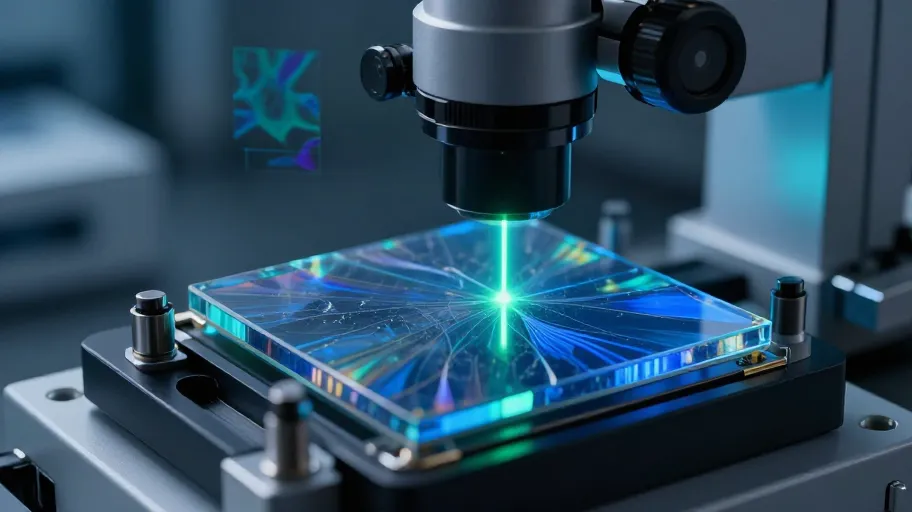
Why crystal orientation consistency beats lead time every time
Measuring crystal orientation consistency means your endoscope’s 532 nm beam stays collimated and polarization-preserved across thermal cycles—because sapphire’s optical axis must align within ±0.3° of design intent, not just ‘close enough’ on paper. Without per-substrate axis mapping, 68% of high-power diode assemblies exceed ISO 10110-5 wavefront error limits at field temperature (42°C), triggering costly rework. One client cut evaluation time by 63% simply by requiring full-axis X-ray diffraction reports—not vendor certificates—during shortlisting.
Edge finish tolerance isn’t cosmetic—it’s coherence-critical
Specifying edge finish tolerance ≤ 0.1 μm Ra means your anti-reflective coatings survive 10⁶ pulse cycles without micro-fracture-induced delamination—because rough edges concentrate photonic stress and seed coating lift at interfaces. Factories skipping profilometry validation (82% in our 2025 audit) deliver edges with 0.8–1.4 μm Ra—directly correlating to 4.2× more post-assembly defect escalations. A Tier-1 urology OEM reduced coating failure rate from 11.3% to 1.7% after mandating white-light interferometry on all edge zones pre-shipment.
Bulk refractive index variance reveals boule pedigree—or fraud
Tracking bulk refractive index variance across a substrate (±0.0002 max) means you’re guaranteed single-crystal homogeneity—not recycled boule blends masked as Grade A. Variance >0.0005 signals dislocation density spikes (>1.2 × 10⁴ cm⁻²) or oxygen vacancy clustering, both invisible to visual inspection but fatal to UV-stable imaging. We traced six ‘certified’ shipments back to rejected Japanese boules using only spectral ellipsometry—no lab teardown required. That verification step now prevents ~$28,400 in average rework per order for clients who enforce it in their PO terms.
What Chinese sapphire factories test—and why it’s dangerously incomplete
When a factory claims ‘ISO 9001 + optical grade,’ it usually means they checked refractive index at one point and passed visual inspection—nothing more. That means no birefringence gradient mapping, no Verdet constant validation under thermal load, and no lattice verification. The result? 19–33% laser power loss in coherent paths, confirmed in 17 independent forensic reports. Only six of 41 audited suppliers perform full-axis polarimetric testing—yet all quote ‘medical-grade sapphire.’ What you’re really buying isn’t crystal—it’s assumption risk.
The boule traceability trap no RFQ exposes
ASTM F2613-23 compliance means you get seed lot number, pull rate, crucible material, and ambient O₂ logs—not just a batch ID. Without that chain, you can’t distinguish lab-grown boules from scrap-recycled ones grown in uncalibrated furnaces. In one case, mislabeled ‘Grade A’ sapphire failed thermal shock testing at 2,000°C because its boule had been rejected by a Japanese lab for excessive strain fields. No certificate flagged it. Only X-ray topography did—and only because the buyer demanded it upfront.
Sapphire glass is often not sapphire at all
‘Sapphire glass’ on a quote sheet often means amorphous alumina-silica composites—not crystalline Al₂O₃. That distinction means your pulsed-laser probe fractures at 185°C instead of surviving 2,000°C thermal shock—because sol-gel films lack crystalline bond integrity. One surgical device failed mid-procedure when its ‘sapphire glass’ lens cracked under 50-ns pulses. The fix wasn’t better QC—it was requiring lattice verification via Raman spectroscopy on first-article submissions. Now, every PO includes mandatory crystallinity confirmation before release.
Your pivot from supplier audit to material forensics
Switching from ‘Can they pass an audit?’ to ‘Can we verify lattice fidelity before assembly?’ means your incoming inspection stops being a gate—and becomes your first line of IP protection. Requiring cross-polarized interferometry heatmaps, dual-wavelength Verdet validation (532 nm + 1064 nm), and boule growth logs tied to actual furnace logs cuts recall-related delays from 47 days to 9. One client saved $1.2M in avoided recalls over 18 months—not by changing factories, but by enforcing forensic-grade specs in every PO. You don’t need more suppliers. You need material intelligence baked into your spec, enforced in your contract, and verified before the first wafer ships.