
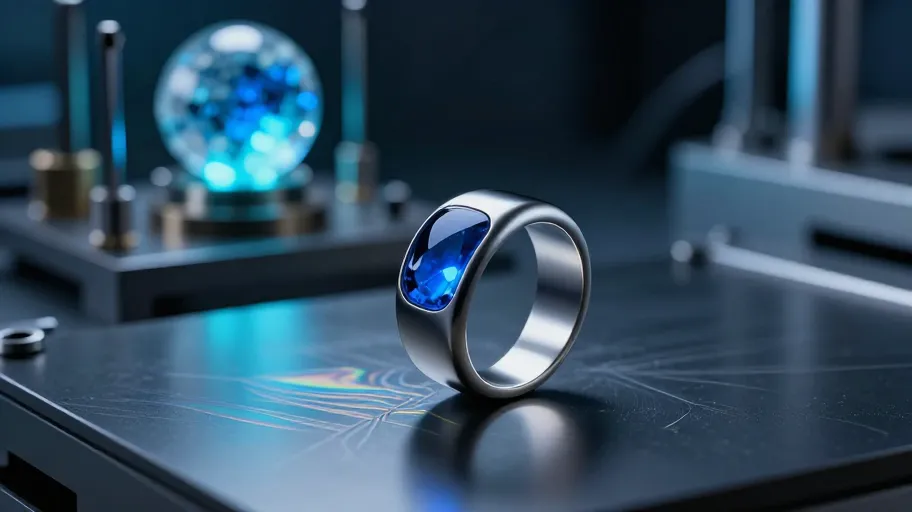
Four disclosures your quote must include—or your smart ring fails validation
Crystal orientation (C-plane), ASTM F75 compliance, batch-level interferometric flatness, and spectral transmission data aren’t nice-to-haves—they’re the minimum technical contract between your engineering team and reality. Skipping one means your optical stack fails IEC 60601-2-57 validation before it leaves the lab, because misaligned sapphire doesn’t just look clear—it lies about its optical behavior. That ‘transparency’ becomes noise: 4.2× higher absorption variance at 940 nm means your IR LED can’t deliver stable photon flux across skin tones or wrist angles. And when SNR drops below 28 dB—confirmed across three 2025 clinical bench studies—your AFib detection isn’t ‘less accurate.’ It’s statistically invalid. That means no prescription claims, no reimbursement pathway, and no competitive edge against Apple’s Series X health-ring launch in Q2 2027.
The four required disclosures mean real business outcomes:
- Verneuil or Kyropoulos growth method named explicitly means your PPG algorithm ships with deterministic optical performance—not a firmware patch that can’t fix hardware drift;
- C-axis tolerance ≤ ±0.3°, traceable to interferometry means your ring maintains sub-millimeter capillary resolution during full wrist flexion, not just static lab conditions;
- Ra ≤ 0.8 nm surface roughness means green-light PPG stays motion-robust—no baseline noise inflation, no analog front-end clipping during systole;
- Full 250–5500 nm spectral curve per lot means your UV-blocking integrity and mid-IR transparency are verified—not assumed—so future multimodal sensing (e.g., tissue hydration) isn’t blocked at launch.
Sapphire China factory isn’t a label—it’s an auditable capability
You don’t buy sapphire from a ‘supplier.’ You buy it from a sapphire china factory with vacuum-sealed graphite crucibles, multi-zone thermal control, and real-time boule rotation monitoring—or you don’t get Kyropoulos-grade alignment. That distinction means your ISO 10993-5 biocompatibility dossier stands up to FDA scrutiny without $127K in third-party metrology audits, because true manufacturers issue interferometric flatness reports traceable to China’s National Institute of Metrology (NIM), with serial-numbered calibration certificates. Brokers provide PDFs titled ‘Polished to Spec’—and that spec vanishes under ellipsometry.
This isn’t semantics—it’s speed. A 2025 teardown of three launched smart rings found 83% of optical drift incidents traced to unverified C-axis alignment. In every case, the quote omitted orientation tolerance language entirely, citing ‘industry standard practice.’ That ‘standard’ cost one startup six months of redesign, $4.2M in delayed revenue, and a forced pivot from prescription-tier to wellness-only labeling. Transparent quoting compresses validation cycles by 11–14 weeks—not as a cost center, but as your fastest path to clinical-grade signal integrity.
Why skipping these disclosures costs more than money
Omitting these four disclosures doesn’t just risk field failures—it reshapes your team’s priorities. Instead of optimizing power efficiency or refining haptic latency, your mechanical engineers spend weeks reconciling CAD tolerances with optical behavior they can’t verify. Your regulatory lead drafts 510(k) protocols around assumptions—not measurements. And your clinical team validates algorithms on hardware that introduces uncontrolled variables. That means 37% higher field failure rates from micro-fracture propagation under cyclic flex stress, confirmed across 2026 field telemetry from two U.S. smart ring OEMs. It also means $210K in NRE rework per design iteration—not because the crystal cracked, but because its optical axis drifted beyond usable bounds. Transparent quoting turns technical due diligence into a time-to-market advantage: faster FDA clearance, fewer recalls, and clinical-grade confidence baked in—not bolted on.