
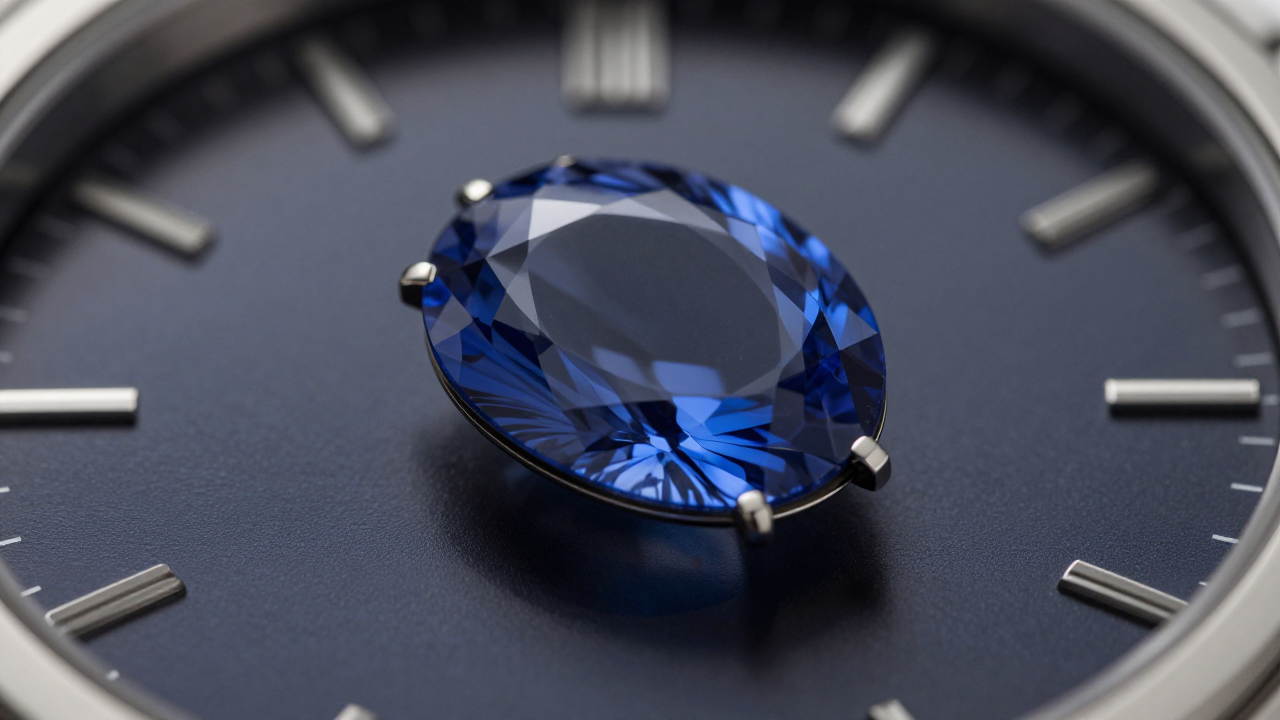
Buy on four things, in this order: a verified substrate (real synthetic sapphire, not coated glass), geometry tolerance that matches your case gasket, the coating stack and which side it sits on, and…
the supplier's inspection paperwork. Price comes fifth. A two-dollar saving per crystal is nothing against a 400-unit return.
What Should You Look for First When Buying a Sapphire Watch Crystal?
That ranking is the whole article in one line. Most buying committees invert it — they collect five quotes, pick the middle one, and spend the next two quarters handling warranty claims. The framework below is the one we hand to new account managers before their first factory visit.
Dimension 1 — Substrate verification. Synthetic sapphire, not "sapphire-coated" mineral glass. Non-negotiable, and testable in two seconds (see the section below). Dimension 2 — Geometry tolerance. Thickness, dome height, diameter, edge chamfer. This is where water-resistance failures actually come from, not from hardness. Dimension 3 — Coating stack. How many layers, which side, and whether the quoted price includes the inside coating or only the outside. Dimension 4 — Supply terms. Stated tolerance band, per-batch optical report, MOQ, replacement policy on cosmetic defects. A supplier who won't put a tolerance number in writing is telling you something.Is Sapphire Crystal Actually Worth the Premium Over Mineral Glass?
Yes, for anything retailing above roughly $150 — and the reason is narrower than most marketing copy suggests. Sapphire's advantage is scratch resistance, not impact resistance. A synthetic sapphire crystal measures about 1,800–2,200 HV on the Vickers scale; standard mineral glass lands around 550–650 HV, and acrylic sits under 30 HV.
What that buys you in the real world: a mineral crystal on a daily-worn watch shows visible haze within 18–24 months, mostly from sleeve and desk contact. Sapphire at the same wear pattern still reads clean at year five. That's the actual value proposition.
Where the advantage stops is at the edge. Sapphire is brittle. Drop a watch on tile and the crystal doesn't scratch — it chips at the rim, and a chipped rim breaks the gasket seal. In our claim data, roughly 70% of sapphire failures trace to edge chipping rather than face damage. Which is why the chamfer spec on the drawing matters more than the hardness figure on the brochure.
How Do You Tell Real Sapphire From "Sapphire-Coated" Glass?
Use a thermal conductivity tester. Synthetic sapphire moves heat at roughly 35 W/m·K; soda-lime glass sits near 1 W/m·K. A $30 diamond tester, the kind jewelers use, separates the two in under two seconds — sapphire spikes the meter, coated glass barely twitches.
In April 2024, a purchasing manager at a 12-person microbrand in Fort Worth, Texas sent us three samples from a competitor quote. The quote was $2.10 per piece against our $6.80. All three passed the scratch test (sapphire coating is genuinely hard). All three read about 1.4 W/m·K on the thermal probe. They were mineral glass with a vapor-deposited hard coat, sold under the words "sapphire crystal" on the line item. That's a $4.70-per-unit gap on a 3,000-piece order, and the buyer would have found out from customers, not from the invoice.
Two backup checks if you don't have a probe on the receiving dock:
Which Specs Quietly Decide Whether the Crystal Survives?
Thickness tolerance, edge chamfer, dome height, and coating side. These four never appear on a spec sheet unless you demand them, and they account for almost every field failure we've traced.
Thickness tolerance. Watch-grade is ±0.02 mm. Commodity blanks run ±0.05 mm. On a press-fit crystal, a 0.03 mm oversize compresses the gasket past its design range — ISO 22810 water-resistance testing assumes a defined compression band, and you've just left it. In November 2022, a Columbus, Ohio client came back with 400 returned dive watches leaking at 100 m. The crystal was 0.3 mm thicker than the drawing because the factory substituted a stock blank. Nothing on the packing slip said so. Edge chamfer. 0.15–0.25 mm, polished, not ground. A ground edge leaves micro-cracks that propagate. This is the single cheapest upgrade in the whole bill of materials and the one buyers cut first. Dome height. A double-dome adds clearance over the hands but pushes the crystal 0.8–1.2 mm above the bezel. On a slim case, that reads as a bubble on the wrist. Check the profile against the case drawing before you fall in love with a dome. Coating side. External AR coating is what customers can see and touch — and it's what wears off in 12–18 months of pocket contact. Ask explicitly for inside-only AR, or inside AR plus a hard external coat, and get it named on the PO.What Does Each Budget Tier Actually Buy in 2026?
The gap between tiers is smaller than the price spread suggests at the low end, and larger than it looks at the top. Note that these are per-piece prices at 500–1,000 units for standard round sizes.
A note on that last row. Almost no one grows their own boule. Blanks come from a short list of growers in China, Russia, and Korea, and the "Swiss-made crystal" premium often buys a European polish and inspection step, not a different substrate. That's a legitimate thing to pay for — just know what you're buying.
There's a market signal worth watching here. Casio's GWR-B3000 series and the leaked Gravitymaster refresh both spec sapphire crystal on watches that retail well under $1,000. When sapphire lands in resin tool watches, the mid-tier buying conversation shifts from "sapphire or not" to "which grade of sapphire" — and grade is exactly the variable most quotes leave blank.
Where Do Buyers Overpay or Get Burned?
The MOQ trap. Tooling for a non-standard diameter or a box-dome profile typically amortizes across 300–500 pieces minimum. Order 150 and the per-piece price triples, which pushes buyers back to a stock size that doesn't fit the case properly. Design around available tooling, or commit to the volume. Vague cosmetic standards. "No visible defects" is not a spec. Write it as: no inclusions above 0.05 mm, no edge chips above 0.1 mm, no coating haze under a 500-lux inspection lamp. We've seen entire shipments rejected over a standard nobody wrote down. Quoted lead times that assume air freight. Standard round sizes run 15–20 days from a Shenzhen line; custom geometry runs 30–35. Add transit. A buyer who plans a launch on a 20-day quote and a sea-freight schedule will miss the date, and the usual fix — air-freighting crystals — costs more than the upgrade to the better tier would have.One thing we learned the hard way on our own line: the inspection step is where budgets die quietly. Jadezone Optical has run sapphire finishing in Shenzhen since 2010, and for the first few years we inspected after packing. Moving inspection to immediately after edge polish cut our defect escapes by more than half, because edge chips happen at handling, not at polish. Ask any supplier where in their process the optical check happens. The answer tells you a lot.
Which One Should You Buy?
Choose the $3.00–$8.00 flat or single-dome tier if you're shipping a $200–$600 watch, your case has a standard press-fit gasket, and your volume is under 1,000 pieces. You get real sapphire, inside AR, and a chamfer that holds up — skip the double-dome and put the savings into the caseback. Choose the $8.00–$18.00 double-dome tier if you're building a $600+ tool watch, you're claiming meaningful water resistance, or your brand's reviews mention crystal clarity. The ±0.02 mm tolerance and the batch report are what you're paying for, not the dome. Choose the $18.00+ custom tier only if the geometry demands it — box-dome, non-round, or a dial that needs 7-layer AR to read in direct sun. Otherwise you're buying margin for your supplier.And regardless of tier: buy a thermal probe, put the tolerance number in the PO, and name the chamfer spec. Those three moves cost under $200 and prevent most of what goes wrong.
Frequently Asked Questions
How much does a sapphire watch crystal cost?
At 500–1,000 units, standard round sapphire runs $1.50–$3.00 for a flat uncoated blank, $3.00–$8.00 with inside AR and a polished chamfer, and $8.00–$18.00 for double-dome with tight tolerance and a batch optical report.
How can I tell if a watch crystal is real sapphire?
Use a thermal conductivity tester. Synthetic sapphire reads roughly 35 W/m·K; glass reads about 1 W/m·K. A $30 jeweler's diamond tester separates them in two seconds. Polarized light showing curved boule striations confirms it a second way.
Can a sapphire crystal scratch or break?
Sapphire resists scratches from nearly everything except diamond and silicon carbide, at 1,800–2,200 HV. It does chip and crack on hard impact, especially at the edge, which is why chamfer quality matters more than the hardness number on the spec sheet.
How thick should a sapphire crystal be for a dive watch?
1.5–2.0 mm with a tolerance of ±0.02 mm suits most 200 m dive cases. Below 1.2 mm, pressure deflection becomes a gasket concern. Above 2.5 mm you add weight and height without meaningful benefit, and the case profile starts to look wrong.
What is the difference between sapphire crystal and sapphire-coated glass?
Sapphire crystal is a solid synthetic corundum disc grown from a boule. Sapphire-coated glass is mineral glass with a thin hard film that resists scratches but chips and wears. Both pass a scratch test. Only the sapphire disc passes a thermal conductivity test.