
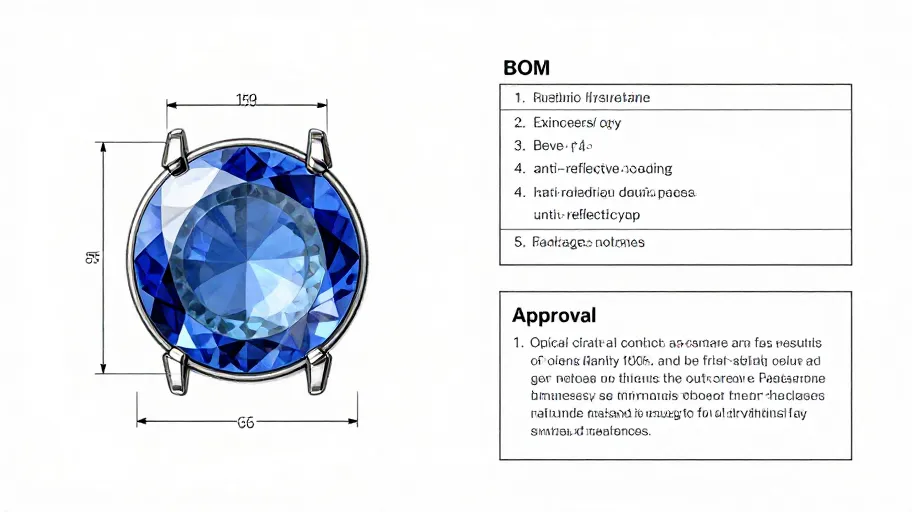
When you ask a sapphire watch glass supplier for a quotation, the quality of the quote depends less on the supplier and more on what your drawing, BOM and approval notes already fix. Use a simple three-document gate — the Drawing–BOM–Approval (DBA) Specification Gate: every technical, material and commercial detail must live in exactly one of the three documents, and any detail missing from all three is a quotation risk. Below is how to assemble that package before you send it.
Why three documents, and why separation matters
Most quotation friction between watch brands and crystal suppliers comes from details that are either duplicated inconsistently across documents or absent from all of them. A dimension stated one way on the drawing and another way in the BOM forces the supplier to guess which governs. An edge finish described only in an email thread never makes it into inspection. The DBA gate gives each document a single job:
- Drawing — geometry and physical form.
- BOM — material, quantity structure and line-item identity.
- Approval notes — process rules, acceptance criteria and change control.
When a detail could plausibly sit in two documents, the approval notes should state which document governs.
What belongs in the drawing
The drawing is the geometric contract. For a sapphire watch crystal, the elements to define — as project-specific values, agreed with your supplier — include:
- Outer profile and all governing dimensions, with the dimensional scheme (which surface is the datum) stated clearly.
- The tolerance framework you require, expressed as your specification for the supplier to confirm feasibility against — do not assume a supplier's default tolerance class; ask what they can hold for your geometry.
- Crown height, curvature profile and where the apex sits relative to the reference plane.
- Edge treatment: chamfer dimensions, bevel angles, polished versus as-ground surfaces, and which edges are visible in the finished watch.
- Gasket or seal seat geometry: profile, groove or step features, and surface finish on the sealing path.
- Date window or aperture position, shape and edge condition, if applicable.
- Print or logo placement zone: position, orientation, and keep-out areas relative to other features.
Anything geometric that affects fit, sealing or appearance belongs here, not in an email.
What belongs in the BOM
The BOM is the material and line-item contract. For each crystal part number, the BOM should identify:
- Material designation as you require it — for sapphire, the crystal orientation and grade you specify for the application — stated as your requirement for the supplier to confirm.
- Coating specification: whether anti-reflective coating is required, on which faces, and how it must be identified at inspection. Do not assume coating behaviour; document what you will accept.
- Print/ink specification: ink type, colour reference and adhesion requirement as line-item attributes, priced as separate BOM lines if your supplier prices them separately — confirm how they structure this.
- Quantity breakpoints you want quoted, expressed as your requested quotation quantities, since minimum order rules are supplier-specific — confirm the current policy directly.
- Part numbering that links the BOM line to the exact drawing revision, so a drawing change visibly invalidates the old quote.
What belongs in the approval notes
Approval notes are the process contract — the document most buyers skip and most disputes trace back to. They should cover:
- Which document governs when the drawing and BOM appear to conflict.
- The approval workflow: drawing sign-off, first-article or golden sample approval, and what constitutes production release.
- Golden sample rules: who holds the reference sample, how it is identified, and how inspection compares against it.
- Acceptance criteria for appearance features: print registration, coating presence, edge polish — described as inspectable conditions, not adjectives.
- Change control: what happens to pricing and open orders if the drawing revision changes.
- Commercial policy items — sampling arrangements, tooling ownership, terms — every one of which is supplier-specific. Confirm the current policy directly.
Decision table: where each specification detail belongs
| Specification choice | Question to resolve before quoting | Document home |
|---|---|---|
| Outer geometry and tolerance scheme | Which datum governs, and what can the supplier hold for this profile? | Drawing |
| Curvature and crown profile | How is the curve defined — radius, sagitta, or scanned profile file? | Drawing |
| Edge and bevel treatment | Which edges are cosmetic, which are functional? | Drawing |
| Gasket seat geometry | What sealing path does the case design require? | Drawing |
| Material grade and orientation | What crystal orientation does the application require, and can the supplier confirm it? | BOM |
| Anti-reflective coating | Which faces, and what inspection confirms it is present? | BOM + Approval notes |
| Print or logo | What ink, colour, and adhesion requirement, and how is registration inspected? | BOM + Drawing (position) |
| Golden sample process | Who approves and holds the reference sample? | Approval notes |
| Revision control | Which drawing revision does the quoted price apply to? | Approval notes |
| Sampling and tooling terms | What are the current arrangements? Confirm the current policy directly. | Approval notes |
Concrete approval questions to send your sapphire watch glass supplier
Before you release a purchase order, put these in writing and get written answers:
- Which drawing revision does this quotation apply to, and what is your process when we revise it?
- Can you confirm feasibility of our stated tolerance scheme for this geometry, and what would you flag as a risk?
- How will coating presence and print registration be verified at inspection, and against what approved reference?
- Who approves the golden sample, how is it identified, and how does production inspection compare to it?
- How do you price coating, print and packaging — as part of the crystal line or as separate BOM lines?
- What dimensional report or first-article documentation accompanies the first delivery?
- What is your change-control process if we modify the print position or edge treatment after approval?
These questions are deliberately answerable in writing. Verbal answers about any policy — sampling, tooling, terms — are not documentation. Confirm the current policy directly and attach the written reply to the approval notes.
Checklist: quote-ready brief
Use this checklist before sending any sapphire watch glass supplier a request for quotation:
- Drawing states every governing dimension, the datum scheme and the tolerance framework you require.
- Curvature profile, edge treatment and gasket seat geometry are all on the drawing, not in emails.
- Print or logo position, orientation and keep-out zones are dimensioned.
- BOM lines each reference one drawing revision by number.
- Material designation, orientation and grade are stated as your requirement.
- Coating faces and print/ink attributes appear as BOM line-item data.
- Approval notes define which document governs conflicts.
- Golden sample approval and identification process is written down.
- Change-control and revision rules for pricing are documented.
- All commercial policy questions answered in writing: confirm the current policy directly.
FAQ
Do I need a full production drawing just to get a first quote? You need at least a geometry definition and your material requirement. A rough sketch invites a rough price. The more of the DBA package is complete, the more comparable your quotes will be. Ask suppliers what minimum package they can quote against.
Should tolerances go on the drawing or in the BOM? Tolerances are geometric, so they belong on the drawing, tied to a stated datum scheme. The BOM should reference the drawing revision rather than restate numbers, which creates conflicting sources of truth.
How do I handle coating and print specifications if I haven't decided them yet? Quote them as options. Structure the BOM so the base crystal, coating and print are separate lines, and ask the supplier to quote each option. Document which options your approval covers, so production never includes an unapproved feature.
What is a golden sample and why does it matter?
How do I keep quotes from multiple suppliers comparable? Send every supplier the identical DBA package and request they quote to it, flagging any requirement they cannot meet. Differences in their exception lists tell you more than differences in price.
Next step
Prepare a quote-ready brief using the DBA structure above: one drawing, one BOM, one set of approval notes, no orphan details. If you want a lighter starting point, download or copy the checklist in this article and walk your internal team through it before the package leaves your desk — the low-friction version of the same discipline.