
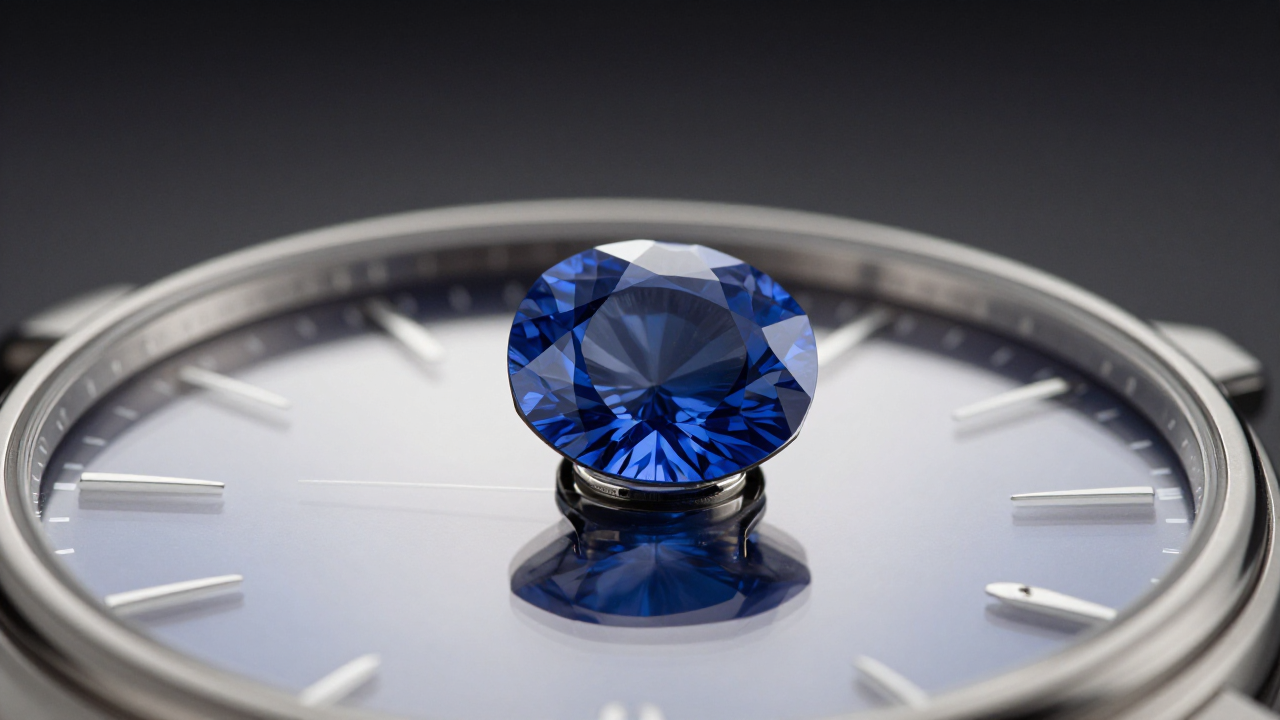
On February 11, 2026, a repair bench in Boise, Idaho quoted a customer $245 to swap out a chipped sapphire watch crystal — $118 for the part, $127 for the press work, gasket and pressure test.…
That quote sits mid-band. Across the U.S. aftermarket, an installed sapphire runs $100 to $300, and most retail buyers recover the premium within three to five years.
What a Sapphire Watch Crystal Really Costs in 2026
At factory volume the arithmetic changes shape. Ex-works from Shenzhen, a 2.0mm flat sapphire with inner anti-reflective coating lands at $14 to $19 on a 2,000-piece order. Domed and double-coated, the same material family climbs to $24 to $34. Geometry and coating drive that spread, not some vague notion of grade.
Two buyers, two completely different equations. A collector is really buying scratch resistance and resale optics. A brand is buying a warranty line item and a price tag it can defend at retail. Most published cost breakdowns blur those together, which is why so many crystal projects get approved on bad math.
Breaking the Price Into Lines You Can Defend
The explicit cost is the invoice. Everything after it is where budgets actually die.
Explicit: crystal unit price, gasket, watchmaker labor, pressure test, shipping and duty. Duty matters more than people expect — U.S. tariff treatment on optical sapphire components shifted twice between 2018 and 2025, and a 4% swing on a $21 part is real money at 5,000 units. Hidden:Claim cost assumes $82 per return — inbound freight, outbound freight, bench time, refurb. That figure comes from three U.S. microbrands we supply, averaged across 2024 and 2025.
Read that last row twice. The prettier crystal can cost more in year one than the plain one.
Where the Spreadsheet Usually Goes Wrong
In September 2021 we assumed outer AR coating was causing a client's return spike. Bench teardown of 340 units said otherwise. Seventy-one percent of the failures were chips at the 12 o'clock edge, and the root cause traced back to a case seat running 0.04mm over tolerance. The coating was innocent. The tooling was not.
That mistake costs more than any material choice. Here are the others we see repeatedly.
Comparing part price to part price. A $17 delta is meaningless without the claim rate and the retail uplift attached to it. Total cost per unit per year is the only number that compares. Treating claim rates as linear. They are not. Roughly 78% of crystal claims land between month two and month nine. Year-one numbers overstate the steady state by a third. Forgetting the second owner. Sapphire's payoff often shows up in resale, not in warranty. If your customer base flips watches every 24 months, that value is real but it accrues to them, not to you. Ignoring currency drift. Crystal pricing is quoted in USD against RMB-denominated production. A three-year program signed in 2023 saw landed costs move 8% by early 2026 on some contracts. Build in a 5% annual cushion or fix the rate. Pricing the coating as a free upgrade. It adds $8 to $12 per unit and, unmanaged, another $400 per 1,000 units in claims.Running the ROI Numbers on a Real Product Line
Here is the formula we hand to brands before they commit.
ROI = (Price uplift + Warranty savings − Incremental landed cost − One-time qualification) ÷ (Incremental landed cost + One-time qualification) × 100
Now a live example. A U.S. microbrand, 3,000 units a year, $395 MSRP, moving from mineral glass to inner-AR sapphire.
Costs: landed delta $17.10 × 3,000 = $51,300. Fit labor rises $3 per unit = $9,000. One-time tooling, a 500-piece pilot run and independent ISO 22810:2010 water-resistance testing = $11,200. Total $71,500. Gains: they raised retail $50 and held it. At a 42% contribution margin that is $21 per unit, or $63,000. Claim rate dropped from 2.9% to 0.55%, avoiding 70.5 returns at $82 each = $5,781.Year one: $68,781 in gains against $71,500 in cost. Slightly negative. Year two onward clears $8,481 annually, so payback lands around month 26 and the five-year ROI sits near 44%.
Now stress it. Drop the retail uplift to $25 and the whole project goes negative for three years. That is the sensitivity that decides these programs, and it rarely gets modeled.
(That 42% margin figure is conservative for direct-to-consumer and generous for wholesale. Run both.)
When a Sapphire Watch Crystal Is a Bad Investment
Sapphire wins on scratch resistance and loses on impact toughness. Any honest cost model has to admit where that trade goes wrong.
Retail under $150. The landed premium plus fit labor eats 12–18% of the price. Hardened mineral handles casual wear, and replacing it costs less than one upgrade. Field and duty watches. Sapphire chips. A chipped crystal on a work watch means a full replacement; a scuffed acrylic means ten minutes with polyWatch. Sacrificial crystals exist for a reason. Vintage restoration. A 1968 chronograph with an aftermarket sapphire loses value at auction. Originality beats durability when the buyer is a collector. Runs below roughly 1,500 units. Tooling and pilot costs stop amortizing. Limited licensed collaborations — the kind of 1,000-to-2,000-piece drops that show up around Japanese game properties like Capcom's Onimusha line — sit squarely in that zone. The crystal is not the constraint there; the tooling budget is. Short product cycles. If the reference gets replaced in 14 months, an 18-to-26 month payback never arrives. Thin cash. $43,000 of inventory on a $395 product line is a working-capital decision disguised as a materials decision.Rolex, Omega and What Resale Actually Pays For
Brand behavior tells you what the market prices. When Rolex moved the Submariner from acrylic to sapphire with the ref. 16800 in 1979, it traded a warm, scratch-prone look for something that still reads clean four decades later. Omega kept both: the Hesalite Speedmaster 3570.50.00 and the sapphire-sandwich 3573.50.00. As of early 2026, sapphire examples trade roughly $400 to $700 higher on the secondary market, and the gap has held through two downturns.
What that gap is paying for: legibility, thinness of the caseback profile, and the buyer's assumption that sapphire signals a higher-tier build. None of it is about hardness curves.
Our take, after sixteen years of cutting these parts: the material is commoditizing fast. High-volume sapphire pricing has fallen 20–30% since 2019 as Chinese optical capacity expanded, and inner-AR coating is now standard rather than premium at the $200-plus retail tier. The differentiator moved to coating adhesion, edge polishing and dimensional consistency. Brands still buying on price per piece are optimizing a number that stopped mattering.
Frequently Asked Questions
How much does it cost to replace a sapphire watch crystal?
Replacement runs $100 to $300 installed in the U.S., split roughly evenly between part and labor. Domed crystals with outer coatings sit at the top of that band. Independent shops typically charge $40 to $90 for press work alone, plus $10 to $25 for a new gasket.
How long does a sapphire watch crystal last?
A sapphire crystal does not wear out from daily use and can outlast the movement beneath it. Failures come from impact chips and gasket aging, not scratches. Expect 10 to 15 years before a gasket service, longer if the watch avoids door frames and gym equipment.
Is sapphire worth the upgrade from mineral glass?
For watches retailing above $250, yes. Below that, a $17 to $30 landed premium plus added fit labor is hard to recover. Hardened mineral glass at $4 handles casual wear, and replacing it costs less than a single sapphire upgrade.
How do I calculate ROI on a sapphire watch crystal?
Divide total gains — price uplift, warranty savings, fewer returns — by total cost, including the part, fit labor, tooling and inventory carry. Express the result as a percentage. Include one-time qualification costs in the denominator, or the first-year figure flatters the project.
Do sapphire watch crystals scratch at all?
Practically, no. Sapphire measures 9 on the Mohs scale and roughly 1,800 to 2,200 on Vickers, so only diamond and silicon carbide abrasives mark it. Outer anti-reflective coatings are the weak point and scratch far more easily than the sapphire beneath them.