
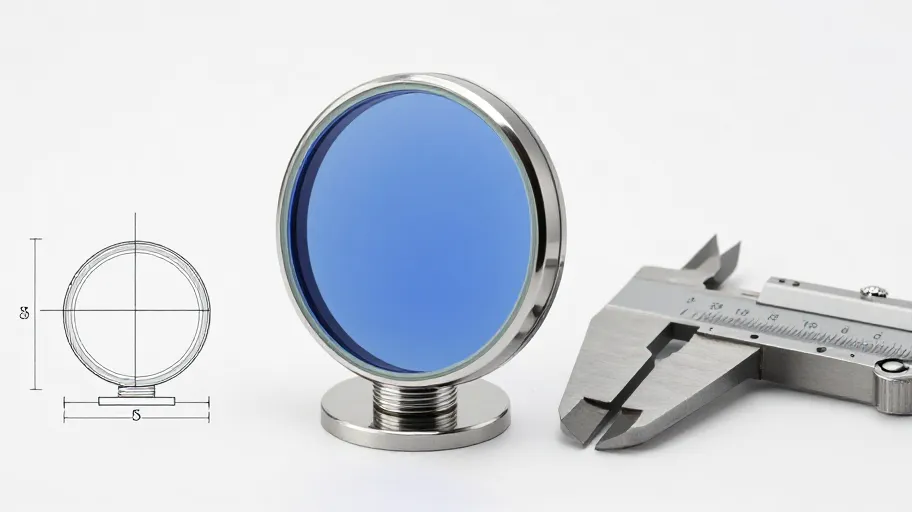
A complete first brief to a sapphire watch glass supplier should contain case reference, lens geometry, edge treatment, coating specification, and reference samples or drawings — captured in the CLEAR Brief Framework. Most quotation delays come not from pricing complexity, but from missing measurements: edge height, bezel seat diameter, dome profile and coating call-outs. Define these up front, and your supplier can quote, compare and sample without repeated clarification.
Why first briefs stall at the measurement stage
When a sourcing team sends a drawing to a sapphire watch glass supplier, the supplier's first job is to reconstruct the full fit: how the crystal sits in the bezel, how light passes through the dome, and how the edge meets the case. If any of those measurements are absent, the supplier must either quote with assumptions — which produce revisions later — or pause the quote to ask questions.
Neither outcome helps a procurement timeline. The fix is not more email; it is a structured brief. The CLEAR Brief Framework gives you a repeatable order of information so that nothing critical is left to assumption.
The CLEAR Brief Framework
| Letter | Input | What to specify | Why it matters |
|---|---|---|---|
| C — Case reference | Watch case and movement reference | Case material, bezel type (snap, screw, glued), movement height if relevant | The crystal must match the case family, not just the dial diameter |
| L — Lens geometry | Diameter and thickness | Maximum diameter, thickness at centre and edge, dome profile (flat, double-domed, box) | Geometry drives both raw-material planning and polishing method |
| E — Edge treatment | Edge shape and finish | Edge profile (flat, stepped, chamfered), seat diameter, edge height, surface finish | The edge is the fit surface; ambiguity here causes assembly issues |
| A — AR / coating | Coating placement and intent | Coated or uncoated; inside, outside or both; visual intent (colour, reflectance goal) | Coating placement changes appearance and processing sequence |
| R — Reference samples | Drawings and physical parts | 2D drawing with tolerances marked as critical or reference, plus any sample crystal or case | References let the supplier confirm interpretation before quoting tooling |
Each letter answers a question the supplier will ask anyway. Filling them in before the first email converts a clarification loop into a quotation cycle.
Decision table: geometry, edge and coating trade-offs
Use this table during internal alignment, before the brief leaves your team:
| Decision | Options | Trade-off to weigh | Document in brief as |
|---|---|---|---|
| Dome profile | Flat; single-domed; double-domed | Visual character vs thickness control and polish complexity | Profile type with drawing sketch |
| Edge profile | Flat edge; stepped edge; chamfer | Bezel interaction and seating surface | Edge cross-section drawing and seat diameter |
| Coating placement | None; inside only; both sides | Reflectance management vs surface exposure and processing | Coating intent and placement |
| Tolerance intent | Critical fit dimensions; reference dimensions | Which measurements govern acceptance | Marked drawing, not prose |
| Gasket / sealing role | Crystal seals directly; gasket carries seal | Affects edge finish requirements and measurement criticality | Assembly note with case reference |
Note that no numerical tolerance, coating performance figure or fit standard belongs in this table. Those values are project-specific: ask the supplier to propose and confirm them in writing, then approve them as part of the drawing package.
The measurements buyers leave out
Drawing on internal planning evidence from our quotation intake — not external benchmarks — these are the inputs most frequently absent from first briefs:
- Seat diameter and edge height. Buyers send the outer diameter but not the diameter where the crystal actually rests in the bezel, or the height of the edge wall. Both govern fit.
- Dome profile definition. "Domed" is not a geometry. State the dome style and provide a cross-section sketch, even a rough one.
- Thickness at two points. Centre thickness alone is insufficient when a dome is involved. State centre and edge thickness.
- Coating placement and intent. State whether anti-reflective coating is wanted, on which surfaces, and the visual goal, without assuming a performance level — confirm what the supplier can verify.
- Tolerance intent. Mark which dimensions are critical to fit and which are reference. Suppliers quote and inspect differently when tolerance intent is explicit.
- Date window, logos or printed elements. Any aperture or printing must appear on the drawing with position call-outs.
- Movement and hands clearance. If the crystal is box-shaped or double-domed, state the clearance available above the hands.
Each missing item is a question your supplier must ask before pricing. A brief that answers them in advance lets two or three suppliers be compared on equal information.
Approval questions to settle before tooling
Before you approve any tooling or sampling step, get written answers to these:
- Have you confirmed our seat diameter and edge height interpretation against our drawing?
- Which dimensions will you treat as critical, and what inspection method will confirm them?
- Can you hold the tolerance intent we marked, or do you propose different values for our review?
- What coating options can you verify for our intended placement, and how will you evidence them?
- What information do you need from our case sample or reference crystal to complete the fit check?
- What is your current minimum order quantity, lead time and capacity position for this specification? (All are supplier-confirmed and project-specific.)
Document every answer in the drawing package or the quotation annex. This becomes the acceptance reference for sampling and production, and it removes ambiguity if the specification needs to change later.
Comparing suppliers on equal information
Send the identical CLEAR brief to every sapphire watch glass supplier you are evaluating. When quotations return, compare them line by line: geometry interpretation, edge treatment, coating placement, tolerance approach, and the questions each supplier raised. The quality of a supplier's questions is itself evidence — a supplier that interrogates your edge profile is reading the drawing properly.
Do not compare on price alone when the underlying interpretation differs. A quote built on an assumed dome profile is not comparable to one built on your sketch, no matter how the numbers look.
FAQ
Do I need a full technical drawing to get a first quotation? A marked 2D drawing with critical dimensions, dome sketch and coating intent is the minimum that lets a supplier quote without assumptions. A physical sample crystal or case improves interpretation further — confirm with the supplier which references they need.
Can I just send a sample crystal for replication? Many suppliers can work from a sample, but a sample alone does not communicate tolerance intent or coating placement. Pair the sample with a CLEAR brief so acceptance criteria are explicit.
What tolerance should I specify? Do not adopt a number from a template. Define which dimensions are critical to your case fit, then ask the supplier what values they can hold and verify for your geometry, and approve the result in writing.
How do I handle AR coating specification? State the placement (inside, outside, both) and your visual intent, then ask the supplier what coating options they can offer and how performance is evidenced. Confirm the current specification and any verification method directly.
What if my design is not final? Send the brief with dimensions marked as provisional, and flag which items may move. Suppliers can then indicate which changes affect tooling or pricing, which helps you lock the design with better information.
Prepare a quote-ready brief
Run your specification through the CLEAR Brief Framework, mark your critical dimensions, and send the complete package to JadeZone Sapphire for review. A quote-ready brief shortens the quotation cycle and lets you compare suppliers on equal, documented information. [Prepare a quote-ready brief →]
Low-friction option: Start with the checklist alone. Confirm case reference, lens geometry, edge treatment, coating intent and reference samples — then send it. [Use the CLEAR brief checklist →]