
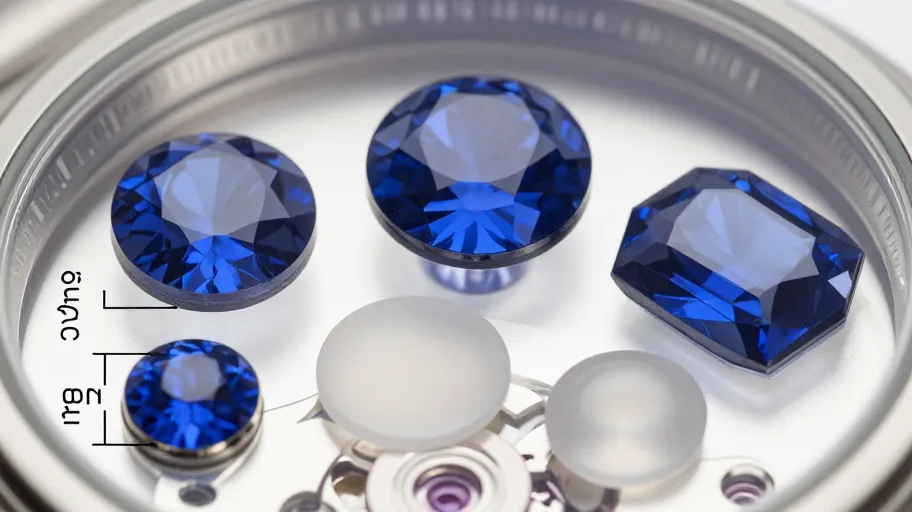
Before a supplier can quote your sapphire watch glass accurately, they need four things defined: the crystal geometry, the dimensional specification, the surface treatment and coating choice, and the intended application. Choosing among sapphire watch glass types is less about "which is best" and more about matching geometry and finish to your case design, movement layout and market positioning — then documenting it so nothing is left to interpretation.
The Spec-First Quoting Framework
When sourcing custom sapphire crystals, the most expensive mistake is not choosing the wrong geometry — it is submitting an incomplete brief. We call the fix the Spec-First Quoting Framework: assemble the full specification package before the first quotation request, so the supplier prices one defined product instead of several guesses.
The framework has four layers:
- Geometry — the shape and curvature profile of the crystal.
- Dimensions and fit — how the crystal seats in or on your case, including how those fit points will be controlled.
- Surface and optical treatment — polish quality, coatings, and any functional features such as date windows or magnifiers.
- Application context — the watch's positioning, expected use environment, and assembly method, which influence material and finishing recommendations.
Each layer you leave undefined becomes an assumption. Assumptions become revisions. Revisions become delayed sampling and budget drift.
Sapphire Watch Glass Types: A Geometry Decision Table
The main sapphire watch glass types refer primarily to geometry. Here is a working comparison to guide your selection discussion:
| Crystal geometry | Profile | Suits case designs where… | Sourcing considerations to confirm |
|---|---|---|---|
| Flat sapphire | Planar top and bottom | Minimalist dials, thin cases, modern aesthetics | Simpler drawing definition; confirm edge finishing requirements |
| Domed (single-curvature) | Convex top, flat underside | Vintage-inspired or dress watches seeking height and light play | Curvature radius must be fully specified; confirm tooling implications with the supplier |
| Double-domed | Convex top and concave underside | Higher doming with reduced dial clearance loss | Most parameter-sensitive; provide curvature data and case profile drawings |
| Box crystal | Stepped or vertical side walls, flat top | Tool-watch and field-watch styling | Wall height and seating step need precise definition |
| Tonneau / shaped crystals | Curved or non-round outlines | Distinctive case shapes | Confirm the supplier's capability for the specific outline before finalising the case design |
| Beveled / faceted edge | Flat or domed top with cut edge angles | Designs where the crystal edge is a visible design element | Bevel angle and finish must be documented in the drawing |
The important point: none of these types is universally superior. A double-domed crystal that elevates one design may create clearance problems in another. Define the geometry against your case drawings, then verify with the supplier that the combination of outline, curvature and thickness is manufacturable as drawn.
Coatings, Finishing and Functional Features
Geometry alone does not define the part. Your specification should also state:
- Anti-reflective treatment — whether you want coating, on which surfaces (inner, outer, or both), and how coating performance and durability will be verified and approved.
- Polish specification — what surface quality standard applies and how it will be inspected at approval.
- Functional openings — date windows, magnifier lenses, or other cut features, with the drawing defining position, size and edge treatment.
- Edge finishing — how visible edges are polished or beveled.
For every one of these, ask the supplier what they recommend, what they can document, and what approval criteria will govern the result — rather than assuming a shared default.
What to Submit With Your RFQ
A complete enquiry package lets the supplier quote once, correctly. Before requesting a quotation, prepare:
RFQ Readiness Checklist
- Dimensioned drawing of the crystal from two or more views
- Case drawing or the relevant case opening cross-section
- Stated geometry type with curvature or bevel parameters
- Thickness specification and any stepped features
- Coating choice and surfaces to be treated
- Date window or feature openings, fully dimensioned
- Assembly method (how the crystal is fitted into the case)
- Target watch positioning and use environment
- Open questions you want the supplier to answer with the quote
- Confirmation request for current sample, pricing and production policies
Supplier Approval Questions
Whether you are evaluating JadeZone Sapphire or any manufacturer in Shenzhen, Hong Kong or elsewhere, put these questions in writing and approve the answers:
- Can you manufacture this exact geometry as drawn, or what would you change — and why?
- How will dimensional fit points be controlled, and what inspection evidence will accompany approval samples?
- What coating options do you offer, and how is coating performance verified?
- What is your current sample policy, and what does it depend on?
- What is your current lead time, MOQ and pricing basis for a specification like this?
- What drawing format and tolerance notation do you prefer to receive?
- Who is the named engineering contact for technical queries during the project?
The answers become your documented baseline. Where a supplier answers vaguely on points that matter to you, treat that as a sourcing signal worth resolving before commitments, not after.
Frequently Asked Questions
What is the difference between domed and double-domed sapphire crystal? A domed crystal has a curved outer surface and a flat underside. A double-domed crystal curves the underside as well, which can preserve dial clearance at higher doming. Which suits your watch depends on your case profile and dial layout — specify both curvature parameters and confirm manufacturability with your supplier.
Which sapphire watch glass type should a new private-label brand start with? Start from your case design, not from the crystal. If your case drawings define a clean flat opening, a flat or box crystal simplifies specification; vintage or dress positioning points toward doming. Document the choice, then verify with the supplier that the geometry, thickness and any date feature work together.
Do I need anti-reflective coating on a sapphire crystal? That is a design and positioning decision. Coating choices affect legibility and visual character, and each option carries verification questions: which surfaces are treated, how durable the coating is, and how performance is approved. Compare options with your supplier and document the agreed specification.
Why do sapphire crystal quotes vary so much between suppliers? Because quotes for an under-specified part are quotes for different imagined parts. Geometry, thickness, coating, edge finishing and quantity expectations all move the number. A complete specification package — the core of the Spec-First approach — makes quotations comparable across suppliers.
What information must I confirm directly rather than assume? All commercial and technical policies: sample terms and costs, shipping arrangements, production lead times, minimum order quantities, and current quality documentation. These are project-specific and change over time; confirm them in writing with the supplier at enquiry stage.
Next Steps
Ready to choose the right crystal profile for your case? [Compare crystal geometries] — and see which sapphire watch glass type matches your design before you request a quotation.
Not ready to enquire yet? Download or copy the RFQ Readiness Checklist above and work through it against your case drawings. A complete brief is the fastest route to an accurate quote.
(All internal links and the CTA destination are marked for confirmation before publishing.)