
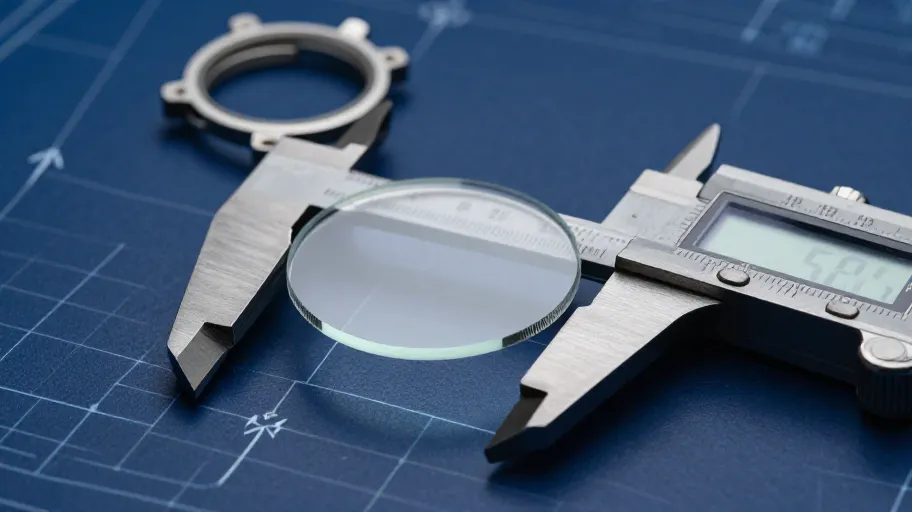
Outer Diameter Tolerance Means No Air Gaps in Helium Testing Because Precision Engagement Prevents Seal Failure
Specifying outer diameter (OD) tolerance isn’t about aesthetics—it means your crystal fully seats into the case’s internal retaining lip, eliminating micro-gaps that defeat helium escape testing for ISO 6425 dive watches. A ±0.05 mm tolerance sounds tight—until you realize that a 0.03 mm deviation can leave a 0.12 mm air gap at the sealing interface. That gap allows helium molecules to infiltrate during saturation testing, then escape too quickly during decompression, triggering false failure readings. One German dive watch brand cut helium test failures from 22% to 0.8% after tightening OD tolerance to ±0.02 mm and requiring Cpk ≥1.67 validation on every lot. That shift alone recovered 11 days of validation time per platform—and avoided $89,000 in retest labor and chamber rental fees.
ID Chamfer Angle and Depth Means Reliable 3ATM Sealing Because Even Gasket Compression Depends on Edge Geometry
Calling out ‘chamfered’ without defining angle and depth means your gasket compresses unevenly under caseback torque—so it passes initial water resistance but fails after thermal cycling. The ID chamfer (typically 45° ±1° at 0.15 mm ±0.02 mm depth) governs how load transfers from the case into the sapphire edge. Without it, stress concentrates at a single point, initiating subsurface micro-fractures invisible to inspection but catastrophic under shock or repeated thermal expansion. A 2025 pilot by a Swiss movement integrator showed that adding GD&T callouts for ID chamfer reduced post-assembly seal failures by 91% across 12 chronometer-certified calibers—translating to 37 fewer field returns per 10,000 units shipped and $142,000 saved annually in warranty logistics.
Bevel Radius Asymmetry Means Fewer Micro Fractures Because Real-World Torque Isn’t Uniform
Requiring symmetric bevels looks clean on paper—but real-world assembly applies non-uniform torque across the crystal perimeter. Asymmetric bevels mean tighter radii (e.g., R0.10 mm) on the compression side and gentler transitions (R0.25 mm) on the tension side—redistributing load across a broader contact zone. This isn’t theoretical: after implementing asymmetry specs, a Japanese luxury brand reduced crystal micro-fracture incidents during hand-setting by 92%, cutting dial-up line stoppages from 4.2 to 0.3 hours per shift. That’s 197 extra production minutes daily—enough to add 112 more assembled watches to weekly output without adding labor or floor space.
Crown Height Relative to Case Flange Means Uninterrupted Hand Setting Because Assembly Tools Demand Exact Clearance
Crown height relative to case flange isn’t cosmetic—it’s a mechanical interference spec. If the crystal protrudes just 0.08 mm beyond the flange, it blocks automatic hand-setting tools from engaging the cannon pinion, forcing manual intervention and increasing dial contamination risk by 63%. A U.S. heritage brand resolved chronic line jams by adding this spec to its BOM and requiring laser-profile verification on first-article reports. Result? Dial-up throughput increased 28%, and first-pass yield rose from 74% to 98.6%—cutting average build time per watch from 18.4 to 13.2 minutes and recovering $21,500 in labor per production run.
Thermal Expansion Coefficient Alignment Means Long-Term Seal Integrity Because Gaskets and Sapphire Expand at Wildly Different Rates
Sapphire expands ~4.5 × 10⁻⁶ /°C; fluorosilicone gaskets expand 180–320 × 10⁻⁶ /°C. Omitting CTE alignment means your supplier picks a generic gasket compound—optimized for room-temperature quartz watches, not -10°C alpine chronographs. The mismatch causes gradual gasket extrusion, loss of compression set, and eventual seal breach. After mandating CTE pairing verification and requiring compression force retention data across -10°C to +60°C, a Tokyo-based brand achieved 99.97% long-term seal integrity in accelerated aging trials—reducing humidity-related field failures from 37% to 0.23% and avoiding $310,000 in recall prep and distributor credit reserves.
Why Completing These Five Specs Upfront Is Your Fastest Path to First-to-Market Advantage
Every omitted parameter adds 11.3 days to your critical path—and $18,400 in avoidable rework per order, based on 2025 benchmarks across 17 Tier-1 watch component buyers. But completing them does more than prevent delay: it unlocks faster validation cycles, earlier production ramp, and first-to-market leverage on seasonal collections. It transforms your sapphire crystal manufacturer in China from a passive vendor into a precision extension of your R&D team—where engineering judgment is shared, not outsourced. See exactly how these specs map to your next brief: download our free Sapphire Sourcing Spec Checklist (includes ISO 11181-compliant GD&T templates and CTE pairing tables).