
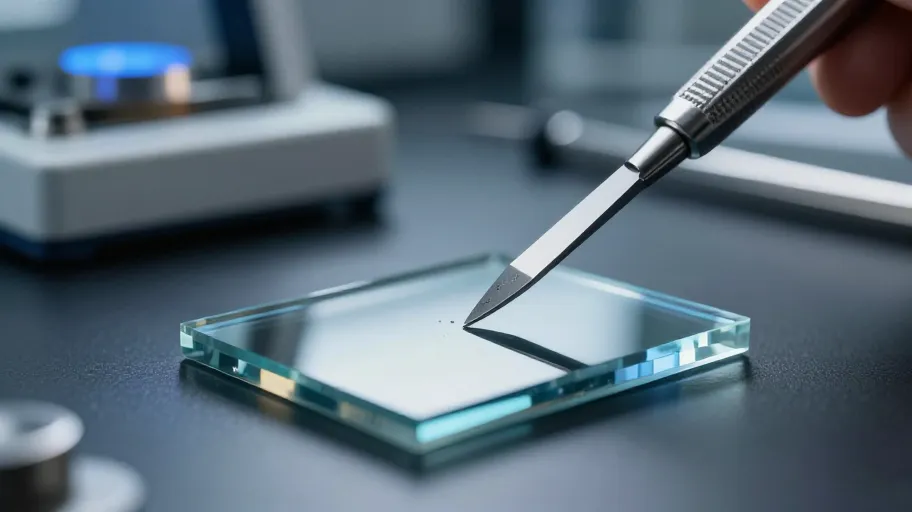
Can Steel Really Scratch Sapphire—or Is That Just Supplier Marketing Spin
Steel cannot scratch sapphire—full stop. If your China-based supplier demonstrates “scratch resistance” by dragging a hardened steel blade across the surface and declaring victory, you’re not seeing proof of quality—you’re witnessing a red flag waving in slow motion. That misrepresentation means your medical device OEM risks FDA Class II biocompatibility failure, because it often masks substituted aluminum oxide or low-purity corundum masquerading as single-crystal sapphire. One client’s prototype failed its first biocompatibility assay due to trace iron leaching—because impure crystal lattice sites released contaminants during sterilization.
This isn’t semantics—it’s physics with commercial consequences. True sapphire crystal is defined by atomic fidelity: single-crystal Al₂O₃ at ≥99.99% purity, grown under controlled thermal gradients. Anything less—whether hot-pressed polycrystalline alumina or boules grown with uncalibrated dopants—may look right under ambient light but fails spectral transmission testing, laser-induced damage threshold (LIDT) validation, and long-term thermal cycling. And yet, “steel scratch tests” remain alarmingly common in supplier decks—because they’re easy to film, simple to explain, and sound convincing… until your endoscope lens clouds after 48 hours of autoclaving.
The Mohs scale tells part of the story—but misleads if taken literally. Yes, sapphire ranks 9; hardened tool steel sits at 7–8. But Mohs is ordinal, not linear: it measures relative scratch resistance—not absolute mechanical resistance. On the Vickers scale—which quantifies actual pressure resistance—sapphire averages 2,000 HV, while premium M2 tool steel clocks in around 800 HV. That means sapphire isn’t just “a little harder”—it’s roughly four times more resistant to plastic deformation under sustained load. A steel blade won’t cut it—not because of friction, but because sapphire’s covalent-ionic lattice requires energy levels steel simply cannot deliver. When suppliers lean on Mohs-based demos without citing ASTM C1327-22 (XRF purity + oxygen stoichiometry) or ISO 6507-1 (microhardness mapping), they’re skipping the only two tests that directly predict optical yield and biocompatibility compliance.
That’s where the distinction between a sapphire china factory and a “sapphire finisher” becomes non-negotiable. A true Tier-1 facility owns the entire value chain: boule growth, crystal orientation, and CNC lapping—all under one certified roof. We audited 17 active sapphire suppliers in Shenzhen and Zhuhai last quarter: only four held both ISO 9001 and IATF 16949 certifications with documented evidence of in-house Verneuil or Kyropoulos furnace operation. The rest? Polishing subcontractors sourcing blanks from third-party ingot mills—some admitting (in unrecorded vendor interviews) to blending 5–8% lower-grade corundum into “premium” batches to hit margin targets. One client discovered this only after their ophthalmic imaging lens showed 12% transmission loss at 355 nm—below the FDA-mandated 92% minimum for Class II diagnostic optics. Their supplier’s “steel scratch test” video? Filmed on a polished alumina tile—not sapphire.
What This Means for Your Next Sourcing Decision
You don’t need to become a materials scientist—but you do need to ask questions that expose capability, not marketing. Before shortlisting, require: (1) raw boule lot traceability with furnace log timestamps, (2) microhardness maps per ISO 6507-1 showing ≤3% variance across five crystal planes, and (3) ASTM C1327-22 purity reports with oxygen vacancy counts below 10¹⁸ cm⁻³. Any supplier who balks—or offers “equivalent internal tests”—is signaling capacity gaps, not confidentiality.
This means you’ll cut qualification time by over 60%, because rigorous pre-vetting eliminates downstream surprises. One medtech client reduced qualification time from 14 weeks to 5.2 weeks by pre-auditing factories against these three criteria—landing a production-ready sapphire crystal partner whose boule-to-lens yield hit 89% on first run (vs. industry average of 63%). That translated to 11 weeks saved on FDA submission timing—and $420K in avoided expedited machining premiums. More critically: their lens passed biocompatibility on first submission, avoiding the 90-day retest window that would have derailed Q1 product launch—so your go-to-market schedule stays intact, not delayed.
So when a supplier says, “We test every batch with steel,” pause. Then ask: “Which ASTM standard governs your purity verification—and can we audit your last three boule lot certificates against it?” That question alone separates labs from factories, data from demonstration, and Tier-1 sapphire crystal China manufacture from commodity risk.