
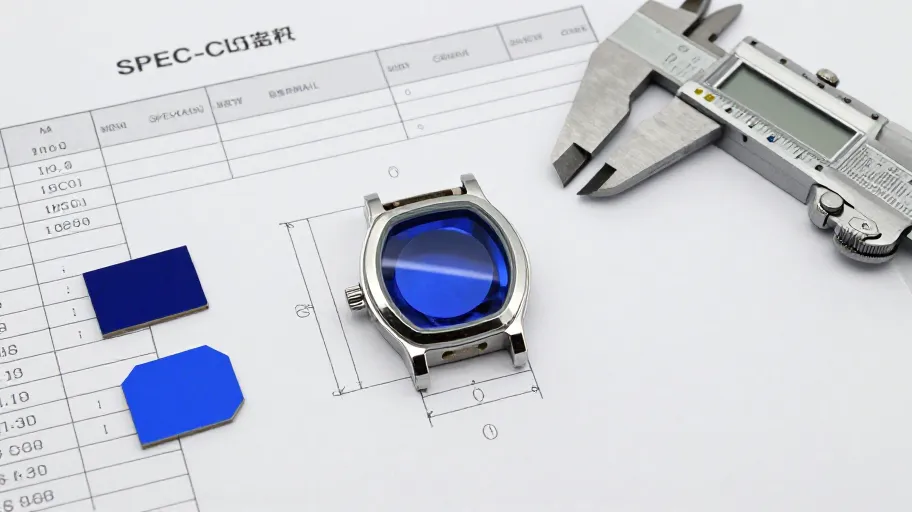
Most rework in custom sapphire watch crystal projects starts before production: it starts in the enquiry. When a sapphire watch glass supplier receives a drawing without a locked case interface, a stated polish and coating definition, and written acceptance criteria, the quotation can only be an interpretation. The SPEC-CLOSE framework below helps sourcing teams close specification gaps before requesting quotes, so revisions, disputed first articles and defensive pricing are reduced. Confirm the current policy directly on every commercial term.
Why quotations drift before production begins
A crystal is never specified by its outline alone. It is specified by its relationship to the case, the gasket or adhesive path, the visible surface quality under defined lighting, and the coating the brand expects. When any of these are absent from the enquiry, the supplier fills the gap with an assumption. If that assumption differs from the design intent, the gap resurfaces at first article inspection as rework.
The purpose of a quote-ready brief is not to over-specify. It is to make every assumption explicit so both sides approve the same interpretation.
The SPEC-CLOSE framework for quote-ready briefs
S — Shape and form. Define plan shape, curvature or dome profile, and how the profile is measured. State whether the drawing controls the inner or outer surface.
P — Polish and surface finish. Name the surfaces (top, bottom, side), the finish expected on each, and the inspection method and lighting under which finish will be judged.
E — Edge and case interface. This is where most rework originates. Document the seat geometry, gasket or bonding path, chamfers, and how the crystal locates in the case. A beautiful crystal that does not seat correctly is still a rejected part.
C — Coating. State whether an anti-reflective coating is required, on which faces, and how coating presence and quality will be verified. Do not rely on the word "coated" alone — define the check.
C — Compliance and documentation. List what documentation the project requires the supplier to provide, and confirm the current policy directly for material origin, reports and traceability.
L — Lot acceptance. Agree in writing how a production lot will be accepted: sampling approach, inspection criteria, reference samples, and the dispute path if opinions differ.
O — Origin and material record. Confirm how material source and grade will be documented for each lot, and confirm the current policy directly.
S — Surface and cosmetic standard. Define cosmetic acceptance under agreed magnification and lighting, and who holds the boundary sample.
E — Engineering exchange. Agree the format for drawings, revisions and change control before the first tooling conversation.
Decision table: close the gap now or risk it later
| Specification gap | Close it now (before quote) | Risk if left open |
|---|---|---|
| Case interface undefined | Supply case drawing or section with the crystal drawing | Fit failure at assembly; tooling revision |
| Finish inspection method unstated | Agree lighting, magnification and boundary samples | Subjective rejections; lot disputes |
| Coating verification undefined | Specify faces and test method for coating presence | Coating disagreements after delivery |
| No lot acceptance plan | Write sampling and acceptance criteria into the enquiry | No agreed basis to accept or reject |
| Revision control absent | Fix drawing numbering and change process | Suppliers quoting superseded revisions |
| Material documentation unclear | State required documents; confirm the current policy directly | Traceability gaps at audit or launch |
Approval questions to put to any sapphire watch glass supplier
Before approving a quotation or moving to tooling, put these questions in writing and record the answers:
- Which drawing revision are you quoting, and which dimensional records will you return with first articles?
- How will you verify the case interface we have defined, and what will you do if our interface data is incomplete?
- Under what inspection conditions will surface finish be evaluated, and will you agree boundary samples with us?
- How will coating presence and quality be checked, and what evidence will accompany each lot?
- What documentation will you provide per lot for material origin and grade? Confirm the current policy directly.
- How do you propose we handle a disputed lot, and what acceptance criteria will appear in our agreement?
- What is your process for engineering changes after tooling has begun?
- What do you need from us — beyond the drawing — to quote accurately?
That final question matters. A supplier who asks precise questions about your case and finish intent is demonstrating the engineering exchange you want to rely on.
Comparing suppliers on equal footing
Vague briefs produce incomparable quotes. Once your SPEC-CLOSE brief is complete, send the identical document to each candidate sapphire watch glass supplier and compare responses against how well each one addresses the gaps. Score them on the quality of their questions, the clarity of their acceptance proposal, and their documentation answers — not only on the commercial line. Then confirm the current policy directly on every commercial term, including samples, fees and scheduling, before any commitment.
FAQ
What should a quote-ready sapphire crystal brief contain? At minimum: the crystal drawing with revision number, the case interface definition, finish and coating requirements with verification methods, required documentation, and written lot acceptance criteria.
Why do suppliers quote conservatively when specifications are incomplete? Because open interface and acceptance questions are risk, and risk gets priced in or hedged. A complete brief lets a supplier quote the actual project rather than the worst interpretation of it.
How do we prevent cosmetic finish disputes? Agree the inspection method, lighting and magnification in writing, and exchange boundary samples that both parties approve before production.
Who owns the specification — the buyer or the supplier? The buyer owns design intent; the supplier owns confirming manufacturability. A good brief makes that split explicit, and a good supplier confirms manufacturability in writing before tooling.
What is the single most overlooked item in crystal RFQs? The case interface. The crystal outline is documented; the seat, gasket path and locating features are not. Closing that one gap prevents a large share of rework.
Prepare a quote-ready brief
Use the SPEC-CLOSE checklist above to build your brief, then send it to JadeZone Sapphire for review. We will examine your case interface, finish and acceptance criteria and respond with the questions that matter — so your quotation reflects the real project, not an assumption. Confirm the current policy directly on all commercial terms.
Low-friction next step: download the one-page gap checklist
Short on time? Work through the eight SPEC-CLOSE headings and mark each as defined, partially defined or open. Even that single pass will show exactly where your next enquiry needs attention.