
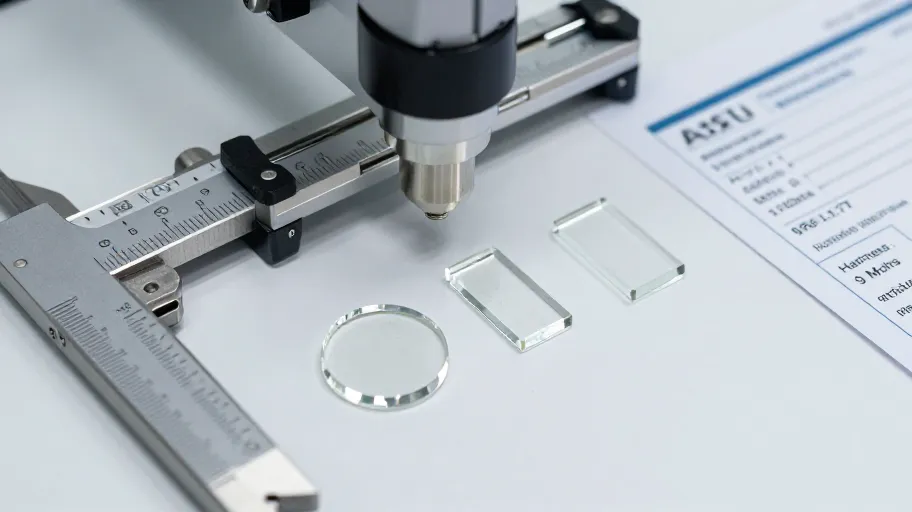
Synthetic sapphire is a lab-grown, single-crystal form of aluminium oxide (Al₂O₃) valued in watchmaking for its scratch resistance and optical clarity. For a B2B buyer, the material itself is only half the equation: the other half is specifying, sampling and approving each crystal against documented criteria before a production order is released. This guide gives you a gate-based way to do exactly that.
What synthetic sapphire is — and what it is not
Synthetic sapphire is grown industrially as a boule and then sliced, ground and polished into watch crystals and precision components. Because it is a single crystal rather than a glass, it resists scratching far better than mineral glass. Two things follow for buyers:
- Hardness is directional and test-dependent. Sapphire's hardness is anisotropic — it differs along different crystal planes — and any quoted Vickers number depends on the test method, load and surface preparation. Treat a bare number as a claim to verify, not a fact.
- Brittleness is not the same as weakness, but it is a real trade-off. High hardness coexists with susceptibility to chipping at edges under sharp impact. Edge finish, thickness and case fit matter as much as the material grade.
A supplier who can explain how their hardness figures were obtained — test method, standard, load, who performed it — is giving you something you can audit. One who cannot is giving you marketing.
The SPEC–SAMPLE–SIGN-OFF framework
Use three gates for every custom crystal project:
- SPEC. Write a complete technical specification: material grade, geometry, thickness, edge profile, surface finishes, coating, print or logo, gasket interface and inspection criteria. Ambiguity here becomes cost later.
- SAMPLE. Inspect physical samples against the written spec — not against a photo, not against a verbal assurance. Measure, view under magnification, test the fit in the actual case.
- SIGN-OFF. Approve in writing, referencing the sample batch and the spec revision, and agree what happens if production parts differ from the approved sample.
This framework does not assume any supplier is dishonest. It simply replaces trust with documentation, which protects both sides.
Hardness: how to read and question the numbers
Because search behaviour around "sapphire Vickers hardness" is frequent, buyers arrive with a number in mind. Useful questions to put to any supplier instead:
- Which hardness scale is being quoted, and was it Vickers, Knoop or Mohs?
- What test load and dwell time were used, and which crystal plane was measured?
- Was the testing done in-house or by a third party, and is a report available for your project lot?
- Does the quoted value apply to the finished, polished crystal or to raw material?
No specific test result is asserted here — the point is that a number without method, plane and provenance cannot be compared between suppliers. Ask for the method, then compare like with like.
Specification checklist for custom watch crystals
Use this checklist as the SPEC gate:
- Material grade and growth method declared by supplier
- Diameter, thickness and any curvature, with drawing revision number
- Edge profile and gasket-seat geometry matched to the case
- Surface finishes: top, bottom, side faces
- Anti-reflective coating: which side(s), and how coating performance will be verified — do not assume coating performance; confirm the test plan
- Print, logo or date window: position, ink or metal deposition method
- Inspection criteria: what counts as an acceptable vs rejected part
- Packaging and handling requirements to protect finished surfaces in transit
Note: no numerical tolerance is given here, because tolerances should be agreed per project and per drawing with the supplier — ask what they can hold, then document it.
Sampling and approval: the decision table
| Situation | Buyer action | What to document |
|---|---|---|
| Sample matches spec on all points | Proceed to approval in writing | Approved sample reference, spec revision, approval date |
| Minor deviation on non-critical features | Request a corrected sample or written concession | Deviation description and disposition decision |
| Deviation on fit, coating, optics or edges | Do not approve; request revised sample | Full findings, measurements, photographs |
| Supplier cannot supply test reports or methods | Pause; verify claims before ordering | Outstanding questions and agreed resolution path |
| Sample policy, fees, MOQ or lead time unclear | Confirm current policy directly with the supplier, in writing | Quoted terms for your specific project |
Concrete approval questions before releasing a production order:
- Which sample batch and drawing revision does our approval reference?
- What inspection will be applied to production parts against the approved sample?
- What is the agreed process if production parts deviate from the approved sample?
- Which hardness and coating test reports accompany our lot, and who performed them?
- What are the current sample, MOQ, lead-time and payment terms for this specific project — confirmed in writing?
On the last point: this article deliberately states no sample, fee, shipping, refund or production policy, because none was supplied and such terms change by project. Confirm every one directly.
Frequently asked questions
Is synthetic sapphire the same as natural sapphire? Chemically both are crystalline aluminium oxide, but synthetic sapphire is grown in controlled conditions, giving consistent purity and optical quality without the inclusions of mined stones. For watch crystals, synthetic material is the functional choice.
How does synthetic sapphire compare with mineral glass for watch crystals? Sapphire resists scratching far better; mineral glass is less costly and can be less brittle on impact. The trade-off between scratch resistance, thickness, case design and budget is a project decision, not a universal one.
Can a sapphire crystal be tested before I approve it? Yes — and it should be. Agree the test methods in advance: hardness testing method and plane, coating verification approach, dimensional measurement technique, and optical inspection conditions. Approval should reference measured results, not impressions.
What should I ask about anti-reflective coatings? Ask which side(s) are coated, what coating technology is used, how performance and durability will be verified for your project, and what reports you will receive. Do not accept a coating performance claim without a verification plan.
Do sample and order terms vary between suppliers? Yes, and they can vary between projects with the same supplier. Sample availability, fees, shipping responsibility, MOQ, lead times and revision handling must all be confirmed in writing for your specific project before you commit.
Next steps
If you are preparing a custom crystal project, 获取采购 Brief — a structured brief you can use to specify, question and approve sapphire crystals with any supplier, including us at JadeZone Sapphire.
Not ready for that? Take the low-friction first step: copy the specification checklist above into your next supplier RFQ. It costs nothing and immediately sharpens the conversation.