
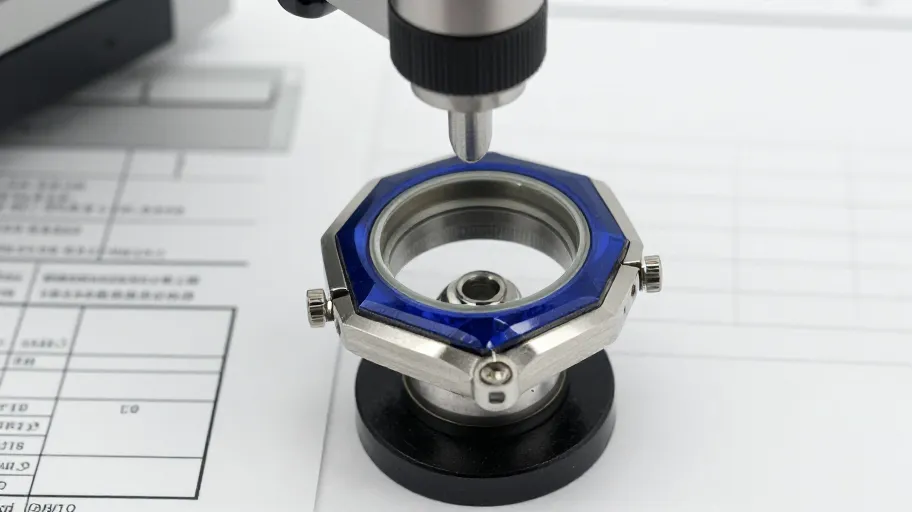
A sapphire crystal system is the complete, coordinated set of elements that make a sapphire crystal work in a watch: the crystal geometry, its coating, the gasket seat, the case interface, and the inspection and test evidence that proves each element. To buy one well, specify every element in a frozen drawing pack, qualify physical samples against that pack, and secure a written sign-off before volume production. Suppliers who cannot document each stage should be compared, not assumed.
Why "system" matters more than "crystal"
Buying a sapphire crystal on the basis of material alone is a frequent source of rework. The crystal is one component inside an assembly. If the case-seat geometry, gasket channel, edge finish and coating are not specified and matched together, even a well-grown sapphire blank can fail at assembly or in the field.
A workable procurement approach is the SPEC–SAMPLE–SIGN-OFF framework:
- SPEC. Freeze every specification element into a drawing pack that both parties sign.
- SAMPLE. Qualify physical samples against that pack, with measurable acceptance criteria.
- SIGN-OFF. Formalise the approval, including what happens when a later batch differs from the approved sample.
Each stage has a gate. Do not move to the next stage until the current one is documented. This is the discipline that separates a controlled sourcing project from an email thread.
Stage 1: SPEC — specify the whole system
A complete specification for a custom sapphire crystal system should cover at minimum:
- Crystal geometry — diameter or shape, overall thickness, and any curvature or dome profile, defined on a dimensioned drawing.
- Case interface — how the crystal sits in or on the case: snap-in, tension ring, glued, or gasket-seated, with the mating dimensions called out.
- Gasket and seat — the seat surface, gasket channel profile and the surface finish the gasket seals against.
- Edge and surface treatment — edge polishing, chamfers, facet definitions, and any printed or applied markings.
- Coating — whether an anti-reflective coating is specified, on which faces, and how coating quality will be inspected.
- Material evidence — how the supplier demonstrates that the material is sapphire, and how mechanical properties are documented.
- Inspection plan — what is measured, with what method, on what fraction of parts.
Buyers searching for material properties such as "sapphire Vickers hardness" are asking the right first question, but the procurement question is broader: how will the supplier's specific material lot and finished part be verified for your project? A published hardness value describes a material class; it does not describe the part you will receive. Turn the question into a project-specific one: ask which test method the supplier uses, whether test reports accompany lots, and whether a third-party or in-house method applies. Confirm the answers in writing rather than relying on catalogue values.
Because no dimensional tolerance, coating performance figure or test result can be asserted here without confirmed evidence, every numeric limit in your drawing pack must come from your own engineering requirements and the supplier's written confirmation.
Decision table: evaluating a sapphire crystal system supplier
Use this table to structure every supplier conversation, including with JadeZone Sapphire. Score each row on evidence provided, not on claims made.
| Evaluation dimension | What to ask | Evidence to require | Gate result |
|---|---|---|---|
| Drawing capability | Can you produce and sign a full drawing pack from our case data? | Marked-up drawing, signed revision | Pass / query / reject |
| Material verification | How do you prove the material and its mechanical properties for our parts? | Written method and report format | Pass / query / reject |
| Coating specification | Which coating options can you document, and how is coating quality inspected? | Coating spec sheet and inspection method | Pass / query / reject |
| Sample process | What does your sample process look like, and what is the current policy on samples and charges? | Written current policy — confirm directly | Pass / query / reject |
| Measurement and inspection | Which dimensions and features are measured, and with what equipment? | Inspection plan mapped to the drawing | Pass / query / reject |
| Approval and change control | How are approved samples referenced, and how are changes handled afterwards? | Written change-control procedure | Pass / query / reject |
| Order terms | What are your current MOQ, lead time and pricing for this part? | Written quotation — confirm directly | Pass / query / reject |
No row in this table can be pre-answered for any supplier, including the one writing this guide. Every answer must come from a current, written confirmation for your specific project.
Stage 2: SAMPLE — make the sample prove something
A sample is not a photograph with a delivery note. A qualified sample proves that the supplier can hold the frozen specification on real tooling and real material. Before requesting samples, define:
- What the sample is made on — production tooling or provisional tooling — and which one your approval applies to.
- Acceptance criteria — the measurable checks the sample must pass, referenced to the drawing pack, not to visual impression.
- Sample quantity — enough pieces for your own checks: fit trials, gasket seating, coating inspection and retention samples.
- Retention samples — sealed samples held by both parties as the reference for later batches.
Sample policy varies by supplier and by project. Do not assume that samples are free, charged, expedited or accompanied by test reports. Ask for the current policy in writing: what a sample order includes, what it costs, how it ships, and how long it takes. Confirm every element directly with the supplier before budgeting or scheduling around it.
Stage 3: SIGN-OFF — approval questions that protect the project
Approval is a documented decision, not a feeling of confidence. Before releasing production, put these questions to the supplier and record the answers:
- Does this approval reference a signed drawing revision number, and is that revision attached to the purchase order?
- Are sealed retention samples held by both parties, and how will later batches be compared against them?
- Which inspection results accompany each production lot, and in what format?
- If a batch differs from the approved sample, what is the resolution process?
- If we change the case, gasket or coating after approval, what requalification is required?
- What is your current written policy on MOQ, lead time, pricing and any changes to them for this part number?
None of these questions presumes a policy. Each converts an unknown into a documented answer you can compare across suppliers.
Approval checklist
- Drawing pack complete: geometry, case interface, gasket seat, edges, coating, markings
- All numeric tolerances drawn from your engineering requirements and confirmed in writing by the supplier
- Material verification method and report format agreed
- Coating specification and inspection method documented
- Sample acceptance criteria defined before samples are requested
- Current sample, cost, shipping and production policy confirmed in writing
- Written quotation covering MOQ, lead time and price for this part
- Retention samples sealed and held by both parties
- Signed approval referencing the drawing revision
- Change-control and requalification process documented
FAQ
What exactly is included in a sapphire crystal system? It is the coordinated set of crystal geometry, case interface, gasket seat, edge treatment, coating and inspection evidence. Buying the "system" rather than just the crystal means every element is specified, sampled and approved together.
How should I verify sapphire hardness claims for my parts? Ask the supplier which test method they use, whether reports accompany lots, and whether the testing is in-house or third-party. Then require the answer in writing for your specific part. A general material value cannot substitute for project-specific verification.
Should I approve a sample or a drawing? Both, and the link between them matters most: the approval should reference a signed drawing revision, and sealed retention samples should be held so later batches can be compared against what you approved.
What production terms should I confirm before ordering? MOQ, lead time, unit price at your quantities, sample policy and change-control terms — all in a written quotation for your specific part number. Confirm each directly with the supplier, since none can be asserted in advance.
How do I compare suppliers fairly? Give every supplier the same drawing pack, the same sample acceptance criteria and the same decision table, then compare documented evidence rather than claims.
Get the sourcing brief
If this framework would help your team run a controlled sapphire crystal sourcing project, 获取采购 Brief — a structured brief covering specification, sample qualification and approval gates that you can send to any supplier, including us at JadeZone Sapphire in Shenzhen and Hong Kong.
Not ready to contact anyone yet? Start smaller: copy the approval checklist above into your next supplier email and use it to structure your questions. A well-asked question set is the cheapest quality control you will ever implement.