
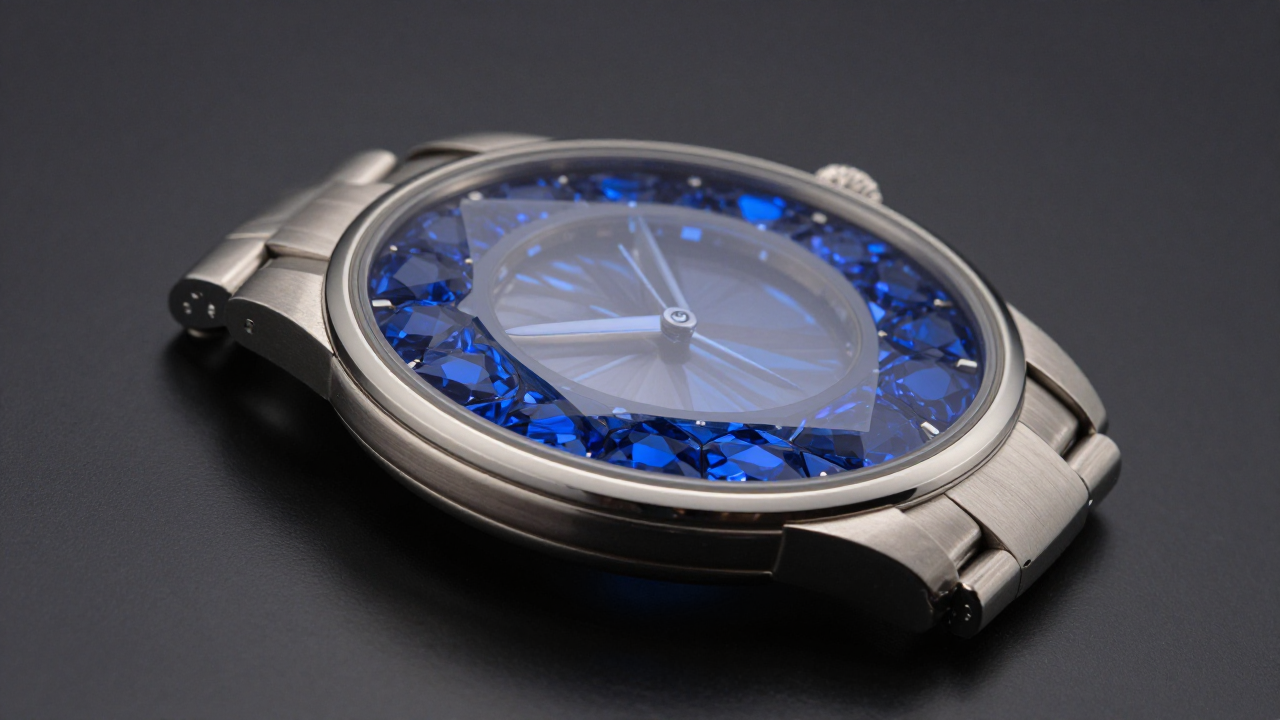
A sapphire watch crystal is a lens cut from synthetic single-crystal corundum (Al₂O₃) that is grown in a furnace, not mined.…
Sapphire watch crystals rate 9 on the Mohs scale and roughly 2,000 kg/mm² on the Knoop scale (ASTM C1326 method), which makes sapphire about four times harder than mineral glass and 80 times harder than acrylic.
What Is a Sapphire Watch Crystal and How Does It Differ from Mineral or Acrylic Glass?
The material starts as a boule. Most watch crystals come from Verneuil flame-fusion boules grown at 2,045 °C, or from EFG (edge-defined film-fed growth) tubes for high-volume flat parts. The boule is sliced, CNC-ground to the case diameter, lapped flat or domed, then polished with diamond slurry until the surface is optically clear. Anti-reflective coating goes on last, inside a vacuum chamber.
Two things surprise first-time buyers. First, "sapphire" here means colorless corundum with no gem value — a 1.2 mm blank costs cents, not dollars. Second, sapphire's refractive index is 1.77 against 1.52 for mineral glass. That higher index means an uncoated sapphire face reflects about 7.7% of light per surface versus 4.3% for mineral glass, so a sapphire crystal without AR coating actually reads *worse* on the wrist than cheap glass. The coating is not an upsell. It is the product.
That cost gap has narrowed. Timex's Atelier Marine M1a ships a double-curved sapphire crystal, a ceramic bezel, and 200 m of water resistance — a spec stack that sat above $2,000 five years ago. When sapphire reaches a Timex case, it stops being a luxury marker and becomes a baseline expectation. That shift is the real reason spec sheets in 2026 read the way they do.
How Do You Choose the Right Sapphire Watch Crystal for Your Case?
Choose a sapphire watch crystal by locking five specs before anyone quotes a price: diameter with tolerance, thickness, dome profile, edge chamfer, and AR coating placement. Production tolerances typically run ±0.05 mm on diameter and ±0.03 mm on thickness. Anything looser will weep at the gasket on a case rated to 200 m.
Sizing is where most sourcing mistakes happen. Buyers send us the diameter of the crystal they're replacing. Measure the case opening instead — after plating, after bead-blasting, after the bezel press. A sapphire crystal seats on an I-ring gasket with 0.15 to 0.25 mm of radial compression. Miss that window on the low side and the watch fails a pressure test at 3 bar; miss it on the high side and the crystal stress-cracks three weeks after assembly, usually in a customer's hands.
Thickness is the second trap. A 40 mm flat crystal at 1.0 mm thickness gives you a 40:1 diameter-to-thickness ratio, and that disc will deflect under a dive bezel press. Keep flat crystals under roughly 12:1, or step up to 1.5 mm, or add curvature.
A quick selection path we walk buyers through:
Case under 26 mm with a flat bezel → flat crystal, 1.0–1.2 mm, inner AR only. Case 26–34 mm with a rotating bezel or a 200 m rating → flat or single-dome, 1.5–2.0 mm, inner AR. Dress case with a domed rehaut → double-dome, 1.2–1.8 mm at center, double-sided AR. Diameter-to-thickness ratio above 12:1 → fix the geometry before you order, not after.Chamfer matters more than the spec sheet suggests. A 0.15–0.25 mm chamfer at 45°, polished, is what keeps the rim from chipping during pressing. Unpolished edges are where cracks start.
On AR coating: inner-only protects the coating but leaves the outer face at 7.7% reflection. Double-sided AR gives the blackest dial and the strongest showroom impression, and that outer layer will haze at the edges after 18–24 months of daily wear. If you sell tool watches to people who actually dive or climb, coat the inside. If you sell dress watches that live under a cuff, coat both faces. Reference the abrasion and adhesion checks in MIL-C-48497A and ASTM D3359 when you specify.
For supplier vetting, ask four questions in writing: which growth method (Verneuil or EFG), what flatness the crystal holds, what coating thickness the chamber targets (250–450 nm is standard), and whether inspection is 100% dimensional or AQL sampling. A vendor who can't answer the first question is a trader, not a factory.
We learned that the hard way. In August 2019 we shipped 4,200 flat sapphire crystals to a case assembler in Providence, Rhode Island, and the edge chamfer had drifted 0.08 mm across three production lots. Two hundred and forty crystals fractured at their pressing station before anyone called us. Nobody had asked for a chamfer report because nobody had specified one. Every order sheet we issue now carries the chamfer as a controlled dimension with a photo. That document exists because of one bad August.
Why Are Sapphire Watch Crystals More Expensive Than Mineral or Acrylic Ones?
Sapphire costs 4 to 12 times more than mineral glass because the material is grown rather than melted and floated. A Verneuil boule grows at 5 to 10 mm per hour; a Kyropoulos boule for larger blanks takes 8 to 15 days in the furnace. Then 55 to 70% of that mass disappears in slicing, grinding, and polishing.
The polishing line is the hidden cost. A flat crystal spends 8 to 15 minutes on the lap. A double-domed crystal can spend 30 to 50 minutes there, and the operator has to hold curvature without introducing wedge. Diamond slurry, not cerium oxide, does the work on corundum.
Coating adds a fixed cost most buyers underestimate. One vacuum chamber run holds 300 to 600 crystals, and the chamber has to pump down whether it holds 300 or 600. Small orders pay the same pump-down as large ones, which is exactly why per-unit AR pricing collapses above 800 pieces.
Tooling is the other lever. A new dome profile needs a new lap and pressing die — $1,800 to $4,500 one-time in our shop — which is what actually sets minimum order quantities. First-article scrap on a new profile runs 3% to 8% before the process settles.
Set against that, the math still works for the buyer. A sapphire crystal that never scratches removes a warranty claim, a return shipment, and a one-star review. Mineral glass on a $400 watch costs you $12 at replacement and $60 in logistics when it happens.
How Much Does a Sapphire Watch Crystal Cost in 2026?
In 2026, a custom flat sapphire crystal with inner AR coating runs $6 to $14 per piece at 500 units from a Shenzhen factory. A double-domed crystal with double-sided AR runs $14 to $28. Swiss or EU-made equivalents typically land 2.5 to 4 times higher on the same drawing.
Landed cost is where budgets break. Take 1,000 pieces at $9 FOB: $9,000 in goods, roughly $400 in air freight, and Section 301 duties that have added 7.5% to 25% on China-origin goods since 2018, on top of the MFN rate for the 7015.90 watch-glass line. Confirm the current HTS classification with your broker before you sign — the duty stack changed again during 2025 and importers who modeled 2023 rates got burned.
For context on the retail side: an independent US watchmaker charges $150 to $400 to replace a sapphire crystal on a microbrand or a Seiko-based case, and a brand service center charges $350 to $650. A mineral glass swap runs $40 to $90. That spread is why brands specify sapphire at retail but negotiate hard at the factory gate.
One flag worth repeating. If a quote comes in 40% under everyone else on identical specs, something is missing — usually the AR chamber, the flatness check, or the 100% dimensional inspection. Ask which one got cut.
When Should You Replace a Sapphire Watch Crystal?
Replace a sapphire watch crystal when the rim chips, when the AR coating hazes or delaminates, or when the case is opened for a gasket service. A genuine sapphire crystal at Mohs 9 does not scratch from daily wear, so a surface mark is almost never the reason to swap one.
Edge chips are the real failure mode. A 0.3 mm chip at the rim breaks the seal, and a 200 m case with a chipped crystal fails at the pool. Any watch that takes a bezel-denting impact should be pressure-tested to ISO 22810 before it goes back on a wrist, and the crystal should be inspected under raking light at the same time.
Coating failure looks different from mechanical damage: a blue or purple sheen spreading inward from the edge means the outer AR layer is going. That's cosmetic, and a watchmaker can strip the coating in about 20 minutes if the owner prefers clarity over coating.
What will scratch sapphire: diamond, silicon carbide abrasives, and ceramic tile edges. What will not: sand (quartz sits at Mohs 7), keys, door frames, or a desk edge. If a customer reports scratches after normal wear, the crystal is not sapphire, or the "scratch" is coating damage.
Service intervals matter more than damage. Most brands call for crystal and gasket replacement at every 5-to-7-year service. Gaskets harden, compression drops, and the crystal is coming out anyway. Replace the gasket with the crystal, always.
Frequently Asked Questions
Can a scratched sapphire crystal be polished out?
A scratch deep enough to catch a fingernail cannot be polished out of a sapphire crystal, because removing it requires diamond lapping that changes optical flatness. Shallow marks are usually on the outer AR coating, which a watchmaker can strip in about 20 minutes.
How can I tell a real sapphire crystal from mineral glass?
Run the breath test: a mineral glass crystal fogs instantly and clears slowly, while a sapphire crystal fogs briefly because the surface pulls heat away faster. A diamond tester confirms the difference, reading sapphire at Mohs 9 and mineral glass at roughly 5.5.
What MOQ should I expect for a custom sapphire watch crystal?
Plan on 300 to 500 pieces for a new diameter paired with a new dome profile, since tooling and first-article inspection carry the cost. Catalog sizes with existing laps can run at 100 to 200 pieces, and lead time shortens by roughly a week.