
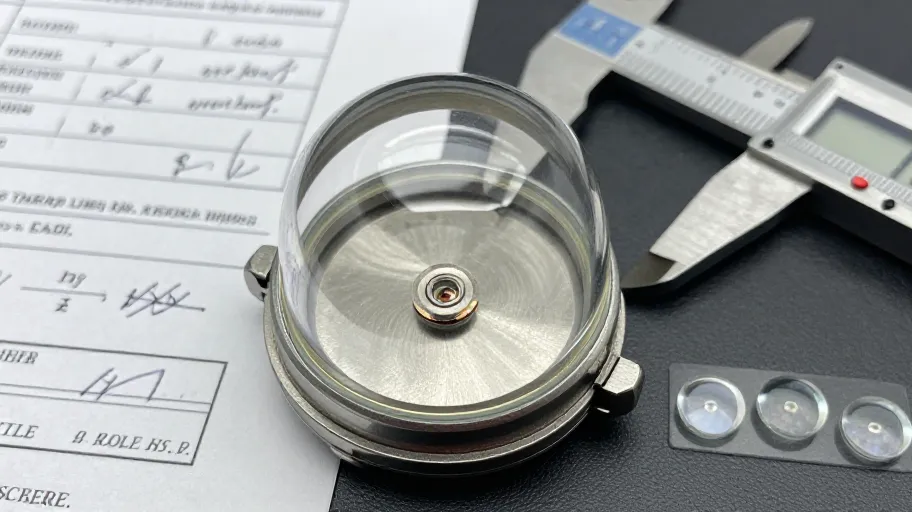
When a B2B buyer asks about domed sapphire crystal heritage watch price, the honest answer is that no single number exists without a specification. Price moves with dome geometry, diameter and thickness, coating stack, edge treatment, gasket-seat fit, batch size and inspection level. Use the SPEC–SAMPLE–SIGN-OFF framework: specify every geometry and treatment variable in writing, sample and measure the part against your case, then sign off with documented acceptance criteria before production. Quotes become comparable only when these variables are fixed.
Why domed sapphire crystal quotations are not comparable by default
A domed crystal for a heritage-style watch is not a catalogue part in most sourcing conversations. Two suppliers quoting "the same" 36 mm dome may be quoting different blank thicknesses, different coating counts, different edge finishes and different inspection regimes. The buyer's job is to remove that ambiguity before asking for price.
That starts with recognising that the dome itself is the largest geometry variable. A double-domed profile, a box crystal with vertical walls and a tall retro dome remove different amounts of material and demand different polishing paths. Coating adds a second layer of decisions: how many anti-reflective layers, applied to which side, and whether any additional surface treatment is specified. Fit adds a third: a crystal seated on a gasket, in a bezel, or pressed into a case each carries their own dimensional requirements that the buyer must define and the supplier must confirm as achievable.
The SPEC–SAMPLE–SIGN-OFF framework
Stage 1 — SPEC: fix the variables before requesting price
Write down, per part:
- Reference geometry: diameter, dome height or radius description, thickness at centre and edge, and whether the profile follows a supplied legacy sample, a drawing, or a scanned profile from an original crystal.
- Edge and seat treatment: edge polish grade, gasket-seat form, and any step or lip.
- Coating stack: number of AR layers, side(s) coated, and any additional surface treatment — each as a separate line item so quotes can be compared line by line.
- Case fit target: which case reference the crystal must fit, and who owns the fit risk if the case drawing is approximate.
- Inspection level: what you will measure on delivery, and what evidence you require from the supplier's own checks.
Ask each supplier to quote against this same document. Where a supplier cannot meet a line item, ask them to state so in writing rather than silently substituting.
Stage 2 — SAMPLE: measure against the case, not the drawing
A sample programme should be documented before it starts. Questions to settle with the supplier in advance — because no sample policy was supplied for this article and terms must be confirmed directly:
- What is the current sample fee policy, and what does it cover?
- How many sample iterations are anticipated before sign-off, and what triggers a re-quote?
- Which dimensional report accompanies the sample, and which instruments produce it?
- If the sample is cut from production tooling or from prototype tooling, which is it — because that changes what the sample proves about future batches?
On receipt, measure the sample in the actual case, under the intended lighting and viewing conditions the watch will face in market. Dome height changes perceived dial colour and reflection behaviour; a dome that measures correctly can still read wrongly on the wrist. Document photographs, measurement records and fit observations in a shared file so both parties are looking at the same evidence.
Stage 3 — SIGN-OFF: approval with written acceptance criteria
Sign-off is a gate, not a courtesy email. Record:
- The approved sample's identity (serial, date, tooling reference if disclosed).
- The acceptance criteria for production parts, expressed as measurable checks you can repeat at goods-in.
- The procedure if a production batch deviates: rework, replacement or requalification, and who decides.
- Ownership of tooling, drawings and coating specifications if production moves or pauses.
Decision table: specification choices and their procurement impact
| Specification choice | Options to compare | What to verify with the supplier | Impact on price and approval |
|---|---|---|---|
| Dome form | Single dome, double dome, box crystal, tall retro dome | Achievable radius per diameter; polishing method per form | Larger material removal and more complex polishing change quoted price and sample count |
| Blank thickness | Thinner aesthetic profile vs thicker section | Minimum thickness they will stand behind structurally | Thinner blanks raise yield questions; ask how yield is handled commercially |
| Coating stack | Uncoated, single-side AR, double-sided AR, additional treatments | Layer count, side, colour signature, adhesion evidence offered | Each layer is a separate process and cost line; require it itemised in the quote |
| Edge and seat | Polished edge, bevelled edge, gasket groove, step lip | Form achievable to your case drawing; fit responsibility split | Fit-critical features drive measurement and requalification conversations |
| Fit basis | Your case drawing vs supplied legacy crystal vs scanned profile | Which reference they will tool from and its acceptance tolerance approach | Vague fit inputs push risk into the approval stage |
| Inspection level | Basic visual check vs dimensional report vs first-article inspection per batch | What documentation accompanies each shipment | Higher evidence levels add cost but protect the sign-off gate |
Translating a heritage profile into a manufacturable specification
Many heritage projects begin with an original crystal rather than a drawing. In that case, agree with the supplier on the conversion method: a measured profile scan, a sectioned reference part, or a dimensional reconstruction. State in the RFQ which reference is authoritative and what happens if the reference and the case drawing disagree. This single paragraph in your brief prevents the most expensive category of dispute — a batch that matches the reference but not the case, or the reverse.
Concrete approval questions before production release
Put these in writing and require written answers:
- Does the quotation cover the exact coating stack, dome form and edge treatment in the attached specification, line by line?
- Which dimensional characteristics will you report with each shipment, and with what measuring equipment?
- What is the agreed deviation procedure if a delivered batch fails our goods-in checks?
- What sample terms apply to this project — fees, iteration count, and shipping responsibility — under the current policy, which we will confirm directly with you?
- Who owns the tooling, drawings and coating specification, and under what conditions?
- What is your current MOQ, lead time and capacity position for this part, quoted as of today rather than assumed from past projects?
- If we change case suppliers mid-project, what requalification do you require?
Frequently asked questions
What drives the price of a domed sapphire crystal for a heritage watch? Dome complexity, blank thickness, diameter, coating stack, edge treatment, fit requirements, batch size and inspection level. Fix these in a written specification and price comparisons become meaningful; without them, quotations measure different parts.
Should I request a double-domed or box profile for a heritage reissue? That is a design decision anchored to the original watch and your case engineering. Ask the supplier which profiles they can produce at your diameter and what each means for sample iterations, then decide with the reference watch on the bench.
How many sample rounds should I plan for? Do not assume a number. Agree in advance what each sample round is intended to prove — geometry, coating appearance, or fit — and what evidence accompanies it. Confirm the supplier's current sample and iteration policy directly, since no policy details were supplied here.
How do I compare suppliers quoting the same dome? Compare the line items, not the totals. If one quote includes a double-sided AR stack with a dimensional report and another includes an uncoated crystal with a visual check, the totals are not comparable. Require both to quote against your specification document.
What should goods-in inspection check on production crystals? The measurable criteria you defined at sign-off: the approved geometry, coating appearance against the approved reference, edge finish, and fit in the actual case. Repeat the same checks used to approve the sample, and record results.
获取采购 Brief — download the procurement brief template with the full specification checklist, approval questions and supplier comparison sheet, and send it to JadeZone Sapphire for a quotation against a fixed specification.
Or start smaller: copy the seven approval questions above into your next supplier email. If you would like them as a one-page pre-order checklist, request it alongside the brief.