
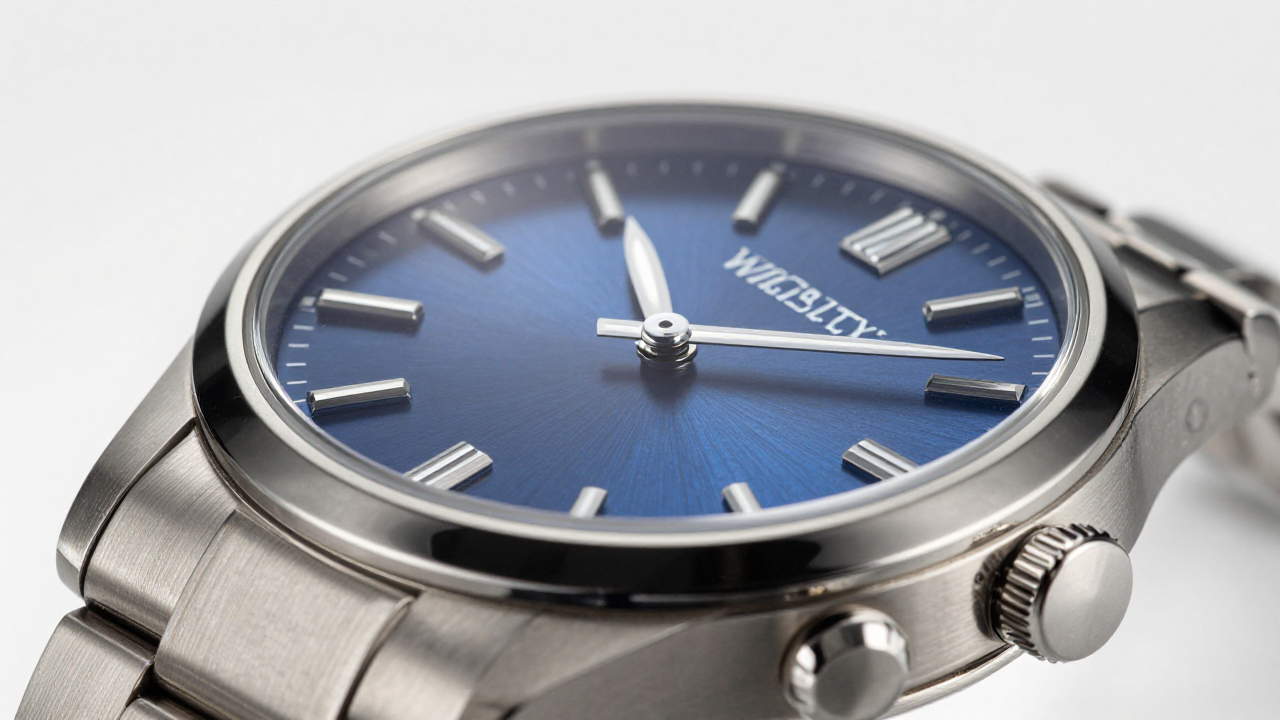
When you buy a sapphire watch crystal, put edge quality first, the optical grade of the blank second, and price last. Chip resistance and clarity get locked in before the price conversation starts.…
Buyers who rank cost first tend to replace the part within eighteen months, and the replacement always costs more than the original did.
What Actually Decides a Sapphire Watch Crystal Purchase
That ordering isn't a philosophy. It comes from reading incoming inspection reports for fifteen years and watching the same failure repeat across a hundred purchase orders.
Why Sapphire Still Owns the Top Slot
Sapphire keeps the top slot because synthetic corundum measures roughly 1,800–2,200 HV on the Vickers scale, about seven times harder than the mineral glass it displaced, and the hardness runs through the entire blank instead of sitting in a surface layer. You cannot polish through it the way you polish through hard-coated mineral glass.
The material is grown, not mined. Most watch blanks come from Kyropoulos-grown boules: a seed dipped into molten alumina near 2,050°C, pulled slowly, then annealed over several days into a crystal 150–200 mm across. Cheaper blanks come out of Verneuil flame-fusion, which is faster and leaves more internal stress and bubble inclusion behind. Both get called "sapphire" on a purchase order. They are not the same product, and the price gap between them is real.
Real limit worth stating plainly: sapphire is hard, not tough. A point impact on a domed edge chips it, and a chipped crystal fails a pressure test the moment you run one. That risk just got bigger. The 2025 faceted-crystal wave that runs from a $648 Vario up to a $143,000 Hublot is built on dozens of cut facets, and every facet intersection is a stress riser. Facets photograph beautifully. They also roughly double your chip exposure.
How We Score a Supplier
We score sapphire suppliers on four dimensions: edge geometry, blank grade, coating stack, and batch traceability. The fourth one eliminates more factories than the first three combined.
Edge Geometry Decides Whether You Get Five Years or Five Months
Edge work is the cheapest line on the quote and the most expensive thing to skip. A finished crystal needs a chamfer of 0.05–0.10 mm that has been polished to remove the subsurface damage left by grinding. Laser-cut and tumbled edges look acceptable at arm's length. Under 10x magnification the micro-chips are obvious, and they are where every field failure begins.
In September 2021, a microbrand out of Fort Worth, Texas, sent us 3,600 crystals from a previous vendor for a second opinion. Incoming inspection at 10x found chipped bevels on 4.1% of the lot. The parts had been laser-cut and tumbled, never polished. Polishing that bevel would have added $0.15–$0.30 per piece. Instead they had a $4 component generating $65 service claims plus shipping both ways.
I assumed for two years that our own return spikes were a coating problem. They were a bevel problem. Fixing the bevel cut our chip-related returns by more than half.
Blank Grade Has Numbers Behind It
A good 1.2 mm polished blank transmits 91–92% in the visible range at 550 nm, with haze under 0.3%. Impurity-driven color matters just as much: some boules carry a faint yellow-green cast that is invisible in a parts tray and painfully visible against a white dial under retail lighting. Optics buyers specify scratch-dig quality using MIL-PRF-13830B. Watch buyers almost never do, which is exactly why your spec sheet says "high clarity" and nothing measurable.
The Coating Stack Is Where the Margin Hides
Anti-reflective coating on sapphire is a dielectric multilayer, usually SiO2/TiO2, four to eight layers. Electron-beam evaporation is the cheap route. Ion-assisted deposition costs 25–40% more per piece and produces a denser film that survives damp heat.
In March 2019, a Chicago assembler showed us a competitor quote of $1.85 against our $3.10 for a 1.2 mm flat crystal with double-side AR. The delta was a 180 nm E-beam stack with no densification step. Nine months later, roughly 500 units came back with a blue haze after a humid summer in Florida — moisture had migrated under the film. The $1.25 saved per piece bought them a recall.
Traceability Sorts the Factories From the Traders
Ask who grew the boule and ask for the Vickers report on the specific lot. Jadezone Optical has cut sapphire in Shenzhen since 2010, and in that time the single fastest way to spot a broker rather than a factory is to request lot-level hardness data. Factories answer in a day. Brokers change the subject.
What Each Price Tier Actually Buys
FOB pricing for sapphire watch crystals in 2026 splits into four working bands: roughly $0.90–$1.80 for commercial-grade flat blanks, $2.20–$4.50 for optical-grade with ion-assisted AR, $5.50–$12.00 for precision ground and domed work, and $18–$40 for select-grade faceted or box-domed parts at 1,000-piece volumes.
Those are factory numbers. Landed cost in the US typically lands 12–18% above FOB once freight, duty, and brokerage are counted, so budget the table accordingly.
Two Things That Never Appear on the Quote
Double-Sided AR Is a Durability Downgrade You Pay Extra For
The AR stack is the softest thing on the entire watch — Mohs 5 to 6 against sapphire's 9. Coat the outside surface and you have put a scratchable film on the one part of the watch that faces every doorframe and desk edge in its life. Outer AR scuffs in months on a daily wearer, and you cannot polish a scuff out of a 300 nm film. You strip it and recoat it, or you live with it.
Our rule: inner-only AR for anything rated to 100 m or above, and for anything a customer wears daily. Full double AR only when "invisible crystal" is the actual selling proposition and the watch lives in a box. Dress watches on a display shelf, fine. Dive watches, no.
"Sapphire Coated" Is Not Sapphire
Mineral glass with a micron-scale aluminum oxide layer shows up in listings phrased as "sapphire crystal glass." Any full crystal priced at $12 retail is coated mineral. Ask for the growth method by name and the answer sorts it out immediately.
One more that hides in plain sight: the quote says 1.2 mm and 1.0 mm ships. A 0.2 mm difference is invisible on a spec sheet, saves the supplier roughly 15% of blank cost, and quietly eats into your case's pressure margin. Measure with a micrometer on receipt. Every time.
Choosing Your Tier
Choose the entry tier if you are building a private-label line under $200 retail and the crystal sells on appearance and price. Accept that the bevel will chip, price the return rate into your margin, and do not pretend otherwise.
Choose the working tier if you are a microbrand or an established brand's sub-$1,000 line and you need the crystal to outlive the warranty without looking cheap. Polished bevels plus ion-assisted AR is where the US independent market actually lives, and it returns more per dollar than anything above or below it.
Choose the precision or select tier if you are shipping a diver past 200 m, a display-back piece where the crystal is part of the design argument, or anything faceted. The gap between a $4 crystal and a $9 crystal is $5 on a $1,200 watch. Skipping that $5 is the single worst line-item decision I watch buyers make, and they make it every quarter.
Frequently Asked Questions
What is the difference between sapphire crystal and sapphire-coated glass?
A sapphire crystal is a solid blank of synthetic corundum with hardness around 1,800–2,200 HV through its full thickness. Sapphire-coated glass is mineral glass carrying a micron-scale aluminum oxide layer; once that film wears through, the softer glass underneath scratches like ordinary mineral glass.
How much does a sapphire watch crystal cost?
Factory pricing for a flat 1.2 mm sapphire blank runs about $0.90–$1.80 at commercial grade and $2.20–$4.50 with an optical-grade blank plus ion-assisted anti-reflective coating, at 1,000-piece volumes. Fitted US retail replacement crystals typically land between $40 and $150 depending on case shape and brand markup.
How long does a sapphire watch crystal last?
Ten to twenty years is realistic for a 1.2 mm optical-grade blank with a polished bevel and inner-only coating. Failure is almost never scratching. It is chipping at the edge from impact, or delamination of an outer anti-reflective coating after two to three years of daily wear.
How do I choose the right thickness?
Match thickness to case diameter and pressure rating. A 1.2 mm blank suits most 30–36 mm flat crystals; step up to 1.3–1.5 mm above 38 mm, or for anything rated past 100 m. Verify delivered thickness with a micrometer, because 1.0 mm substituting for 1.2 mm happens more often than suppliers admit.
Why do some sapphire crystals look blue or purple at an angle?
That tint comes from the anti-reflective coating, not the sapphire. A single-layer film leaves visible color at oblique angles; multi-layer stacks reduce it. The blank itself shows a faint yellow-green cast when impurities are present, which is why serious buyers request the blank's color grade in writing.