
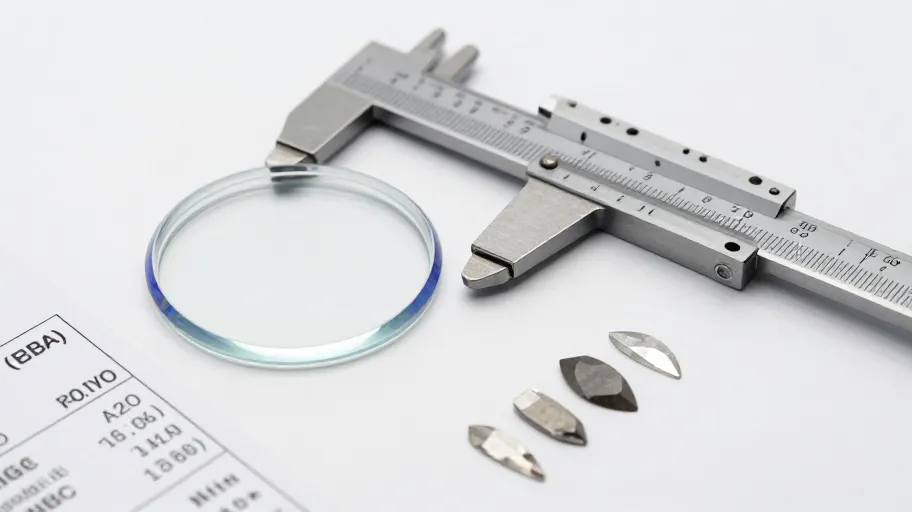
How much does sapphire crystal glass cost? There is no published list price, because a custom sapphire watch crystal is priced per project: the specification, the sampling path and the approval criteria determine the number you are quoted. The practical way to answer the question is to work the Spec–Sample–Approval Loop — define the spec, verify samples against it, and approve only against documented criteria — and let a complete spec produce comparable quotes.
Why no supplier can answer this from a price list
Buyers searching for a cost figure want a number they can budget against. The honest answer is more useful: the question "how much does sapphire crystal glass cost?" resolves into a set of engineering and commercial decisions you control. Two buyers asking for "a sapphire crystal for a 40 mm watch" can receive materially different quotes, because the quote follows the drawing, the coating requirement, the edge treatment, the volume commitment and the approval process — none of which appear in the phrase.
This is not a reason to distrust suppliers. It is a reason to standardise your request. When your specification is complete, quotes become comparable, and the cost conversation becomes evidence-based rather than impression-based.
The Spec–Sample–Approval Loop
Use this framework on every custom sapphire crystal project, whether you are sourcing one development piece or briefing a production run.
| Stage | What you define | What the supplier should confirm | What it changes about cost |
|---|---|---|---|
| Spec | Drawing, dimensions and tolerances, edge and dome profile, coating requirements, material grade expectations, packaging | Whether the drawing is manufacturable as stated, and what clarifications are needed | An incomplete spec produces a quote built on assumptions that later become revision costs |
| Sample | Which sample types you require, what each must demonstrate, acceptance criteria | The current sample policy, any fees, who arranges shipping, and the expected sample timeline | Sample scope and shipping arrangements are project terms you must confirm directly — never assume them |
| Approval | Written acceptance criteria, measurement method, sign-off authority, revision handling | Agreement to the approval criteria before production begins | A documented approval gate prevents dispute-driven cost overruns |
The loop is deliberately boring. Its value is that every unknown that could surprise your budget is converted into a written question before money moves.
The specification elements that drive quote variance
Before asking any supplier how much sapphire crystal glass costs, complete this part of your own homework. Bring the following to the table:
- Geometry. Diameter, thickness profile, dome height or flatness, and edge style. Complex profiles demand more from manufacturing and from sampling.
- Tolerances. The tighter the tolerance on any dimension, the more the drawing constrains the process. State the tolerance your movement and case actually require rather than defaulting to the tightest number on the sheet.
- Coatings. Anti-reflective treatment on one side, both sides, or none. Coating scope changes both the quote and the acceptance criteria you will need at approval.
- Edge and cosmetic criteria. Define what counts as an acceptable cosmetic condition, and where. Vague cosmetic standards are a frequent source of friction at approval.
- Volume structure. Separate your development quantity from your production intent. Suppliers quote differently against a confirmed programme than against an unquantified enquiry.
- Documentation. State what records you need: drawings, measurement reports, and the sign-off trail for the approved sample.
The exact influence of each element on price is project-specific. Any figure you hear before these six items are fixed is provisional.
Samples: what to verify, and the questions to ask
A sample is only worth what it proves. Treat sampling as a verification exercise, not a courtesy.
Questions to put directly to any supplier before sampling begins:
- What is your current sample policy for a project of this description, including any fees? (Ask; do not assume.)
- Who arranges and pays for sample shipping, and under what terms? (Confirm current policy in writing.)
- Which measurements will you report against my drawing, and with what method?
- What happens if the first sample fails my acceptance criteria — what is the revision process?
- Will the production crystal be made to the same specification basis as the approved sample, and how will that be documented?
- What is your current quotation validity, and what could change it?
A standardised RFQ checklist
Use this checklist to make every enquiry comparable. Tick each line before you send the brief.
- Dimensioned drawing attached, with tolerances stated per dimension
- Dome/flat profile and edge style specified
- Coating requirement stated (none / single-side / both sides) with acceptance criteria
- Cosmetic acceptance standard written down, with zones defined
- Development quantity and production intent stated separately
- Documentation requirements listed (measurement reports, approval records)
- The six sample questions above sent verbatim to each supplier
- Approval criteria agreed in writing before any production commitment
- Quotes collected on the same specification basis, so variances are attributable to the supplier, not the brief
A brief that passes this checklist will attract more accurate quotes and shorten the path to approval.
Frequently asked questions
Can I get a rough cost for a sapphire crystal without a full drawing? A supplier can only give a provisional indication without a drawing, and you should treat any such figure as non-binding and subject to change once the specification is fixed. If you need a budget range early, say so explicitly and ask the supplier to state the assumptions behind any indicative figure.
Why do quotes for the same-looking crystal differ between suppliers? Because "same-looking" is not "same-specified". Differences in coating scope, tolerance, cosmetic criteria, sample terms and volume assumptions produce different quotes. Reissue the RFQ on an identical specification basis and the variance becomes interpretable.
What should I check when a sapphire crystal sample arrives? Measure against your drawing using an agreed method, inspect cosmetics against your written zones, and evaluate any coating under lighting conditions you have defined in advance. Record results against the acceptance criteria you set at the spec stage — an undocumented sample proves nothing at approval time.
Do I have to commit to production volume before sampling? That is a commercial term to confirm with each supplier. State your development quantity and production intent separately in the brief and ask each supplier to describe their current policy for moving from sampling to production.
Work with JadeZone Sapphire
JadeZone Sapphire is a Shenzhen and Hong Kong based B2B manufacturer of custom sapphire watch crystals and precision sapphire components, working with watch brands, product developers and watchmakers on OEM projects.
Get a procurement brief. Send us your drawing, quantity structure and coating requirement, and we will respond with the questions, clarifications and confirmation points your project needs before any number is quoted. Contact JadeZone Sapphire to request your procurement brief.
Before you contact any supplier — including us — work through the checklist above. It costs nothing, takes an hour, and it is the single biggest factor in getting a quote you can actually compare and approve.