
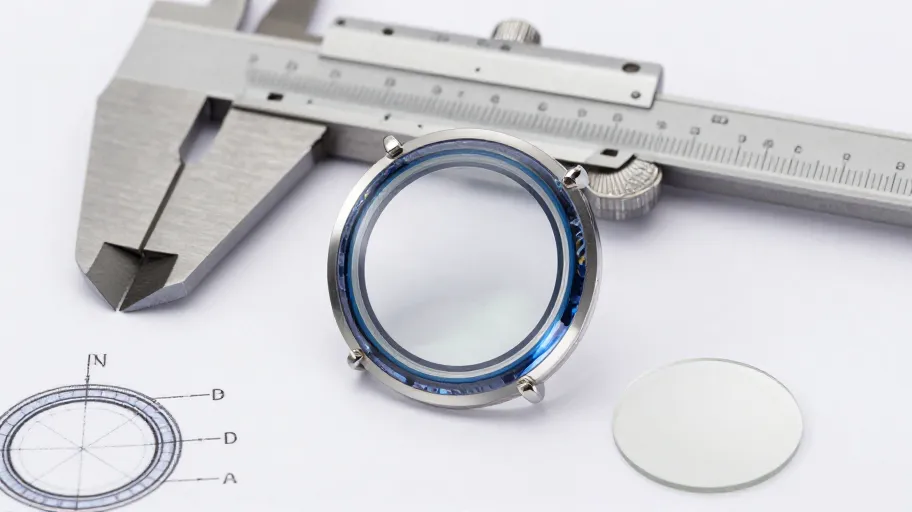
A sapphire crystal is not a commodity part with one market rate. Two quotations for "a domed sapphire crystal" can describe two very different deliverables: one may assume a flat polished edge and a single-layer coating; the other may assume a stepped edge, a double-domed profile, multilayer anti-reflective treatment on one or both sides and full dimensional inspection against the drawing. Neither quote is wrong; they are answering different questions.
For a sourcing manager, this has a practical consequence: any price comparison done before the specification is fixed is unreliable. The disciplined approach is to make every commercial assumption explicit — in the drawing, in the enquiry and in the quotation — so that sapphire watch crystal price differences can be read as genuine capability or efficiency differences rather than hidden scope differences.
This is also where a manufacturer such as JadeZone Sapphire, working with watch brands and component buyers from its Shenzhen and Hong Kong bases, adds value early: a supplier who reviews your drawing and returns questions before quoting is reducing your revision risk, not slowing you down. Judge that behaviour in the enquiry stage; it predicts the approval stage.
The Spec–Sample–Approval Loop
The framework used throughout this guide has three gates, and each one exists to prevent a specific kind of failure:
- Spec gate. Freeze the drawing and the specification assumptions before requesting prices. Failure prevented: quotations that cannot be compared.
- Sample gate. Request samples built against the approved drawing, and agree in advance what the sample must demonstrate. Failure prevented: samples that look fine but prove nothing about mass production.
- Approval gate. Sign off the sample against written acceptance criteria before production release. Failure prevented: disputes about what "matching the sample" means.
Run the loop once per project, and re-run the spec gate whenever the drawing changes — even a minor thickness or edge change can alter material yield, coating behaviour and inspection method, and therefore the final sapphire watch crystal price.
Decision table: specification lines that shape your quotation
Use this table when preparing an enquiry or comparing quotes. For each line, record what each supplier has assumed; differences here explain most price gaps.
| Specification line | Why it moves price | Question to put to each supplier |
|---|---|---|
| Shape and profile (flat, single-domed, double-domed, box, stepped) | Complexity affects grinding, polishing time and yield | "What in my drawing drives your process cost most, and is there a spec-neutral alternative?" |
| Diameter, thickness and tolerances | Tighter requirements can change tooling and inspection | "Which tolerances in my drawing are the expensive ones, and which can I relax without affecting fit?" |
| Edge treatment (polished, ground, coated edge) | Edge finishing is a distinct process step | "Is edge finishing included in the quoted scope? Please state it in writing." |
| Coating / AR treatment (single or double side, layer count) | Coating adds process steps and testing needs | "What coating specification are you quoting against, and how will conformance be demonstrated?" |
| Printing or date-window features | Adds alignment and inspection steps | "What artwork and registration requirements do you need from me?" |
| Material grade and clarity requirements | Different requirements may affect sourcing and inspection | "What material specification are you quoting, and what documentation accompanies it?" |
| Inspection and acceptance method | The verification level must be matched to the risk | "What inspection will you perform, and what criteria will you apply at the approval gate?" |
One caution: never judge a quotation on the price line alone. A lower figure quoted against thinner assumptions is not a discount; it is a smaller deliverable.
From drawing to sample: what to send and what to ask
The sample gate is where most projects either accelerate or stall. Before requesting a sample, prepare the following and send it with the enquiry:
- A dimensioned drawing with tolerances stated, or a confirmed technical reference
- The coating specification and which surfaces it applies to
- Any printing artwork, alignment references and case-fit information
- The crystal's mounting context: bezel, gasket, case construction
- Your intended acceptance criteria, even in draft form
Then ask the supplier a short, direct set of questions before samples are produced:
- "What will this sample round demonstrate, and what will it not?"
- "What is your current sample policy for a project of this scope, including any fees, and who arranges shipping? Please confirm in writing."
- "How will sample dimensions be verified, and what report or documentation comes with the samples?"
- "What changes between the sample process and production, and where could results differ?"
- "What information do you need from me to avoid a second sample round?"
The last question matters more than it looks. Each extra round consumes calendar time and can carry fresh cost, so a supplier who tells you what they need upfront is protecting your schedule as well as theirs.
Sample approval: lock the gate in writing
Do not approve a sample from a photograph or a verbal report. A sample approval should be a document, and it should exist before the sample does. Agree with your supplier:
- The approved drawing revision number that governs the project
- The acceptance criteria for fit, appearance, coating and any printing, expressed as measurable requirements wherever possible
- The inspection method used to verify those criteria, and who performs it
- What documentation accompanies the approved sample
- The change-control rule: no drawing or specification change without a re-quoted scope and a fresh approval
Written approval protects both parties. If production later raises questions, the reference point is a signed document, not a memory of a phone call.
Like-for-like quotation checklist
Before you compare prices from two or more suppliers, confirm each quotation states:
- The drawing revision it is quoted against
- Shape, profile, diameter, thickness and each stated tolerance
- Edge treatment scope, in words, not shorthand
- Coating specification, surfaces covered and any conformance verification
- Printing scope and artwork requirements
- Material specification and accompanying documentation
- Current sample policy, including any fees and shipping arrangements — confirmed directly with the supplier in writing
- The inspection and acceptance criteria applied at the approval gate
- What is explicitly excluded from the quoted scope
If any line is blank, ask for it to be filled before you compare. A quotation you cannot read line-by-line is a quotation you cannot hold anyone to.
FAQ
Q: What most affects sapphire watch crystal price on a new project? The specification itself — shape complexity, tolerances, edge treatment, coating stack and inspection level — plus the scope each supplier assumes when quoting. This is why the Spec–Sample–Approval Loop starts with freezing the drawing before comparing prices, and why every assumption should be written into the enquiry.
Q: Can I get sapphire watch crystal prices without a finished drawing? You can get an indicative discussion, but treat any figure given without a drawing and stated tolerances as directional only. To make a quote binding and comparable, suppliers need the drawing revision, coating specification and acceptance criteria. Sending those first shortens the whole cycle.
Q: How many sample rounds should I plan for? That depends on your drawing quality, your case-fit certainty and how clearly acceptance criteria were agreed in advance — so it is a question to ask each supplier for your specific project rather than a number to assume. Ask what they need from you to keep the round count to one, and put the answer in your project plan.
Q: What should a sample approval document contain? At minimum: the governing drawing revision, the acceptance criteria for fit, appearance and coating, the inspection method, the documentation provided with the sample, and a change-control rule. If your supplier proposes additions — for example project-specific tests — that is worth capturing too.
Q: Do I have to re-quote if I change one dimension? Treat any drawing change as a trigger for the spec gate again. A thickness or edge change can alter yield, coating behaviour and inspection, so the honest route is a re-confirmed scope before proceeding. Ask the supplier directly which changes are commercially material and which are not, for your project.
Work with JadeZone Sapphire
If you are preparing a custom or OEM sapphire crystal project and want a quotation you can actually compare, send us your drawing and project scope. 获取采购 Brief — our buyer's brief template walks you through the specification lines above so your enquiry is complete on the first pass and your samples answer the right questions.
Not ready to enquire yet? Download the low-friction version: a one-page pre-enquiry checklist covering the drawing, coating, approval and policy questions every buyer should confirm with any supplier — JadeZone Sapphire included — before comparing sapphire watch crystal price.