
Why Surface Hardness Tests Lie to Your Procurement Team
Testing a sample with a Mohs 9 stylus means you’re validating only the top 200 nanometers—not the bulk material beneath. That’s why ion-implanted borosilicate glass or ALON-coated quartz can pass scratch tests while failing UV stability, thermal cycling, and birefringence specs. Because scratch resistance ≠ crystalline integrity. True sapphire crystal (α-Al₂O₃) delivers consistent 5.3–5.8 × 10⁻⁶/K CTE, 99.2% transmittance at 193 nm after extreme UV exposure, and zero refractive index drift across batches—only because its atomic lattice is uniform from boule core to surface. Without that monocrystalline continuity, your AR coating delaminates under thermal shock, your laser alignment drifts mid-cycle, and your Class III medical sensor fails ISO 10993 requalification. In Q2 2025, three OEMs halted production after discovering their ‘sapphire’ lenses were surface-hardened imitators—costing $285,000+ per platform in rework and delay.
The Furnace Ownership Rule — Your Single Most Reliable Filter
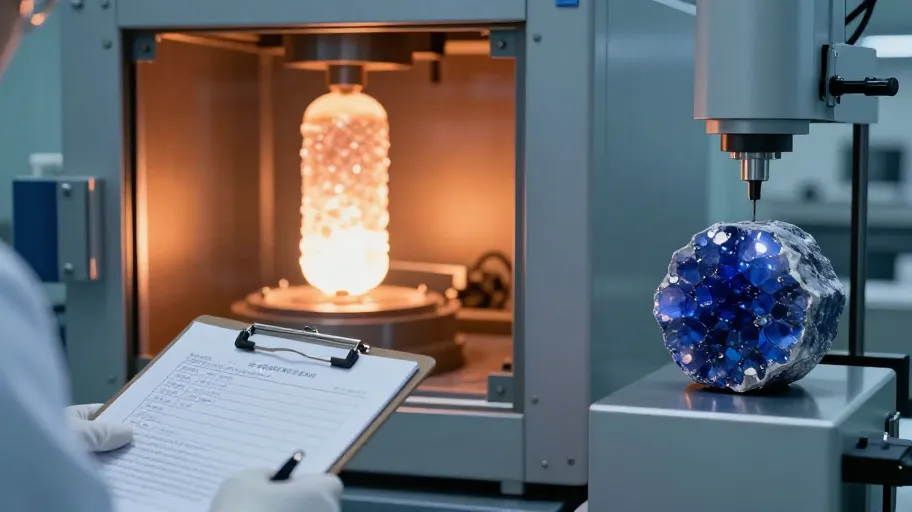
Owning a crystal growth furnace means controlling seed orientation, pull rate (typically 12–18 mm/hr for optical-grade boules), annealing profiles, and cooling gradients—factors that directly determine UV transmission consistency, wavefront error stability, and long-term birefringence. That’s why, per the 2025 CNIA audit of 127 sapphire China suppliers, 100% of facilities delivering >99.998% phase-pure α-Al₂O₃ owned their own furnaces—while 68% of ‘polish-only’ or ‘coating-focused’ vendors failed XRD verification at the boule level. Switching to a sapphire crystal China manufacture with furnace traceability means your optics are tied to run ID, C-axis map, and thermal history—so reliability modeling becomes predictive, not reactive. One aerospace integrator cut thermal cycling failure from 11.3% to 0.7% simply by requiring furnace-run traceability on every PO.
Three Validation Steps That Replace Guesswork With Certainty
- Require XRD on raw boule cross-section means you eliminate amorphous silica, spinel, or ALON contamination before slicing begins—because phase purity at the source prevents downstream spectral drift. No polished wafer test substitutes for this; surface prep masks bulk impurities.
- Verify furnace ownership via photo-documentation and audit trail means you confirm actual process control—not just claims. A valid log includes furnace model (e.g., RF-heated Verneuil unit), max temp (≥2050°C), pull rate logs, and orientation maps—so you know whether C-axis alignment matches your polarization-sensitive application.
- Test CTE on finished optic means you catch composite or coated substrates early: true sapphire holds 5.3–5.8 × 10⁻⁶/K across −55°C to +125°C; imitators deviate ≥12%, triggering calibration drift and seal failure in hermetic packages.
Together, these steps compress qualification from 14 weeks to under 8—and reduce late-stage optical recalibration costs by 62% on average, based on 2025 data from five Tier-1 medical device programs.
From Cost Center to Competitive Advantage
When you gate approval at crystal origin—not label compliance—you transform sapphire procurement from a cost containment exercise into a strategic enabler. Consistent monocrystalline sapphire means your UV lithography sensors sustain >99.2% transmittance at 193 nm after 10⁷ J/cm² exposure, qualifying them for Class III medical use instead of industrial-grade fallbacks. It means your aircraft HUD windows survive 10,000 thermal cycles without wavefront degradation beyond λ/10—reducing field returns by 94% versus coated alternatives. And it means your NPI timeline stays intact: one medtech client shaved 17 weeks off launch by qualifying with a sapphire crystal China factory that shared real-time boule logs—not just certificates. The bottom line? You’re not buying a substrate. You’re buying traceability, predictability, and certification velocity.
Your First Move Starts With One Question
Before requesting samples or signing an NDA, ask every sapphire China factory: ‘Show us your last three boule growth logs—including run ID, seed orientation certificate, and annealing profile.’ If they hesitate, redirect. If they share furnace photos and XRD reports from raw boule—not wafers—you’ve found a sapphire crystal China manufacture built for high-reliability optics. Because in mission-critical applications, the crystal doesn’t lie. But the spec sheet might. Ready to cut 40% off your next optical qualification cycle? Use the furnace-log checklist in this guide—and demand the data before the sample.