
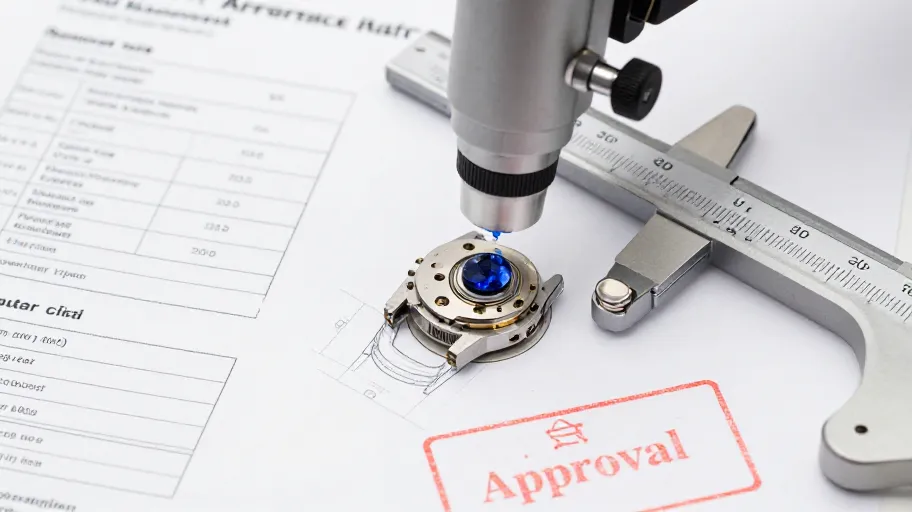
When a buyer asks how much is a sapphire crystal replacement?, the honest answer is that the price is determined less by the crystal itself than by the specification, sampling and approval process around it. A defined drawing, agreed acceptance criteria and a documented sample stage are what turn a vague enquiry into a comparable, defensible quotation — and they are the parts of the project you control.
Why the question has no single number
Sapphire crystal is a manufactured component, not a catalogue item. Two enquiries for "a sapphire crystal" can produce quotations that differ substantially because the specifications differ. The cost drivers that sit on your side of the table include:
- Geometry. A flat round crystal, a domed crystal, a box crystal and a crystal with cut-outs or stepped edges each demand different manufacturing routes.
- Dimensions and edge treatment. Diameter, thickness profile, edge finish and whether the part must seat in a gasket, be glued or be retained by a bezel all affect the process.
- Coatings. Anti-reflective coating on one side, both sides, or none is a specification decision, not an automatic feature.
- Printing and decoration. Logos, date-window rings or tinted elements add process steps that must be specified before quotation.
- Assembly context. Whether the crystal replaces an existing part on a known reference or supports a new case development changes what evidence the supplier needs from you.
None of these can be priced responsibly from a one-line enquiry. This is why the useful version of the question is not "what does a replacement cost?" but "what specification will produce a cost I can defend?"
The Spec–Sample–Approval Loop
JadeZone Sapphire recommends structuring every custom crystal project as a loop with three gates. It keeps quotations comparable and prevents the most expensive failure mode in component sourcing: approving a part against criteria nobody wrote down.
Gate 1 — Spec. Before requesting pricing, document the drawing or technical sketch, material requirement (synthetic sapphire), coating requirement, edge and mounting method, and any printing. State what you do not know — a supplier can flag specification gaps faster than you can research them.
Gate 2 — Sample. Request sample parts made to the documented spec, not "representative" parts. Confirm in writing who bears sample and shipping costs and what the current sample policy is; these terms are project-specific and must be verified directly with the supplier before you commit.
Gate 3 — Approval. Agree, before production, how the part will be judged: which dimensions are checked, against which drawing, by what method, and what happens if a batch does not conform. Put this in the purchase documentation, not in a verbal agreement.
Decision table: specification choices and their effect on cost and approval risk
| Specification decision | Effect on quotation | Effect on approval risk | Question to put in your Brief |
|---|---|---|---|
| Flat round vs. domed/box geometry | Domed and stepped geometries require more process steps | Higher; more surfaces to inspect | "Which drawing views do you need to quote accurately?" |
| AR coating one side vs. both sides | Coating adds a process step per side | Coating appearance is subjective — define acceptance | "How will coating quality be inspected and agreed?" |
| Printing / logos | Additional process and artwork requirements | Misregistration disputes if not documented | "What artwork format do you require from us?" |
| Tolerance on critical dimensions | Tighter control narrows the process window | Lower if tolerances are realistic for the design | "Which dimensions do you consider critical on this drawing?" |
| Replacement of an existing part vs. new design | Replacement may allow quoting from a supplied sample or case | Lower — the fit is already known | "Can you work from our existing crystal or case reference?" |
Use the table as an enquiry template, not as a statement of what any supplier's policy is. Each cell ends in a question because the answers belong to the supplier, not to an article.
The sample stage: questions before you commit
The sample gate is where budgets are protected. Before requesting samples, ask the supplier directly and get the answers in writing:
- What does the current sample policy cover for a part made to our drawing?
- Who arranges and pays for shipping of sample parts, and under what terms?
- How are sample parts documented — are they made on the same process route intended for production?
- What is the turnaround expectation for a sample against our specification? (Ask; do not assume a number.)
- If the sample reveals a design issue, what is the process for revising the drawing and re-sampling?
A supplier that answers these without hesitation is a supplier you can build a specification with. Vagueness here is a signal to slow down, not a reason to walk away.
The approval stage: concrete approval questions
Approval is documentation, not impression. Before any production order, confirm:
- Inspection scope. Which dimensions on the drawing are inspected on every part, and which by sampling?
- Reference standard. Is the approved sample the acceptance reference, and is it retained and dated by both parties?
- Appearance criteria. For coatings and printing, what visual standard applies, and under what lighting or viewing conditions?
- Non-conformance route. If a delivered batch fails the agreed criteria, what is the documented next step?
Write the answers into the purchase order or a short technical annex. It costs an hour and prevents the argument that costs a quarter.
Checklist: ready to request a comparable quotation
- Drawing or dimensioned sketch completed, including tolerances you actually need
- Mounting method stated (gasket, adhesive, bezel retention)
- Coating requirement specified (none / one side / both sides)
- Printing and artwork files prepared, if applicable
- Sample policy, shipping responsibility and turnaround confirmed in writing
- Acceptance criteria and reference-sample rule agreed before ordering
If two or more boxes are unchecked, resolve them first — an incomplete spec produces a quotation you cannot compare.
Request your procurement Brief
JadeZone Sapphire manufactures custom sapphire watch crystals and precision sapphire components for brands, OEM programmes and watchmakers from its Shenzhen and Hong Kong base. Request the procurement Brief: send your drawing or part description and the open questions above, and receive a structured quotation response plus written answers on specification, sampling and approval. [Contact JadeZone Sapphire to get your procurement Brief →]
Low-friction alternative: download the one-page Spec–Sample–Approval checklist and use it internally before you contact any supplier.
FAQ
1. Can I get a price for a sapphire crystal replacement without a drawing?
2. Do I have to pay for samples? Sample terms differ by supplier, project complexity and policy at the time. Ask JadeZone Sapphire directly what the current policy covers for a part made to your drawing, including shipping responsibility, and get it confirmed in writing before ordering.
3. How long does the spec-to-approval process take? It depends on geometry, coatings, printing and how many sample iterations your design needs. Rather than assuming a timeline, ask the supplier for a stage-by-stage schedule against your specific drawing once the spec is documented.
4. What if my design needs a crystal that matches an existing watch? Supplied references — an existing crystal, a case drawing or the watch itself — reduce ambiguity because the fit is already proven. State in your Brief that this is a replacement part and ask what documentation the supplier needs from you.
5. How do I compare quotations from different sapphire crystal manufacturers? Insist every supplier quotes against the same drawing, the same coating spec and the same acceptance criteria. A cheaper quotation against a weaker specification is not a saving; the Spec–Sample–Approval Loop exists precisely to make comparison honest.