
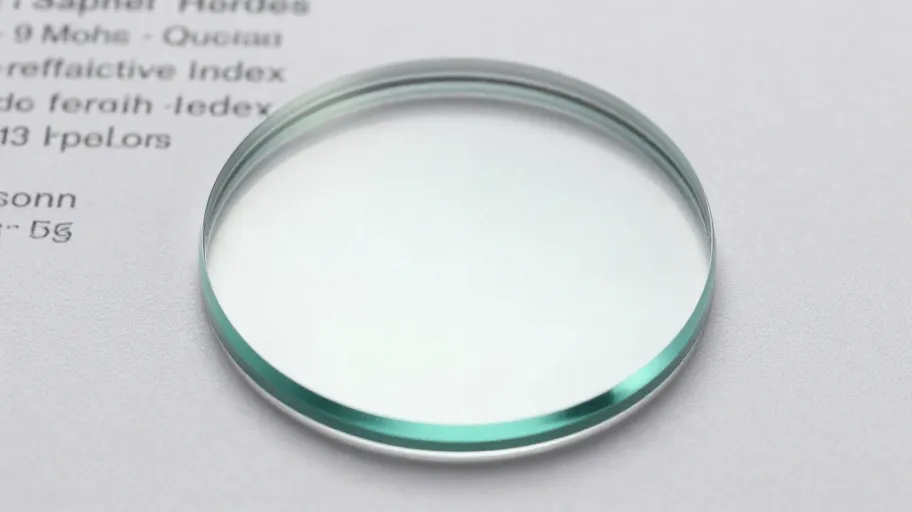
Short answer: Sapphire glass is widely regarded as the premium choice for watch crystals because of its exceptional scratch resistance and optical clarity, but "good" ultimately depends on your specification. For a B2B buyer, sapphire is only as good as the crystal geometry, coating, edge finishing and documentation you define, sample, verify and approve before production.
Why a sourcing manager should ask this question differently
Consumers ask "is sapphire glass on a watch good?" to justify a purchase. You ask it to justify a specification. The difference matters. A consumer wants reassurance; you need to know whether sapphire solves your product's actual problems — scratch complaints, display clarity under a specific dial colour, case integration, serviceability — and whether those benefits survive the transition from a polished sample to a repeatable production batch.
The honest professional answer is: sapphire (synthetic corundum) is an excellent crystal material for most watch programmes, but the value is realised only through disciplined sourcing. Two suppliers can both offer "sapphire crystal" and deliver noticeably different results in edge treatment, anti-reflective coating quality, dimensional consistency and documentation. The material is not the variable. The process around the material is.
That is why this guide does not promise outcomes. Instead it gives you a repeatable method — the 4-Step Sapphire Approval Loop — for turning "sapphire is good" into "this sapphire crystal, from this source, with this documentation, is approved for our programme."
The 4-Step Sapphire Approval Loop
Step 1 — Define. Write down what "good" means for this specific reference before contacting anyone:
- Crystal shape: flat, domed, boxed, or custom contour.
- Dimensions and tolerances you intend to hold — express these as your requirements and confirm feasibility with the supplier rather than assuming.
- Coating: single-side AR, double-side AR, or none, and where the coating sits.
- Edge and gasket interface: how the crystal seats in the case.
- Optical expectations: clarity over your dial, distortion limits at the edge, behaviour under studio lighting for product photography.
- Documentation you require at approval and at each production release.
Step 2 — Sample. Request samples built to your definition, not to the supplier's default. Evaluate them against written criteria (see the checklist below), on your case, on your dial, under your lighting conditions. A sample evaluated in isolation tells you far less than a sample evaluated in context.
Step 3 — Document. Record what the approved sample is: drawings, coating specification, edge treatment, inspection criteria and agreed acceptance limits. This documented "golden sample" becomes the reference against which future batches are compared. Without it, "the same as before" is an argument, not a standard.
Step 4 — Approve. Give written approval only when the sample passes your criteria, and state that production acceptance is tied to the documented golden sample. Re-confirm at the first production release, not just at the sample stage.
Repeat the loop for each new reference or specification change. The loop is deliberately unglamorous — its purpose is to remove ambiguity before money and time are committed.
Sapphire vs alternatives: a decision table
Use this table to frame the internal conversation before you approach a supplier. It compares material characteristics at a specification level; confirm performance details for your exact design directly with your supplier.
| Decision factor | Sapphire crystal | Mineral glass | Acrylic | What to confirm with the supplier |
|---|---|---|---|---|
| Scratch resistance | Very high (synthetic corundum is extremely hard) | Moderate | Low | Hardness treatment claims, if any, and how they are evidenced |
| Optical clarity | Excellent, especially with AR coating | Good | Good | AR coating type, sides coated, how coating quality is inspected |
| Design freedom | High — doming, boxing, custom contours are possible | Limited doming | High | Feasibility of your specific geometry and the resulting spec |
| Breakage behaviour | Hard but can fracture under sharp impact | More tolerant of some impacts | Most impact-tolerant | Impact expectations for your use case and any relevant test approach |
| Positioning | Premium positioning | Mid-market | Vintage/entry aesthetics | Which material matches your brand tier and price point |
| Service and repair | Replaceable; part matching matters | Widely serviceable | Easily polished or replaced | Spare-part availability and reordering process for your reference |
If your brand positions above entry level and scratch complaints are a known service burden, sapphire is the material most buyers in this position specify. If a vintage aesthetic or extreme impact tolerance dominates, the decision may differ. Either way, the material choice is the easy half; the approval process is where quality is actually secured.
Approval questions to put to any supplier
Bring these questions to your first serious conversation. They convert vague confidence into verifiable commitments — and every answer should end up in writing.
On the crystal itself
- Can you produce the exact geometry, including edge profile and any dome or box section, to the tolerances we define? Please confirm feasibility and any constraints before sampling.
- What inspection is performed on dimensional accuracy and optical quality, and what documentation accompanies each batch?
- How is the AR coating specified, applied and inspected, and how do we verify coating quality on received batches?
On samples and approval
- What is the current sample process, including any sample policy and who bears which costs? Please confirm your current policy directly — we will plan around your written terms.
- Will production units be compared against a retained golden sample, and how are discrepancies handled?
On the commercial relationship
- What is the current MOQ and quotation basis for our reference and our volumes? Please quote in writing for this specific project.
- What is the current lead time for our specification and order size, and how is it communicated and confirmed?
- What are the current shipping terms, packaging method and insurance arrangements? Please confirm the applicable terms for our destination.
None of these questions has a universal answer, and a supplier who answers them precisely, in writing, is demonstrating the process discipline that the approval loop depends on. Treat vagueness at this stage as a data point.
Sample evaluation checklist
Evaluate every sapphire crystal sample against this checklist before approval. Work through it with the crystal mounted in your case wherever possible.
- Dimensions measured against your drawing at the defined tolerance points
- Seat and gasket interface verified in the actual case, not a jig alone
- Edge finishing inspected under magnification for chips, polishing quality and consistency
- Optical check: dial colour fidelity, distortion at the periphery, behaviour under your studio lighting
- AR coating evaluated at multiple viewing angles for residual reflection and colour tint
- Coating durability discussed and its verification method agreed with the supplier
- Surface quality inspected for inclusions or blemishes per your agreed criteria
- All findings documented, with the golden sample retained and labelled
- Written approval issued, explicitly referencing the documented specification
If any line cannot be completed because the supplier has not provided the relevant information, that is a finding in itself — resolve it before approving anything.
From approved sample to production discipline
The most common professional disappointment in crystal sourcing is not a bad sample. It is a production batch that quietly differs from the sample that won approval. Your defence is the documentation layer of the approval loop: drawings that fix geometry, a coating specification that fixes optics, inspection criteria that fix acceptance, and a retained golden sample that fixes the physical reference.
Make golden-sample comparison a condition of every production release, and re-run a reduced version of the checklist on first-article units from each new batch or specification change. When you change suppliers, case design or coating, restart the loop from Step 1 rather than assuming prior approvals carry over.
FAQ
Is sapphire glass on a watch good enough for a mid-range brand, or only for premium positioning? Sapphire's scratch resistance and clarity make it a strong specification across many tiers, and buyers increasingly encounter it beyond pure luxury segments. Whether it fits your mid-range programme depends on your cost structure, positioning and service strategy — obtain written quotations for your reference and compare the total programme cost, not the unit price alone.
Does an AR coating change how I should evaluate a sapphire crystal? Yes. A coating introduces its own quality variables — residual reflection, tint, durability — that must be defined and inspected separately from the crystal itself. Specify which sides are coated, agree how coating quality will be checked, and evaluate samples at multiple angles and lighting conditions before approval.
What should I send a supplier to get an accurate quotation for custom crystals? Provide your drawings or a physical reference, target dimensions and tolerances, crystal type (flat, domed, boxed), coating requirement, intended volumes and destination market. The more complete the input, the more precise the quotation — and always ask the supplier to confirm their current MOQ, lead time and commercial terms in writing for that specific project.
How do I make sure production matches the sample I approved? Use the golden-sample discipline described above: document the approved specification, retain a labelled reference sample, require batch comparison against it, and tie written acceptance to the documented criteria rather than to memory or verbal agreement.
Can a supplier guarantee my sapphire crystals will never scratch or break? No responsible supplier should promise absolute performance, and you should be wary of any that do. What you can require is a defined specification, an agreed verification method, and documented inspection. Confirm directly with your supplier how material and coating performance will be evidenced for your design.
Ready to define your specification?
获取采购 Brief. Send us your drawings, reference sample or requirements list, and JadeZone Sapphire will respond with a structured procurement brief covering feasibility questions, the sampling path, and the commercial terms you need to confirm for your specific project — so your approval loop starts on documented ground, not assumptions.
Before you request samples: quick checklist
- Crystal geometry, tolerances and coating requirement written down
- Case and dial available for in-context sample evaluation
- Acceptance criteria agreed internally before sampling
- Golden-sample and documentation requirements stated to the supplier
- MOQ, lead time, sample policy and shipping terms requested in writing
- Budget owner identified for the sample and approval stage
获取采购 Brief and put the 4-Step Sapphire Approval Loop to work on your next reference.