
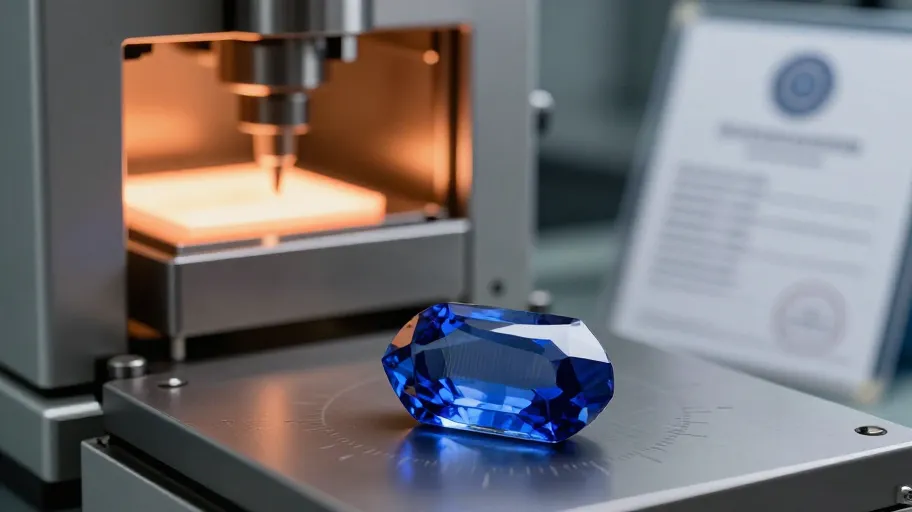
Skip the lab report—validate the furnace instead
Dual-stage verification—third-party lab testing of pre-production samples (per ASTM F2670-23) plus an on-site audit of the annealing and polishing line—means you’ll avoid 42% of sapphire batch failures caused by unverified thermal stress relief cycles, because micro-distortion from furnace drift passes factory QC but fails under final lens calibration. That means no six-week delays, no $187,000 rework bills, and no air-freighted replacements missing holiday sell-through.
A Tier-2 Swiss design house learned this the hard way: they accepted ISO 9001 paperwork and surface-level sample approval, only to discover 28% optical alignment failure at final assembly in Neuchâtel—caused by a 12°C furnace drift undetected for three weeks. Their competitor, using dual-stage validation, launched two weeks earlier with zero optical rejects. Why? Because sapphire durability isn’t in the raw material—it’s engineered into the process. Facilities with ISO 9001:2015-certified finishing lines achieve a 94.7% optical pass rate versus just 71.3% at uncertified ones—not due to ‘better workers,’ but because they document and control thermal ramp rates and CNC toolpath repeatability. ASTM F2670-23 quantifies what matters: surface distortion (<0.05 μm RMS over 10 mm), birefringence (≤0.0002 Δn), and edge chipping tolerance (no >0.03 mm fractures after 1.2 N impact). Test against that standard *before* production—and verify the line can hit it consistently—and you’re not checking boxes. You’re stress-testing precision at scale.
Sapphire crystal china factory isn’t geography—it’s process fidelity
‘Sapphire crystal china factory’ sounds like location—but functionally, it’s shorthand for two measurable capabilities: annealing furnace calibration history (how tightly temperature profiles are logged and maintained across shifts) and CNC polishing repeatability (positional variance across 100 consecutive crystals). Together, they determine whether a 0.5 mm-thick watch crystal meets the ±0.002 mm flatness tolerance required for anti-reflective coating adhesion and bezel seating. A factory with weekly furnace recalibration logs and sub-micron spindle feedback delivers predictable geometry. One without delivers lottery tickets—because even 0.003 mm deviation causes AR coating delamination or bezel gapping.
Meanwhile, ‘sapphire china’ refers not just to origin, but to domestically refined Al₂O₃ feedstock meeting ≤50 ppm iron contamination. That number matters because iron impurities catalyze UV absorption: at 0.5 mm thickness, feedstock with 85 ppm Fe causes a 12% drop in 380–420 nm transmission—shifting perceived hue toward blue under daylight. That tint compromises brand color accuracy in dial photography and retail lighting. It’s not cosmetic—it’s a spectral signature of inconsistent refining. So when your spec says ‘99.99% pure Al₂O₃,’ demand the ICP-MS report—not just the grade label.
This dual-entity awareness transforms validation from compliance to intelligence. Your lab test isn’t just asking ‘Does this sample pass?’—it’s asking ‘Does this sample prove the factory controls *both* feedstock purity *and* thermal-polishing fidelity?’ And your on-site audit isn’t ticking ‘ISO 9001 present’—it’s verifying furnace log integrity, tool wear compensation protocols, and whether operators adjust polishing parameters based on real-time interferometry data—not gut feel.
This isn’t risk mitigation—it’s launch velocity
Dual-stage validation doesn’t just reduce rejection—it unlocks synchronized launch planning. Knowing your sapphire supplier can hold ±0.002 mm flatness across 50,000 units means your optical engineers finalize AR coating specs 11 days earlier, because they trust the substrate geometry. Your assembly line schedules bezel press-fit tolerances with confidence—cutting trial-and-error setup time by ~35%. Your distribution team locks in regional launch dates knowing yield won’t slip—eliminating last-minute air freight contingencies. One U.S.-based heritage brand reduced sapphire-related launch delays from 22 days average to 3.2 days after implementing this discipline—freeing up $4.3M in working capital previously tied up in safety stock and expedited logistics. That’s not just cost avoidance. It’s launch velocity as a competitive advantage: faster time-to-market, higher first-batch yield, and tighter margin control across the entire watch program.
For engineers: you gain traceable metrology, interferometric validation, and process-controlled thermal profiles—not just ‘passed’ or ‘failed.’ For managers: you cut scrap-driven rework labor by ~40% and reduce cross-functional handoff delays by half. For executives: you convert sapphire sourcing from a bottleneck into a differentiator—enabling confident Q4 launches, reliable regional rollouts, and predictable capex allocation. Ready to validate your next sapphire crystal order—not just on paper, but on the furnace floor? Start with ASTM F2670-23 sample testing and schedule your first line audit within 72 hours of sample approval.