
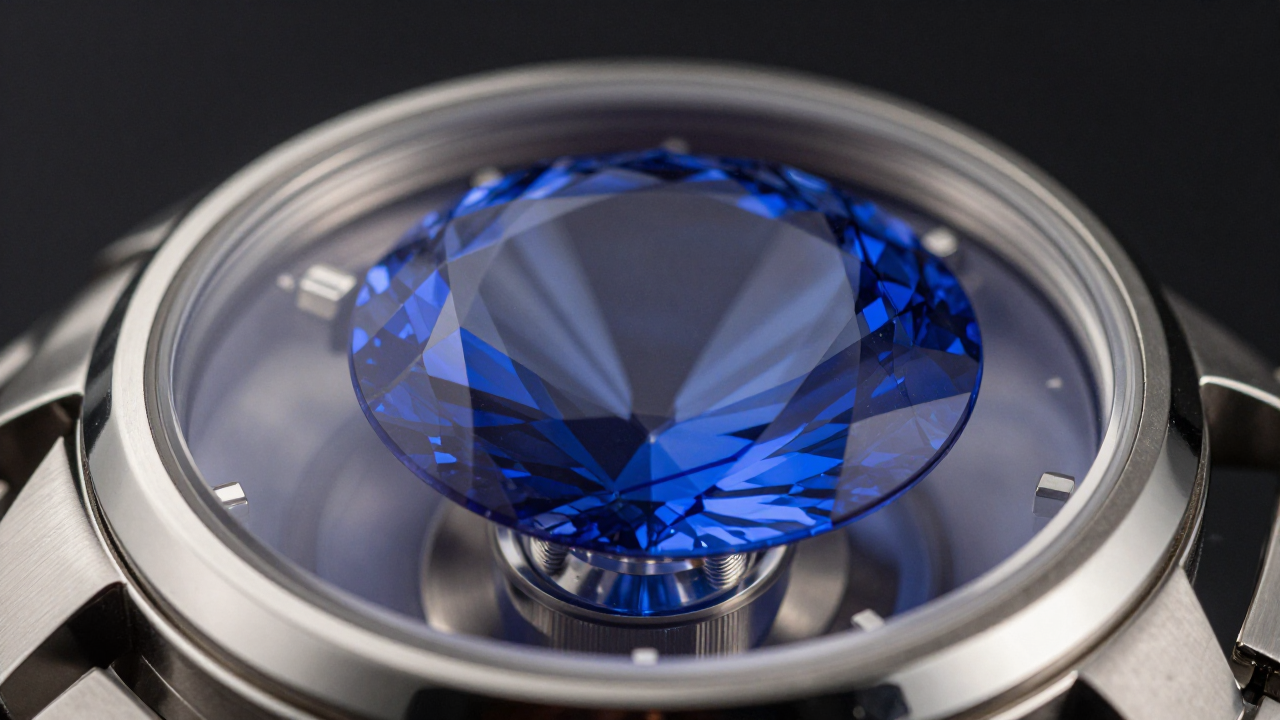
Buying on hardness and unit price alone. Nearly every quotation in this category opens with “Mohs 9, 9H scratch resistant,” so a $2 part and an $8 part produce identical spec sheets.…
The variables that actually fail on a wrist (internal strain, coating adhesion, edge chipping) almost never appear on that sheet.
What Is the Most Common Sapphire Watch Crystal Mistake?
Five mistakes show up in our inbox every week. They are ranked below by what they cost, not by how often they happen.
Why Do Two Sapphire Crystals at the Same Hardness Perform So Differently?
Because Mohs 9 describes the material, not the finished part. The crystal that hazes over in year two and the one that stays clear for six years usually came from different growth processes, different annealing discipline, and different edge finishing, even though both read 1,800 to 2,200 HV on a Vickers tester.
Here is the failure mode. A buyer receives sample crystals, checks the diameter with calipers, looks at them under a 10x loupe, sees nothing, and approves the lot. Sapphire defects that ruin a watch are not visible that way. Lattice strain shows up as birefringence. Birefringence shows up as a faint milky band or Newton’s rings once light passes through the dial side. Inclusions sit deep enough that a loupe check from the top misses them, then the AR coating process heats the part and the surrounding stress field blooms into visible haze.
Why buyers miss it: hardness is the only number on the quote. Growth method is a supplier-side detail that nobody puts in a PDF. Kyropoulos boules, edge-defined film-fed growth, and heat exchanger material all end up sold as “optical grade sapphire,” and that label has no enforceable definition in the United States. A supplier who skips an anneal cycle to protect margin ships parts that measure perfectly and look wrong six months later.
What it costs is not the part. A $6 crystal that hazes generates a return shipping label, a replacement crystal, a technician’s hour, and a one-star review that outlives the watch model. On a 2,000-piece run, a 5% field failure rate is a five-figure problem built out of six-dollar parts.
We got this one wrong ourselves
In February 2021 we took a shortcut. A microbrand assembler in Carlsbad, California had a 2,800-piece order for domed crystals, 38.2 mm diameter, 1.4 mm center thickness, inside AR. Our regular boule supplier slipped a week, so we bought blanks from a broker in Shenzhen to hold the ship date.
The blanks passed dimensional inspection. They passed thickness. They looked clean at 10x. After coating, roughly 11% of the lot (about 300 pieces) showed a milky ring under crossed polarizers, and 24 failed the tape pull with coating lifting at the rim. Our incoming inspection for that SKU had no polariscope step at the time. The defect was in our process, not only in the blanks.
The invoice: $37,400 in scrapped coated parts, $4,100 in expedited air freight to cover the shortfall, and nine days of idle assembly time at the customer in April 2021. We absorbed all of it. What fixed the problem permanently was a 100% polariscope screen before coating, which added about $0.18 per piece in labor and cut coating-stage rejects from 11% to 1.2% within three months.
What to do instead: ask three questions before you approve a supplier. Which growth method, and can you audit the boule source? What is the inclusion spec (a workable one is no inclusions visible at 10x, plus a birefringence limit measured under crossed polarizers)? And is there a lot number on the bag that traces back to a specific boule and anneal run? A supplier who cannot answer the third question is reselling, not manufacturing.
The consumer side of this market has shifted too. Wearable makers now buy sapphire front crystals in volumes that dwarf the traditional watch trade, and that has pushed more fast-grown material into a supply chain that previously ran on optical-grade boules. Volume went up. Average blank quality did not.
Does Anti-Reflective Coating Really Change What You See?
Yes, and more than most buyers expect. Bare sapphire reflects about 8% per surface and transmits roughly 85% of visible light. Single-side coating lifts that to around 92%. A well-built double-side stack reaches 98% or higher at 550 nm, and the dial goes from grey to black.
The mistake is writing “AR coated” on a purchase order and assuming every factory means the same thing. It does not. A four-layer e-beam stack and a seven-layer ion-assisted stack cost different money and behave differently after 500 hours at 85°C and 85% relative humidity.
What to specify: double-side coating, target transmission at 550 nm stated as a number rather than “high,” adhesion tested to ASTM D3359 with a 5B result, humidity per MIL-C-48497A, and a coating design curve on file. Ask whether the outer layer is hydrophobic. Ask what happens if a customer wipes the crystal with a cerium-oxide polishing cloth, because that compound is what factories use to polish sapphire and it will eat an AR stack.
How Thick Should a Sapphire Watch Crystal Be?
Thick enough to survive a doorknob, thin enough that the gasket still compresses. For a flat crystal on a 38 to 42 mm case, 1.2 to 1.6 mm covers most of the market. Anything under 0.9 mm starts flexing, and flex plus a sharp bevel equals a chip.
The error here is copying a thickness from an old drawing without the case in hand. Gasket grooves are designed around a compression range, typically 15% to 25% of the O-ring cross-section. A crystal 0.3 mm too thick will not seat, water resistance fails at the 10-bar hydrostatic test, and the failure shows up in the field, not on the bench.
Send the case drawing and the gasket durometer to whoever cuts the crystal, ask for a compression calculation in writing, and pressure-test ten assembled units to ISO 22810 before the production run.
Are Edge Chips Only a Cosmetic Problem?
No. A chip is a stress riser, and a 0.3 mm chip on the bevel is where the crack starts two winters later. Cheap crystals get a coarse grind and skip the bevel polish; laser-cut edges leave micro-cracks that a loupe will not show.
Specify a polished bevel and a chip tolerance of 0.1 mm maximum outside the viewing area, inspected at 10x. This line item costs a few cents per piece. Skipping it costs a warranty claim.
What Happens When You Skip First-Article Inspection?
You find out at assembly. Drawings for sapphire watch crystals are routinely missing tolerances that matter: diameter ±0.05 mm, thickness ±0.05 mm, flatness, and sagitta on a dome. Without those numbers written down, the factory guesses, and the guess that fits their tooling may not fit your bezel.
Require a first-article report per lot with CMM dimensional data, a polariscope image, and an adhesion result from the same production batch. Use a sampling plan you can defend, ANSI/ASQ Z1.4 at AQL 1.0 major and 2.5 minor is the common starting point for this category. Also get the warranty in writing: 12 to 24 months against delamination and haze, with the lot number referenced on the PO.
What Actually Damages a Sapphire Crystal?
Impact, not scratching. Sapphire shrugs off keys and sand and loses to a sharp edge strike on a bezel corner, because the material is brittle. Thermal shock is rarely the crystal’s problem; it is the gasket’s. Ultrasonic cleaning is safe on a case rated for it, steam is not on a case that is not. And skip the paste polishes, for the reason above.
Self-Check Before You Place the Order
Frequently Asked Questions
How can I check sapphire watch crystal quality before a bulk order?
Ask for a polariscope image of the actual lot, a coating adhesion report to ASTM D3359 at 5B, and dimensional first-article data. Order 20 to 50 pieces, mount three in cases, and pressure-test them. Backlighting the dial reveals haze and Newton’s rings a loupe will miss.
How much does a sapphire watch crystal cost in 2026?
Expect $2 to $9 per piece at 1,000 to 5,000 units for 1.0 to 2.0 mm flat crystals, with domed and double-side coated parts at the top of that range. Tooling runs $400 to $2,500. Freight, duty, and reject allowance add 15% to 30% to landed cost.
Why did my sapphire crystal chip if sapphire is scratch proof?
Scratch resistance and impact resistance are different properties, and sapphire is brittle. A sharp edge strike that mineral glass absorbs can chip sapphire at the bevel. Chips concentrate stress and spread over time. A polished bevel and a slightly recessed bezel protect the edge better than extra thickness.
How thick should a sapphire watch crystal be?
For a flat crystal on a 38 to 42 mm case, 1.2 to 1.6 mm covers most applications; below 0.9 mm the risk of flex and chipping climbs fast. Domes need 0.2 to 0.4 mm more at the apex. Confirm against gasket compression, not just the drawing.
Does a sapphire watch crystal need anti-reflective coating on both sides?
Both sides, if legibility is the goal. Uncoated sapphire reflects about 8% per surface, and inside-only coating leaves an outer reflection that washes out the dial in daylight. Double-side coating raises visible transmission to roughly 98%, at an added cost of $0.60 to $0.90 per piece.