
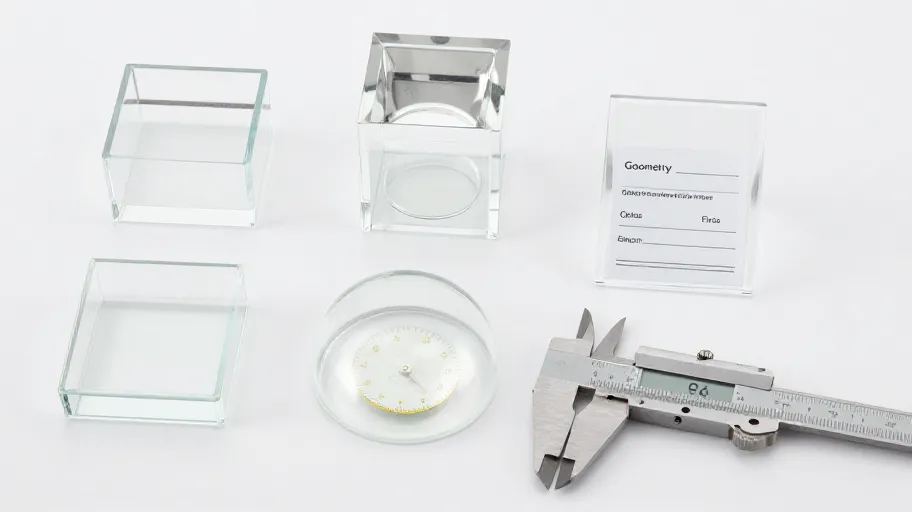
Sapphire watch glass types differ mainly in geometry — flat, domed, box-shaped and stepped profiles each change how a dial reads, how the crystal seats in the case, and what your first sample must prove. Use the Four-Gate Sample Review — Geometry, Optics, Fit, Documentation — to judge a first sample against written criteria rather than appearance, so that approval is a documented decision, not a first impression.
Why geometry comes first
When sourcing managers evaluate sapphire watch glass types, the profile is the single decision that touches every downstream step: case machining, gasket choice, dial legibility, coating application and packaging height. A crystal that looks correct on a bench can still fail at the fit gate if the seat angle, edge treatment or curvature was never specified in writing.
That is why this article treats the first sample not as a courtesy item but as the moment to lock your specification. The framework below is designed for watch designers and private-label brands that need a repeatable review process — one you can hand to a product developer or run yourself before committing to production tooling.
The Four-Gate Sample Review
Gate 1 — Geometry. Confirm the profile matches the drawing, not just the render. Check dome height against the specified value, verify the flank angle on box crystals, and confirm any step or undercut is present where the drawing shows it. Measure and record what you receive; do not rely on visual similarity.
Gate 2 — Optics. Inspect transmission and reflections under the lighting conditions your product photography and retail display will use. If an anti-reflective coating is part of your specification, ask which surfaces are coated (single-side, double-side, edge) and request the coating specification in writing. Confirm any optical performance claim directly with the supplier — treat coating descriptions on marketing pages as conversation starters, not approvals.
Gate 3 — Fit. Trial-fit the sample in a case or case-machining fixture from your own production path. Check seating depth, gasket contact, and clearance against hands, bezel inserts and caseback components. A crystal approved without a fit trial on your actual case hardware transfers all discovery risk to later stages.
Gate 4 — Documentation. Require a sample report or drawing revision that matches what you measured. If the supplier's drawing and your measurement differ, resolve it before approval. Document your acceptance criteria — geometry, optics and fit — so the same criteria govern production units.
Decision table: matching geometry to design intent
| Your design intent | Geometry to evaluate | What the sample must prove | Questions to resolve with the supplier |
|---|---|---|---|
| Thin, minimal case; flat dial aesthetic | Flat crystal | Seat flatness, edge treatment, clearance under the bezel | Confirm minimum thickness your case can accept and edge finishing options |
| Vintage or dress-inspired profile | Domed crystal | Curvature continuity, edge visibility at the case flank | Confirm dome height limits and how curvature affects coating application |
| Strong side profile, high legibility at angles | Box-shaped crystal | Flank angle accuracy, step definition, gasket seating | Confirm how the box profile seats and which gasket geometry it requires |
| Layered or recessed dial design | Stepped crystal | Step placement, internal corner quality, print or seal interaction | Confirm how the step interfaces with seals and any printed elements |
| Maximal clarity in reflections-heavy retail lighting | Any profile + coating request | Coated-surface specification and appearance under your lighting | Ask which surfaces are coated and request the coating specification in writing |
Use this table as a starting scope, then confirm every cell with the supplier for your specific case design. No table substitutes for a drawing signed by both sides.
Approval questions to put in writing
Before you approve a first sample, send these questions to the supplier and record the answers:
- Geometry: Does the sample conform to drawing revision [X]? What measurement method do you recommend for verifying dome height or flank angle on our side?
- Material: What documentation accompanies the material specification for the sample, and what should we request for production units?
- Coating: Which surfaces are coated, if any? What coating specification will apply to production, and how should we handle and clean coated surfaces?
- Fit: What tolerances govern the crystal seat, and which dimensions should our case drawing prioritise for a correct fit?
- Edge and surface quality: What surface and edge quality criteria apply, and how are they inspected?
- Next step: What is the current process and policy for moving from an approved sample to a production quotation, including quantities, timelines and any sample-related costs or shipping arrangements?
That last question matters because sample and ordering policies are business-specific and can change. Confirm current terms directly with the supplier rather than assuming anything from a past project or a general article.
Pre-approval checklist
Print or copy this checklist and complete it before sign-off:
- Sample matches a specific, dated drawing revision
- Geometry measured and recorded against specification
- Optical appearance checked under your actual retail/photography lighting
- Coating surfaces and specification confirmed in writing (if coated)
- Crystal trial-fitted in your case or fixture
- Gasket and seating interface verified
- Documentation received covering material, geometry and coating
- All questions above answered and filed with the sample
- Acceptance criteria written down and agreed with the supplier
A sample approved against this list gives you a defensible reference for production. A sample approved on looks gives you a memory that fades.
Compare crystal geometries before you commission a first sample. Reviewing the geometry options side by side — with your case drawings in hand — is the fastest way to narrow the field to one or two profiles worth sampling, and it makes the Four-Gate review shorter because half the questions are already answered.
FAQ
Which sapphire watch glass type suits a vintage-style case?
Can I judge a coating from a sample alone? You can judge appearance under your own lighting, which is valuable, but you should also request the coating specification in writing — which surfaces are coated and what the production coating will be. Confirm current coating details directly with the supplier and treat any sample observation as one input, not the whole approval.
That depends on the supplier and the project. Ask directly what the sample package covers — documentation, coating, edge treatment, and any associated arrangements for fees or shipping — and confirm the current policy before you request it. Do not assume the answer from a previous supplier relationship.
How many geometries should we sample? Sample the minimum number that resolves genuine uncertainty. If the decision table narrows your case to one clear geometry, one sample may be enough. If two profiles remain plausible, sampling both against the same Four-Gate criteria produces a cleaner, faster decision than iterating on one.
What if the sample fits poorly? Return to Gate 3 with measurements. Identify whether the discrepancy sits in the crystal drawing, the case machining or the gasket interface, and document the finding. A fit failure on a first sample is information — provided you measured and recorded the results against a dated drawing revision.
Do all sapphire crystals use the same material specification? Material grades and documentation can differ between suppliers and product lines. Ask the supplier what specification applies to your project and what documentation accompanies production units, then record it as part of your approval criteria.
A closing note for sourcing teams
The value of a structured review is not that it guarantees outcomes — it does not — but that it converts a subjective judgement into a documented comparison. When your approved sample is tied to a dated drawing, recorded measurements and written answers, every later conversation about production is shorter and every discrepancy is traceable.
Next step: Compare crystal geometries with your case drawings in hand, then request samples for the one or two profiles that survive the comparison — and confirm all sample, cost and production policies directly with the manufacturer before committing.