
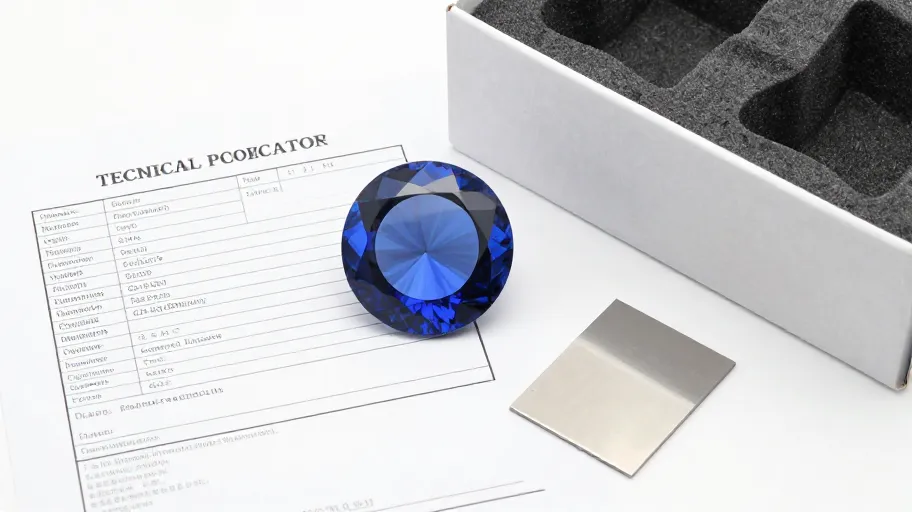
Choosing a sapphire watch glass supplier is less about comparing prices and more about comparing quotations — and quotations can only be compared when your enquiry is complete. The fastest way to get there is the Four-File Brief: Specification, Finish, Verification and Packaging. Supply those four documents to every candidate sapphire watch glass supplier and the quotes you receive back become directly comparable, contractually useful and far less likely to surprise you at incoming inspection.
Why the brief, not the price list, decides the outcome
Most procurement teams shortlist suppliers on capability claims, then request quotes. The quotes come back in different formats: some price per piece, some per batch; some include coating, some list it as an option; some state an inspection method, some simply say the crystal "meets requirements." At that point the comparison is unreliable, because each supplier is quoting a slightly different product.
A structured brief removes that ambiguity before the first reply arrives. It also signals to the supplier that your team inspects incoming goods against written criteria — which tends to produce clearer, more specific quotations in return.
The Four-File Brief
| File | What it defines | Approval question to put to the supplier |
|---|---|---|
| 1. Specification | Case reference, crystal shape (flat, domed, box, etc.), diameter, thickness targets, edge treatment, and whether the drawing or the crystal is the governing document | "Which document governs if the drawing and the physical reference differ?" |
| 2. Finish | Anti-reflective coating specification (single or double side, if any), edge polishing grade, surface quality reference, and any printing or logo requirement | "What finish reference will the quotation be held to, and how is it inspected?" |
| 3. Verification | Dimensional check method, inspection equipment or gauges, sampling plan for incoming inspection, and the acceptance criteria your QC team will apply | "Will you confirm the inspection method and acceptance criteria in writing before production?" |
| 4. Packaging | Packing quantity per unit container, protection between pieces, labelling, and documentation required with each shipment | "How will the crystals be packed, and what documentation accompanies each delivery?" |
Note what the fourth file does: it treats packaging as part of the product, not a logistics detail. A crystal that is dimensionally perfect but arrives chipped at the edge has failed just as completely as one cut to the wrong diameter.
Tolerances: specify the check, not just the number
In practice, tolerance disputes rarely come from the tolerance value itself. They come from three gaps:
- Method gap — one party measures with a dial gauge, the other with an optical comparator, and the results differ.
- Reference gap — the drawing and the approved physical sample disagree, and nobody wrote down which governs.
- Sampling gap — your incoming inspection checks a sample; the supplier's outgoing check covered a different sample or none.
Your brief should therefore ask the supplier to confirm, in writing: the measurement method and equipment used, the governing document when references conflict, and the sampling approach applied before shipment. None of these details can be assumed — confirm them with your supplier directly, and record the answers in the Verification file so both sides hold the same standard.
For shaped or boxed crystals, add an assembly-fit question: how will the fit with your case be verified, and at what stage — sample, first article, or production — does your team approve the fit?
Finish: name the reference before you name the price
Finish is where sapphire crystal quotations diverge most. Anti-reflective coating, edge polish, and surface quality each need a stated reference in the brief:
- AR coating: state whether you require coating on one side, both sides, or none, and ask how coating quality is verified and what visual acceptance standard applies.
- Edge treatment: specify the edge profile your case expects, and ask how edge quality is checked.
- Surface quality: refer to a defined visual inspection condition — lighting, viewing distance and inspector judgement criteria — so "clean surface" means the same thing to both parties.
If your brand applies printed logos or date windows on the crystal, treat those as separate specification items with their own verification method.
Ask each candidate supplier to quote against exactly this finish reference. If a quote omits a finish item, ask for it to be added — an omitted line item is not a saving, it is an unpriced risk.
Packaging and delivery documentation
Packaging failures are avoidable and expensive. In the Packaging file, specify:
- Pieces per container and container type
- Separation method between crystals (to prevent edge-to-edge contact)
- Labelling that ties each container to a drawing or order reference
- Documents you require with delivery — for example, inspection records or material declarations, if your quality system needs them
Then ask the supplier to confirm what packaging their quotation includes and what documentation they can supply per shipment. If your requirements differ from what is quoted, resolve it before the purchase order, not at the warehouse door.
Approval questions checklist
Before issuing a purchase order, work through this checklist and record each answer in writing:
- Governing document confirmed: drawing, physical reference or written specification — which one rules?
- Measurement method and equipment confirmed for every dimension in the brief
- AR coating scope and visual acceptance standard quoted explicitly, or marked "not required"
- Edge and surface finish references agreed, with the inspection condition defined
- Sampling and inspection approach before shipment confirmed in writing
- Packaging specification quoted as supplied, including labelling
- Delivery documentation requirements confirmed as available
- Any item the supplier cannot confirm is listed as an open point with a named owner and a resolution date
If any box stays unchecked, do not proceed — convert it into a question and get the answer documented first.
Frequently asked questions
What information does a supplier need to quote a custom sapphire crystal accurately? At minimum: case reference or drawing, crystal geometry and dimensions, finish and coating requirements, expected quantities, packaging requirements, and your inspection or acceptance criteria. The more of the Four-File Brief you supply, the fewer assumptions the supplier must price in — and assumptions are what make quotes incomparable.
Should I request a sample before committing to a production order? Most sourcing teams do, but sample terms — availability, fees, shipping arrangements and lead times — vary by supplier and order context. Do not assume any policy; ask each supplier to state their current sample terms in writing and compare those terms alongside the production quote.
How do I compare quotes from different sapphire suppliers fairly? Line them up against the same brief, item by item: specification, finish, verification and packaging. A quote that omits an item is not cheaper — it is incomplete. Normalize the quotes by asking each supplier to price every line in the brief explicitly, including packaging and documentation.
Who is responsible for dimensional inspection — the supplier or my team? Both, at different stages. The supplier inspects before shipment; your team inspects on receipt. The key is agreeing in advance on the measurement method, the acceptance criteria and the sampling plan, so both inspections measure the same thing the same way. Put this in the Verification file and have the supplier confirm it.
What should I do if my drawing and the approved sample disagree? Resolve it before quotation, not after production. Ask the supplier which document they will manufacture to, correct the discrepancy, and issue a single governing reference. Ambiguity here is the most common root cause of disputes over delivered sapphire crystals.
Work with JadeZone Sapphire
JadeZone Sapphire is a B2B manufacturer of custom sapphire watch crystals and precision sapphire components, operating from Shenzhen and Hong Kong and serving watch brands, component buyers and watchmaking workshops.
Primary CTA — Prepare a quote-ready brief. Send your Specification, Finish, Verification and Packaging requirements to the JadeZone Sapphire team and request a quotation built against your documents, item by item. [Contact JadeZone Sapphire to prepare your quote-ready brief →]
Low-friction CTA — start with the checklist. Not ready to request a quote yet? Download or copy the approval-questions checklist above, fill in what you know, and mark the gaps. Those gaps are your first questions to any supplier — including us.
Specific sample, cost, shipping, lead-time and production policies were not stated in this article. Confirm all current terms directly with JadeZone Sapphire during quotation.