
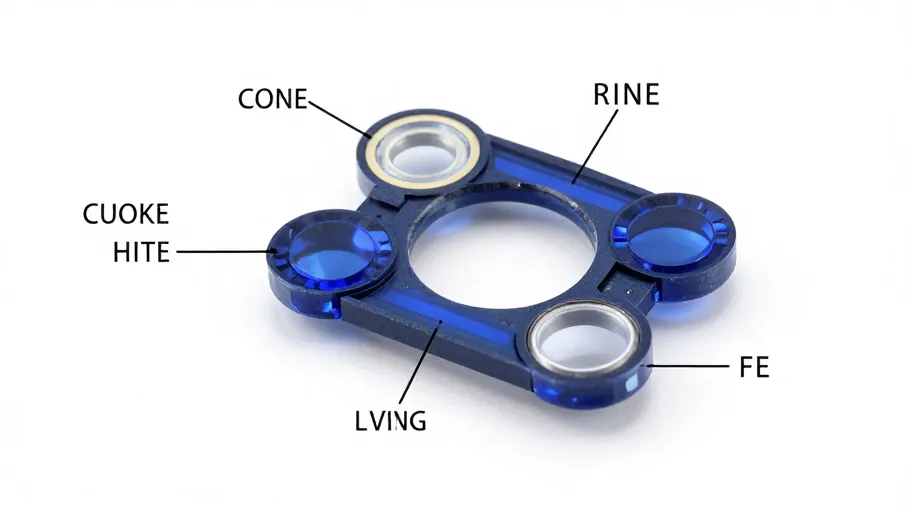
In a sapphire crystal project, most avoidable cost appears because the first drawing brief omits an interface callout rather than a headline dimension. The Six-Interface Tolerance Check — edge seat, gasket zone, underside clearance, coating zone, concentricity, and datums — gives buyers a repeatable way to find those omissions before quotation, so a sapphire crystal tolerance watch review happens on paper, not on the bench.
Why the first brief decides the outcome
Buyers reviewing a crystal drawing for the first time tend to verify what is easy to see: outer diameter, thickness, and maybe curvature. What generates rework is rarely the headline number. It is the undefined middle — how the edge seats, where the gasket sits, what the underside clears, where coating starts and stops, and which dimension governs when callouts conflict. None of these are exotic requirements. They are simply the questions that must be answered in writing before a supplier can quote against one unambiguous specification.
The discipline matters more for sapphire than for mineral glass because sapphire is machined from a hard, brittle material: corrections that would be trivial in another material become planned re-machining steps. A sapphire crystal tolerance watch routine — checking the drawing against every interface before release — is therefore a risk-control measure, not a formality.
The Six-Interface Tolerance Check
Use this table as a review gate. For each interface, confirm the drawing states the requirement explicitly, then record the supplier's response in writing.
| # | Interface | What must be stated on the drawing | Question to put to the supplier |
|---|---|---|---|
| 1 | Edge seat | Seat angle or profile, seat diameter, and reference face for measurement | "Which face is the datum for the seat diameter, and how will you verify it?" |
| 2 | Gasket zone | Gasket groove or flange geometry, surface finish expectation, and whether the zone is dimensioned or controlled by the gasket supplier's part | "Who owns the gasket interface dimension — the crystal drawing or the gasket drawing?" |
| 3 | Underside clearance | Underside profile, any relief or recess, and minimum clearance to hands, dial ring or movement parts | "What underside geometry do you need from me to guarantee clearance in my assembly?" |
| 4 | Coating zone | Which surfaces receive coating, where the coated zone begins and ends, and any uncoated margin | "Confirm in writing which faces are coated and which are deliberately left bare." |
| 5 | ID/OD concentricity | For crystals with an inner feature or stepped profile: which diameter is the reference, and how concentricity is specified | "Which diameter governs concentricity, and what callout language do you want on the drawing?" |
| 6 | Datums and priority | Stated datum system and a rule for what happens when callouts conflict | "If two dimensions disagree after a revision, which one governs?" |
A drawing that passes all six rows gives every quotation the same baseline. One that leaves a row blank invites each bidder to fill the gap with its own assumption — which is how "comparable" quotes stop being comparable.
Approval questions to send with the brief
Beyond the six interfaces, put these questions in the brief itself so the answers come back documented rather than verbal:
- Verification method. For each critical dimension: how will conformance be checked, and what measurement record will accompany approval samples? Ask; do not assume a method.
- Revision control. What is the drawing revision number, and will the supplier confirm in writing that the returned sample and the quotation both reference that same revision?
- Material confirmation. What is the declared material for the crystal, and where is that declaration documented on the spec sheet or purchase order?
- Assembly interface ownership. For the gasket, case and dial interfaces, which drawing owns each dimension? Ambiguity here is a leading source of assembly-floor disputes.
- Approval gate. What exactly constitutes written approval — a signed sample, a signed drawing, or both — and who on the buyer's side signs?
None of these questions commits you to a price or a schedule. They commit both parties to one specification, which is the only condition under which a custom sapphire crystal project can be evaluated fairly.
Drawing-revision and comparison discipline
Tolerance risk grows quietly through revisions. Each change — a diameter tweak, a coating-zone shift, a new underside recess — can silently invalidate an assumption made in an earlier quote or sample. Two habits contain that risk:
- One revision number per conversation. Every email, quote request and sample comment references the same revision. If a supplier response does not cite the revision, ask for it to be restated against the current one.
- A change log with rationale. Record what changed, why, and who approved it. When a later question arises — "why is the coating zone offset here?" — the answer is in the log, not in memory.
The same discipline applies when comparing suppliers. Send every candidate the identical drawing, the identical question list and the identical revision number. Differences in the responses then reflect genuine differences in understanding or capability, and you can compare them on substance. JadeZone Sapphire, as a Shenzhen and Hong Kong manufacturer of custom sapphire watch crystals and precision sapphire components, can review your brief against this checklist; the specifics of their verification process, sample arrangements and commercial terms are yours to confirm directly with them.
Checklist CTA
Before you release your next brief, run the drawing checklist. It walks through the six interfaces, the approval questions and the revision-control steps above, in the order a reviewer should apply them. Download the drawing checklist for custom sapphire crystals — links to confirm before publishing.
FAQ
Do I need to specify tolerance values for every dimension on the drawing?
What happens if my drawing is incomplete when I first request a quote? Any supplier must then quote against assumptions, and every assumption is a potential disagreement later. The safer path is to state openly which rows of the Six-Interface Tolerance Check are undecided and ask the supplier to propose a resolution in writing, as part of the quotation. You then compare proposals, not guesses.
How should I handle coating requirements in the brief? Describe the optical outcome you need and mark the coating zone boundaries on the drawing — which faces, which edges, any deliberate bare margin. Coating performance claims, test methods and durability expectations are project-specific; ask the supplier to state in writing what their coating process delivers for your design and how it will be verified before you approve a sample.
Can I add dimensions after sampling has started? You can, but every change should trigger a new revision number and written confirmation that the quotation, the sample and the change log all refer to the same revision. Late additions that bypass revision control are the classic route to a part that matches an old drawing rather than your current intent.
Who owns the gasket dimension — me, the case maker or the crystal supplier? Whoever you assign it to, in writing. The failure mode is not that nobody measures it; it is that two parties each assume the other does. Name an owner in the brief and cross-reference the crystal and gasket drawings so the interface is defined once.
Primary CTA
Ready to pressure-test your brief? Send your current crystal drawing to JadeZone Sapphire and ask them to respond against the Six-Interface Tolerance Check. Confirm their current sample, commercial and production policies directly — then approve a specification, not a conversation. Contact the team and download the drawing checklist — links to confirm before publishing.