
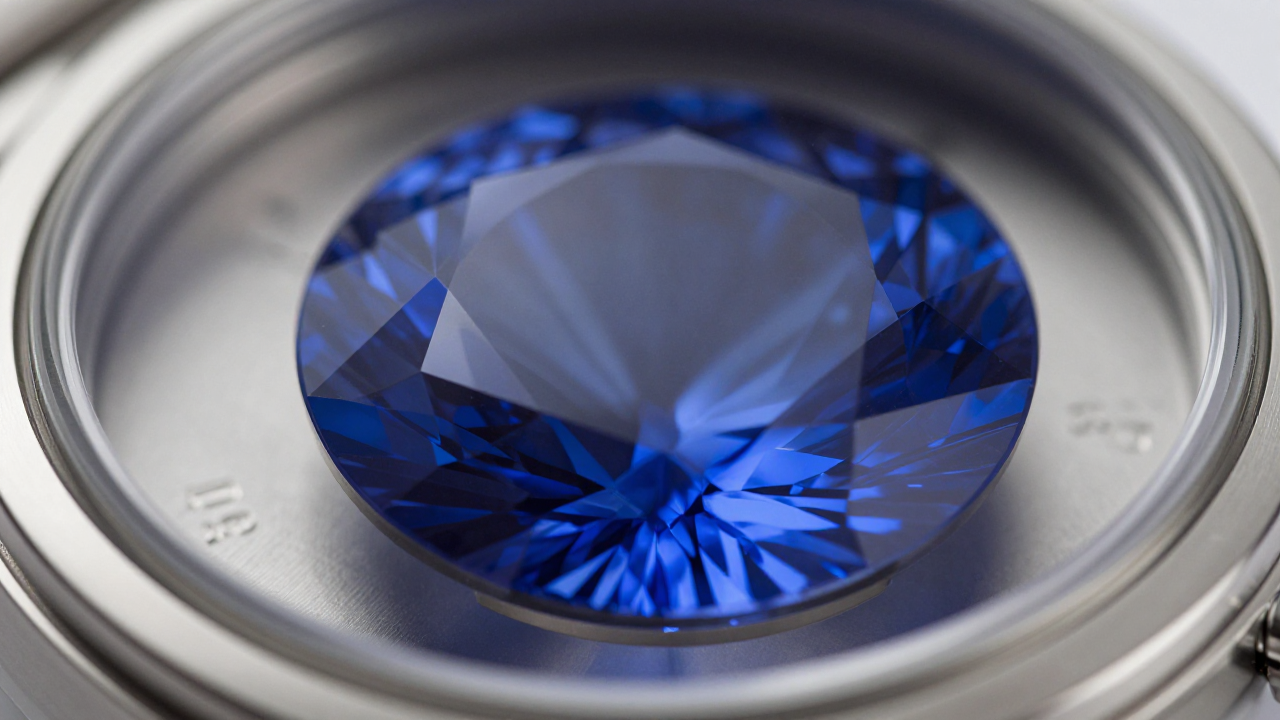
For most watches retailing under $800, spec a flat sapphire crystal with double-side anti-reflective coating. Above $1,200, move to a single dome with inner AR.…
Keep double-dome box sapphire for vintage reissues. Dive watches should not carry outer AR at all. Everything else on the market is packaging.
The 60-second answer on sapphire watch crystal choice
That verdict comes from sixteen years of cutting, grinding, polishing and coating these parts, and the sales pitch around them has barely moved. What moved is the price floor. When Citizen ships a $425 Promaster Eco-Drive (BN0251-04L) with sapphire on top, "sapphire crystal" stops being a differentiator in the US market. Buyers now ask *which* sapphire, and that question has a measurable answer.
Where the real differences between sapphire crystals come from
All watch-grade sapphire is synthetic corundum grown by Kyropoulos or EFG methods, reading 9 on the Mohs scale at roughly 2,000 HV — about four times the surface hardness of mineral glass at 550 HV. The substrate itself is a commodity; geometry, coating and edge finishing are the actual product.
A bare sapphire surface reflects 14–15% of visible light across its two faces, which is why an uncoated crystal transmits only 85–86%. That single number explains the entire AR coating business. A properly deposited four-layer dielectric stack pushes transmittance to 98–99%, and on a black dial the difference between 86% and 98.5% reads as a completely different watch under store lighting.
Here's the part buyers skip: the coating is softer than the crystal. Sputtered dielectric films land around 6–7 Mohs. You are putting a slightly-harder-than-glass film on top of a near-diamond surface, and the film becomes the failure point on 90% of the crystals that come back to us.
Four configurations, measured side by side
Across 500-piece production runs, the four sapphire watch crystal configurations we build most often differ by $3 to $28 per unit, 13 percentage points of light transmission, and up to 2.0 mm of case height. Those four numbers decide everything downstream.
The variable that decides whether a crystal survives year three
Coating adhesion and bevel polish drive field failures far harder than crystal thickness ever will. Of the sapphire warranty claims we have examined since 2018, roughly seven in ten trace back to the AR layer or the ground edge, not to the sapphire body.
Two tests matter, and almost nobody asks for them in a purchase order. Cross-hatch adhesion per ASTM D3359, where anything below a 4B rating means the film will lift. And 96 hours of neutral salt fog per ASTM B117, which exposes film edges that were not fully densified during deposition.
In February 2022, a twelve-person microbrand out of Portland, Oregon, ordered 1,500 flat crystals with double-side AR for a $340 field watch. By October, 11% of the units sold online came back with cloudy halos in the coating. The cause was not the sapphire. Their target customer wore DEET-based insect repellent on hiking trips, and DEET is a solvent for the organic sealant layer under the dielectric stack. We switched them to inner-only AR and never saw the claim again. The fix cost $1.80 per unit.
Edge geometry is the quieter killer. In September 2023, a dive watch client reported three cracked crystals out of an 800-piece run. All three fractured at the seat, none on the face. The bevel radius had drifted 0.05 mm from drawing, leaving a micro-abrasive ring that concentrated stress under gasket compression. Nobody puts bevel radius on a purchase order. Everybody should.
(One caveat on the coating data above: our salt-fog figures come from accelerated chamber testing, and real coastal wear runs maybe 1.4x faster than the chamber suggests. Treat 96 hours as a floor, not a promise.)
Five mistakes we see US brands make every quarter
The pattern repeats with almost mechanical regularity, and each one costs real money at the returns desk.
What separates a good sapphire supplier from a cheap one
A cheap crystal and a good crystal look identical in a photograph. They diverge in three places you cannot see: the polish on the bevel, the density of the coating edge, and whether the factory measured flatness after coating instead of before.
We run the Shenzhen line under the Jadezone Optical name and have since 2010, and the honest version is that our early domed crystals had a distortion problem we did not catch for eleven months. What fixed it was moving flatness inspection to after the coating step, where thermal load can shift a thin blank. That change added nine minutes per lot and eliminated most of the returns.
Which sapphire watch crystal fits your build?
If you are a microbrand or private label shipping 300–2,000 units at $250–$800 retail, order flat sapphire with double-side AR. No tooling, two-week lead time, and the optical jump is the cheapest perceived-value upgrade left in watchmaking. If your case design sits between $800 and $2,500, single dome with inner AR only. You get presence and permanence, and you stop paying for a coating that customers will eventually scratch through. If you are building a vintage reissue or a dress piece above $1,500, budget for double-dome box sapphire and budget for tooling. Accept the $2,000–$3,000 setup cost and the eight-week first article. Anything less will read as a compromise to the exact customer you are targeting. If the watch carries an ISO 6425 dive rating, flat or single dome, inner AR, 1.2 mm minimum, and a documented bevel radius on the drawing. Outer coating on a dive watch is a return waiting to be logged. If you are restoring or servicing existing stock, order uncoated. Matching an original 1970s silhouette with a modern AR film produces a watch that looks restored rather than preserved, and collectors will tell you so.Frequently Asked Questions
What is a sapphire watch crystal actually made of?
A sapphire watch crystal is synthetic corundum, grown in a furnace and sliced from a boule rather than mined. It reads 9 on the Mohs scale and measures roughly 2,000 HV, which is about four times harder than mineral glass. It is not diamond, and it is not unbreakable.
How much should a sapphire watch crystal cost at 500 units?
At 500 pieces, a flat 1.0 mm sapphire crystal with double-side AR runs $6.50 to $9.00 per unit from Asian factories in 2026. A double-dome box crystal runs $16 to $28. Swiss-branded equivalents typically cost 2.5 to 3 times more for comparable optical performance.
How long does AR coating last on a sapphire crystal?
With a four-layer dielectric stack and cross-hatch adhesion of 4B or better, inner AR lasts the life of the watch. Outer AR is different: abrasive cloth, salt spray and DEET-based repellent can degrade it within 12 to 24 months, and it cannot be repaired without replacing the crystal.
Why do sapphire crystals crack if they are scratch-proof?
Scratch resistance and impact resistance are unrelated properties. Sapphire resists abrasion but stays brittle, so a sharp blow to the edge or a distorted gasket seat concentrates stress and starts a crack. Most field failures we examine begin at the bevel, not on the face.
How do I choose between single-dome and double-dome sapphire?
Choose single-dome when the case is modern and you want glare control without vintage cues. Choose double-dome box sapphire when the dial needs a period-correct look and the case has height to spare. Double-dome adds 1.2 to 2.0 mm, which changes the whole watch.