
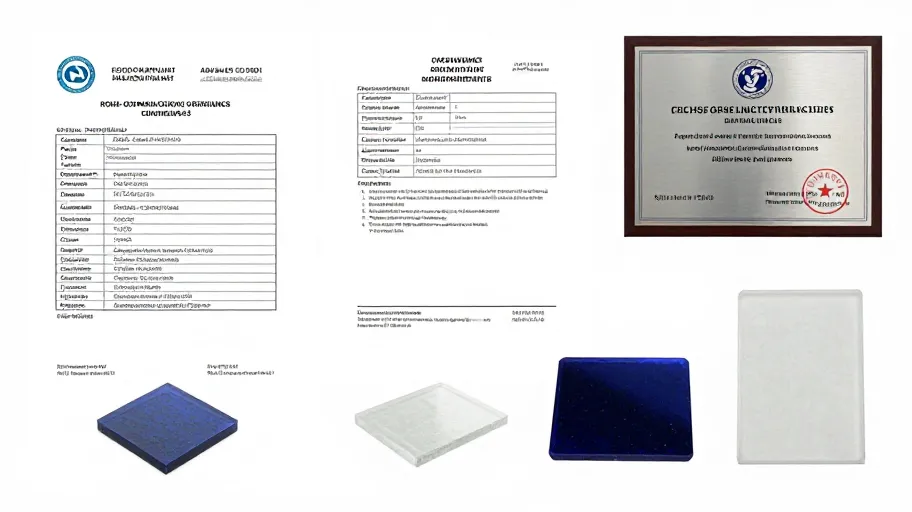
Choosing a china full chain sapphire manufacturer compliant with RoHS, REACH and CP65 is best done through a Documentation-First Evaluation Loop: request the evidence, verify its scope, compare suppliers on identical questions, and approve only what is documented. When you force every supplier to answer the same evidence checklist, differences in real capability surface quickly — and claims that cannot be documented disqualify themselves before they cost you a production run.
Two claims, two verification tasks
"Full chain" and "compliant" sound like one pitch, but they are separate promises requiring separate evidence.
Full chain means the supplier controls — or transparently discloses its partners for — each stage relevant to your part: material growth or sourcing, cutting and shaping, grinding and polishing, coating, and inspection. A buyer who never asks where each step happens cannot tell an integrated manufacturer from an assembler who outsources the hardest steps and inherits the weakest quality controls.
Compliance means documented conformity to the chemical regulations your markets and customers require: RoHS for restricted substances in electrical and electronic equipment where applicable, REACH for substances of very high concern in the EU supply chain, and California Proposition 65 warning obligations where relevant to your distribution. A certificate exists for a specific material scope, a specific legal entity and a specific date. A claim without that scope is a marketing sentence, not an approval document.
Treat both as evidence tasks, and the comparison becomes mechanical.
The Documentation-First Evaluation Loop
Request. Before discussing pricing or tooling, ask each candidate supplier for a fixed evidence package: a process map naming which stages are in-house and which involve partners, plus current compliance documentation for the specific crystal or component construction you intend to buy — including coating chemistry, not only the sapphire itself.
Verify. Read every document against four checks: What material or product scope does it cover? Which legal entity issued or holds it? What date or validity period applies? What test method or standard is referenced? A document with a broad scope, a mismatched entity name or an expired date is not yet evidence.
Compare. Put all suppliers' answers side by side in an identical table. Comparing different suppliers on different question sets produces confident decisions on bad data; comparing identical answers produces ranked, defensible shortlists.
Approve. Approval should have two gates: first-article approval for the physical part, and documentation approval confirming that the compliance file matches what was actually shipped. Then add change control, so any later material, coating or process change reopens the evidence rather than silently voiding it.
Supplier comparison decision table
Score each candidate supplier on the rows below before shortlisting. Any "no" is not automatically a rejection — but it must become an explicit question with a documented answer, not an assumption.
| Evaluation row | What "documented yes" looks like | What to do if unclear |
|---|---|---|
| Process map per stage | Written map stating which stages are in-house and which use partners, with the partner's role named | Request a revised map; treat silence on a stage as an open risk item |
| RoHS documentation for your construction | A current document whose scope covers the glass, coating and any assembled parts you buy | Ask whether the scope matches your exact part revision |
| REACH position | A current statement or report the supplier is willing to have reviewed by your compliance owner | Forward to your own compliance function for interpretation |
| CP65 exposure | A clear answer on warning obligations relevant to your distribution channels | Confirm with your legal or compliance adviser for your specific markets |
| Test method transparency | Documents that state the test method or standard relied upon | Ask for the method name in writing |
| First-article process | A defined first-article procedure with agreed inspection criteria | Agree the criteria before tooling begins |
| Change control | A stated process for notifying material, coating or process changes | Make notification a contractual requirement |
| Communication owner | A named technical contact accountable for documentation, not only sales | Request the contact in the quotation stage |
Reading a compliance scope: questions, not conclusions
This article does not assert what any supplier's certificates cover — including JadeZone Sapphire's. It gives you the questions whose answers decide the comparison:
- Does the RoHS document cover the finished construction you are buying, or only the raw sapphire material?
- Is the coating chemistry included in the tested scope, or does the coating sit outside the certificate?
- Which legal entity appears on the document, and does it match the entity on your quotation and contract?
- What validity or issue date applies, and will you receive updated documents when regulations change?
- What test method was used, and is your own compliance team able to accept that method?
- Does the supplier distinguish between self-declared conformity and third-party testing, and can it state which applies to your part?
- For CP65, has the supplier assessed whether the product or its packaging triggers a warning obligation for your sales channels, and who in your organisation makes that final call?
Send the identical question list to every candidate. A supplier that answers with specific, current, scoped documents is easier to defend internally than one that answers with a logo wall.
Approval questions to send before qualifying a supplier
Copy these into your RFQ:
- Please provide a process map for our part showing which stages — material, cutting, grinding and polishing, coating, assembly, inspection — are performed in-house and which involve subcontractors.
- For each stage involving a partner, who holds the quality and compliance responsibility, and how is it verified?
- Please provide your current compliance documentation for our specified construction, stating the material scope, the issuing entity and the document date.
- Which test methods are referenced in your conformity documentation, and will you confirm them in writing?
- What is your first-article approval procedure, and what criteria will we agree before production?
- How will you notify us of any change to material, coating or process after approval?
- Who is our single named contact for documentation requests during and after qualification?
- What is your current sample policy, including any fees, shipping arrangements and timelines? (We do not state this for any supplier — confirm it directly, as policies vary and change.)
Question 8 matters commercially, but note the boundary: no sample, cost or shipping policy appears in this article for JadeZone Sapphire or any competitor, because policies are specific to each project and must be confirmed in writing at quotation.
Change control: the gate buyers skip
Most sourcing teams stop at first-article approval. The risk that follows is drift: a coating supplier changes, a polishing method changes, a material source changes — and the compliance file approved at qualification no longer describes the part in production.
Before approving any supplier, agree in writing that changes to material, coating chemistry or critical process parameters trigger a notification and refreshed documentation before shipment of affected lots. Make the trigger, the notification format and the responsibility part of the purchase terms. A documentation-first supplier will already have such a process; one that resists the question has told you something useful.
FAQ
Does a sapphire watch crystal automatically satisfy RoHS, REACH and CP65? Conformity depends on the specific construction, materials, coatings and your distribution channels, and must be shown by current, properly scoped documentation. This article does not assert conformity for any supplier or product. Ask each candidate supplier — including JadeZone Sapphire — for documents covering your exact part, and have your own compliance owner review them.
If a supplier calls itself a full-chain manufacturer, does that guarantee nothing is outsourced? No. The term means different things to different suppliers. Request a written process map naming in-house stages and partners, and verify who owns quality and compliance at each stage. Do not rely on the label.
What documents should I collect before first-article approval? At minimum: the process map, current compliance documentation scoped to your construction, stated test methods, the first-article procedure and criteria, and the change-control commitment. All must reference the correct legal entity and a current date.
Do I need third-party testing, or is a supplier declaration enough? That decision belongs to your compliance function and your market requirements; this article takes no position. What matters for the comparison is transparency: ask each supplier to state which form of evidence it provides for your part, in writing.
What should I ask about samples, MOQ, pricing and lead times? Ask each supplier directly and get the answers in the quotation, because these points are project-specific and cannot be assumed from any article, including this one. The evidence checklist below includes the exact questions to send.
Primary CTA
Download the supplier evidence checklist (下载供应商证据清单) — a structured request-and-verify pack covering process mapping, RoHS/REACH/CP65 scope questions, first-article criteria and change-control terms, ready to send to JadeZone Sapphire and every alternative on your shortlist.
Low-friction checklist CTA
Not ready to qualify a supplier? Run this five-line check on any candidate today:
- Written process map with in-house and partner stages named
- Compliance documents scoped to your exact construction, not just the material
- Legal entity and date on every document match your contract
- Test methods stated in writing
- Change-control notification agreed before approval
If any line fails, the supplier is not yet approvable — send the questions from the checklist and compare the written answers.
JadeZone Sapphire is a Shenzhen and Hong Kong based manufacturer of custom sapphire watch crystals and precision sapphire components. Every capability, policy and compliance point discussed above should be verified directly with us in writing before you approve any order — the checklist exists precisely so that both sides qualify on documents, not assurances.