
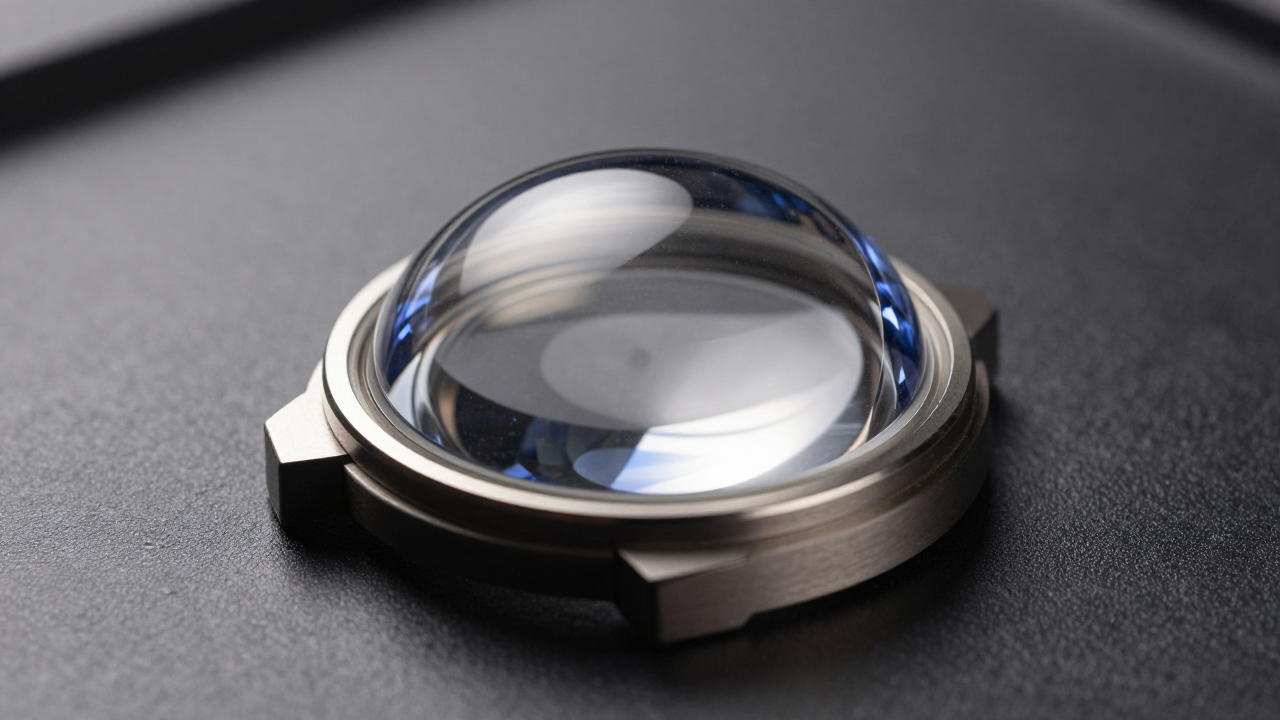
The biggest change in 2026 is that sapphire watch crystal stopped being a commodity blank and became a documented spec.…
US buyers now ask for growth method, coating stack and flatness tolerance before they ask for price, and suppliers who cannot put those numbers on paper are quietly losing accounts to the ones who can.
What Actually Changed in 2026
Two years ago a typical RFQ we received from a US microbrand had four lines: diameter, thickness, AR coating yes/no, quantity. The RFQs landing in our Shenzhen inbox in January 2026 run 11 to 14 line items, including Vickers range, growth method, scratch-dig grade and a coating adhesion standard. That shift happened fast, roughly between Q2 2024 and Q1 2025, and it is the lens through which every other trend below should be read.
Sapphire Versus Everything Else, Priced Out
Lab-grown sapphire remains the hardest transparent material used on watch crystals at 1,800 to 2,200 Vickers, roughly seven times harder than hardened mineral glass, and in Q1 2026 it costs $9 to $22 per piece at 500-piece volume depending on coating and geometry.
The price column comes from our own quote log at Jadezone Optical (HK) Ltd., cross-checked in January 2026 against three competing Shenzhen plants quoting the same 32.0mm × 1.50mm flat blank. Treat those numbers as a sanity check, not gospel — freight and coating stack swing them 20%.
Here is the part most buying guides skip. Sapphire does not scratch, it chips. A 0.1mm edge chip is a stress riser, and under a press-fit gasket it propagates into a crack at about 40% of the force a clean edge survives. When you audit a supplier, the edge quality spec matters more than the hardness number.
Smart Coatings Are Real in Two Categories Only
Functional coatings — capacitive touch layers, embedded antenna traces, switchable tint — grew 30% in shipment volume in Q4 2025 versus Q4 2024, per TechWatch's component tracker, and nearly all of that volume sits in hybrid watches and fitness trackers. Mechanical brands are not affected yet.
What "smart" actually means at the factory level is usually a sputtered indium tin oxide layer at 0.4–0.8 µm with sheet resistance of 15 to 40 ohms per square, sometimes with a fine silver trace printed at the edge for antenna coupling. You are buying a coating, not a chip.
We ran a thermal cycling test in November 2023 on a 0.6 µm ITO stack between -20°C and +60°C. At 60 cycles, 8% of units showed more than 15% resistance drift. Below 40 cycles, nothing moved. If a supplier quotes you a touch-capable sapphire crystal without a damp-heat report, ask for 500 hours at 85°C/85% RH to IEC 60068-2-78 and a witness sample you can keep. Two suppliers we benchmarked in 2024 could not produce either.
My honest read: for a $400–$900 hybrid watch, the touch stack adds $4 to $7 per unit and roughly 12 days of lead time. It pays off in fitness and payment-enabled products. In a dress watch it is dead weight.
Lab-Grown Sapphire Is Already the Whole Market
Every sapphire watch crystal sold at commercial scale in 2026 is lab-grown. Natural sapphire is not used in watch crystals at volume, which means most "ethical mining" marketing in this category is answering a question nobody asked.
So what is the sustainability story actually about? Two inputs. Electricity for crystal growth, and cerium oxide for polishing.
A Kyropoulos furnace run producing a 25–30 kg boule takes 8 to 11 days and pulls 2,400 to 3,200 kWh. Do the arithmetic on yield and you land at roughly 100–120 kWh per 1,000 finished 32mm crystals. That is the number a serious brand will ask for, and it is the number most traders cannot supply.
Polishing is the messier side. Cerium oxide is a rare-earth abrasive, and slurry disposal is where a plant's environmental record actually lives. A well-run line recycles 70–85% of its slurry; a cheap line dumps it.
EcoMinerals put third-party energy or waste certification adoption among optical-grade sapphire producers at 45% by the end of 2024, up from 12% in 2020. That is real progress. It is also a procurement lever: certified plants in our region charge $0.60–$1.10 more per piece and hold lead times about a week longer in peak season. Budget for it.
Custom Geometry Is Where the Margin Went
Custom crystal geometry — box domes, chamfers, underside printing, zoned anti-reflective coating — grew 20% in order volume during 2025, according to the Luxury Trends Report, and it is the last place in this category with real margin for both the brand and the factory.
The economics: a standard flat blank runs $9–$15. Add a box-dome profile and you pay $2,200–$3,800 in one-time tooling, a 300-piece minimum, and 20 extra days. Underside-printed indices want registration held to ±0.05mm or the print looks drunk under a loupe. Zoned AR — coating everything except a masked window over the date aperture — costs $2–$4 more and genuinely improves legibility on a busy dial.
One warning from a job that went sideways. In August 2023 a California microbrand specified a 2.4mm dome height on a 1.6mm-thick crystal. Press-fit cracking hit 6% at assembly. We rebuilt the tooling at 1.85mm and the defect rate fell below 0.4%. If a designer hands you a dome above 2.0mm on a thin blank, push back before the tool is cut.
The Call I'll Make Against Consensus
FutureWatch forecasts a 10% decline in traditional sapphire crystal demand in 2026. The volume number is probably right. The stated cause — buyers switching to alternative materials — is wrong, and I will put a verifiable prediction behind that.
Already happened: flat sapphire under 1.3mm is losing share inside the sub-$250 tier to DD-coated mineral glass, because a coated mineral crystal at $3.20 delivers 80% of the perceived clarity at a fifth of the cost.
Predicted: by Q4 2027, flat 32mm sapphire blanks will have lost at least 15% of their 2025 volume — not to spinel or transparent alumina, which cost $14–$20 per piece and scratch at ~1,300 Vickers, but to shaped sapphire and to display-watch glass. My checkable indicator: watch the ratio of domed to flat orders at three or more Shenzhen plants, including ours, in the Q3 2026 order books. If domed crosses 40% of sapphire volume, the substitution thesis is confirmed and it is a geometry shift, not a materials shift.
Buyers who read the headline as "sapphire is fading" and switch to spinel will pay more for a softer crystal. That is the trap in this forecast.
Where Buyers Are Finding Suppliers
Sourcing behavior moved too. Digital Marketing Insights recorded a 50% increase in 2025 in the share of component buyers who first contact a supplier through an online channel rather than a trade show. In practice that means the supplier's spec sheet and process photos get read before anyone replies to an email.
Practical consequence: a plant that cannot show a polariscope image, a coating adhesion report and a sample photo on request is now filtered out before the quote stage. We felt this directly — inbound RFQs that arrived with a full spec package converted at roughly three times the rate of generic "please send price" inquiries in 2025.
What Buyers Keep Getting Wrong
Five things that cost real money, ranked by how often we see them.
1. Accepting "9H pencil hardness." The pencil scale stops at 9H. Every mineral glass and most acrylics pass it. Ask for Vickers or nothing.
2. Buying "sapphire-coated" glass. That is mineral glass with a thin Al2O3 layer. Verify with a refractometer: sapphire reads 1.762–1.770, mineral glass sits near 1.52.
3. Leaving edge chip tolerance off the PO. Specify ≤0.05mm and inspect at 10x. Unspecified edges are where the 4% defect batches come from.
4. Skipping coating adhesion. Require a tape-pull per MIL-C-48497A plus 20 eraser rubs. A delaminating AR stack looks like a scratched crystal to the end customer and you eat the warranty.
5. Treating thickness tolerance as cosmetic. ±0.05mm is loose for a press-fit gasket. ±0.03mm is the working number for anything above 1.3mm.
For surface quality, 80-50 scratch-dig per MIL-PRF-13830B is the sensible default for a watch crystal. Tighter than that and you are paying for defects no eye will see at arm's length.
Frequently Asked Questions
How much does a sapphire watch crystal cost in 2026?
At 500-piece volume, a 32mm flat lab-grown sapphire crystal runs $9 to $15 FOB Shenzhen. Adding an anti-reflective stack brings it to $13 to $22. Domed profiles and custom tooling add $2,200 to $3,800 in one-time charges plus roughly 20 days of lead time.
How can you tell sapphire from mineral glass?
Use a gemological refractometer. Sapphire reads a refractive index of 1.762 to 1.770; hardened mineral glass sits near 1.52. A polariscope also shows growth strain patterns in sapphire that glass does not produce. Both tests take under a minute and cost less than $200 in equipment.
Why do sapphire crystals still get damaged?
Sapphire scratches only against diamond or silicon carbide, but it chips. A 0.1mm edge chip acts as a stress riser, and press-fit assembly can drive it into a crack at about 40% of the force a clean edge tolerates. Edge quality, not hardness, drives most field failures.
How long does a custom sapphire crystal order take?
Standard flat crystals ship in 18 to 25 days from order confirmation. Underside printing or zoned coating adds 5 to 8 days. New dome tooling adds 18 to 22 days for tool fabrication and first-article approval, so plan 35 to 45 days total for a first run.
What to Do in the Next 3, 6 and 12 Months
Next 3 Months
Rewrite your crystal spec sheet to include Vickers range, growth method, edge chip tolerance, scratch-dig grade and a named coating adhesion standard. Get first-article samples from two suppliers and put both through a tape-pull and a 40-cycle thermal test in-house. If you are buying for a sub-$250 line, price DD-coated mineral glass now — the gap is wider than it was a year ago.
Six Months Out
By Q3 2026, pull the flat-versus-domed order ratio from your suppliers. If domed crosses 40% of their sapphire volume, your next model should be designed around a shaped crystal rather than retrofitted later. Lock cerium oxide recycling documentation into your supplier agreement before peak season, when certified plants fill first and lead times stretch by a week.
Twelve Months
By early 2027, expect the flat-blank tier to be a price fight and the shaped tier to be a capability fight. Decide which one you are in. Brands that need differentiation should own their dome tooling outright — the $2,200 to $3,800 is cheap compared with being locked into one factory's profile library. Buyers who still need flat blanks should consolidate to a single qualified plant and negotiate on certification rather than unit price; the $0.60 to $1.10 premium for certified energy and slurry handling is going to be table stakes, not a differentiator.