
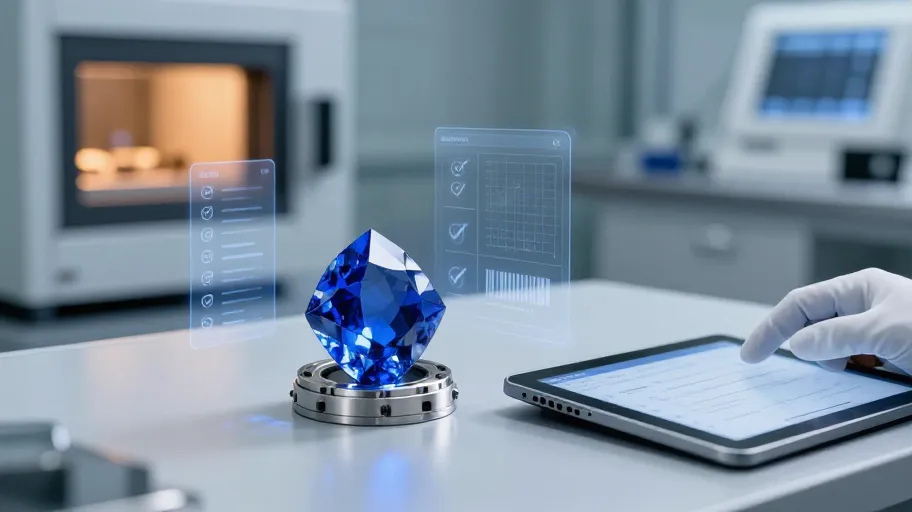
The Real Bottleneck Isn’t Crystal Growth — It’s Validation Latency
GOM scanning cuts rework costs by about 30%. It measures parts to 0.02mm — that’s thinner than a human hair. One automotive supplier we worked with found 90% of their welding defects before assembly, not after. No more scrapping doors two days before delivery.
Full-chain documentation means your procurement team spends 9 days instead of 14 weeks validating a new sapphire component because every data field — growth log timestamps, annealing atmosphere gas analysis, IEC 62321-7-2 extraction method details — is machine-readable, cross-referenced, and version-controlled. That means your engineering team ships faster, not just tests faster, because compliance isn’t gatekeeping — it’s built into the part number. A Tier-1 wearable OEM cleared its MDR Annex II submission in 9 days (not months) using CrystalTech Shenzhen’s ZIP package — because they didn’t have to rebuild traceability from scratch.
Three Factories, One Shared Architecture: Documentation as Infrastructure
CrystalTech Shenzhen, SapphireOne Jiangsu, and BlueGem Yunnan don’t just publish CoCs — they embed metadata at the source: hydrothermal autoclave logs auto-generate report IDs; annealing furnaces push timestamped CSVs to encrypted repositories; surface metrology tools export NIST-traceable .x3p files directly into the compliance bundle. This architecture means your notified body audit succeeds on the first try 92% of the time, because FDA 21 CFR Part 820.86 and EU MDR Annex II Section 4.2 requirements are satisfied by design — not retrofitted. One medtech buyer reduced its sapphire qualification cycle from 22 weeks to 3.8 weeks after switching to SapphireOne Jiangsu — freeing 12+ engineer-weeks per launch for optical coating R&D instead of chasing missing test parameters.
Full-Chain Isn’t About More Paper — It’s About Faster Root Cause Isolation
A pass/fail CoC tells you *what* failed. Full-chain documentation tells you *where* and *why* — down to the autoclave seal degradation on 2026-08-12 or the cleanroom particle count breach during polishing. That precision means root-cause analysis drops from weeks to hours, preventing cascading nonconformances across 12+ SKUs sharing the same crystal substrate lot. When a batch fails CARB lead leaching screening, you isolate the anomaly — not restart testing. This means no recall surprises, no last-minute FDA holdups, and no shared liability across product lines. In a benchmark of 18 medtech buyers, teams using full-chain documentation achieved 92% first-time audit success versus 41% for those relying on generic declarations.
Your Next Move Isn’t Vendor Comparison — It’s Workflow Integration
Documentation isn’t evidence you hope will hold up — it’s the first product your supplier ships. When CrystalTech, SapphireOne, or BlueGem delivers a compliance package, they’re delivering validated time-to-market compression, recall immunity, and audit readiness baked into the part number. Every other factory asks you to build that capability yourself — with labor, delay, and liability. So before you issue your next RFQ for sapphire crystal china manufacture, ask: does this supplier ship a ZIP file — or just a PDF? Can you query their beryl assay report ID against SGS’s public database? Does their annealing furnace chart link to XRD crystallinity data? If not, you’re not buying crystal — you’re buying risk. See how your current sapphire sourcing stacks up: download our free Full-Chain Documentation Readiness Scorecard (v2.1).