
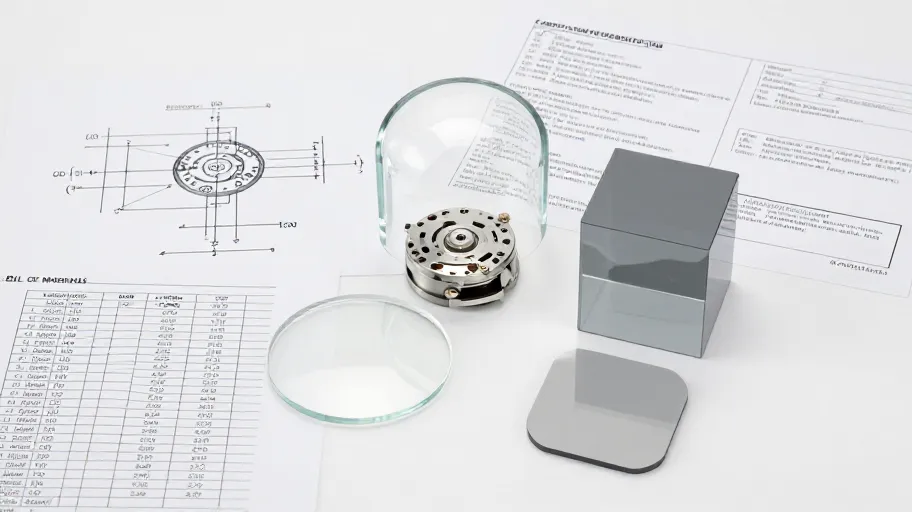
Sapphire watch glass types — flat, domed, box-shaped and coated variants — differ less in how they look in a render than in which parameters must be fixed in writing before a supplier can quote and tool them. The most reliable way to control this is the Drawing–BOM–Approval (DBA) split: geometry lives on the drawing, material and coating identifiers live in the BOM, and acceptance criteria live in the approval notes. Assigning every detail to exactly one document is what turns a crystal type from a nickname into a specification.
Watch designers and private-label buyers lose more time to undocumented assumptions than to bad geometry. A dome described only as "high domed" can be interpreted several ways; an AR coating named without a tint reference can pass one inspection and fail the next. The sections below walk through the main sapphire watch glass types, then show what each one demands from your drawing, your BOM and your approval notes.
The main sapphire watch glass types at a glance
| Type | What defines it | What it stresses in specification | Drawing | BOM | Approval notes |
|---|---|---|---|---|---|
| Flat crystal | Planar front surface, simple edge profile | Edge geometry, seating method, thickness interaction with the case | Overall diameter, thickness, edge profile, seating reference | Material grade line, coating line if any | Fit and visual acceptance criteria |
| Domed crystal | Curved front surface, single curvature | Dome height reference, curvature definition, edge transition | Curvature definition method, dome height datum, edge detail | Material and coating identifiers | Curvature and reflection acceptance method |
| Box / double-dome crystal | Curved front and curved profile with a flange or undercut | Flange geometry, undercut dimensions, assembly orientation | Full profile section, flange and gasket interfaces | Material, coating, gasket pairing if applicable | Profile check method, assembly fit, visual criteria |
| Coated variant (any of the above) | AR coating applied to one or both surfaces | Coating surfaces, residual tint reference, handling sensitivity | Coating boundary if it affects geometry | Coating specification line referencing the agreed definition | Tint and reflection acceptance criteria, handling and inspection conditions |
Use the table as a scoping tool: every tick in the "Approval notes" column is a question you should resolve with your supplier before sampling, not after.
What belongs on the drawing
The drawing is the geometry contract. Whatever is not dimensioned or referenced there is open to interpretation.
- Overall diameter and seating reference. State the diameter and identify which surface the dimension is taken from — a domed crystal measured across its base and one measured across its curve will not interchange.
- Thickness, with the case interface in view. Thickness interacts with gasket compression, case mouth tolerance and assembly clearance. Flag any dimension that must remain fixed because of the case design, and mark which dimensions are negotiable so the supplier can propose a manufacturable balance.
- Edge and flange profile. Flat crystals need a defined edge profile; box crystals need a full section drawing including flange and any undercut, because those features carry the seal and the assembly load.
- Curvature definition. For domed and box types, agree with your supplier how the curvature will be defined and inspected. Do not leave this to a supplier's internal habit.
- Tolerancing priorities. Rather than tightening every dimension, mark the ones that drive fit and function and ask the supplier to confirm which tolerances they can hold and how they will verify them. This is a project-specific conversation, not an assumption to import from a previous programme.
One drawing question to settle early: which document governs if the supplier's proposal differs from your drawing? Decide before sampling whether revisions supersede in writing.
What belongs in the BOM
The BOM answers a different question: not "what shape is it," but "which exact configuration do we purchase, and how is it identified?"
- A part number that encodes the configuration. A naming scheme that distinguishes geometry, coating and any paired component (such as a gasket) prevents the classic error of a revised crystal being ordered against an obsolete line item.
- Material line. State that the component is synthetic sapphire and reference the agreed definition of that term with your supplier. If hardness or composition documentation matters to your programme, ask what documentation the supplier can provide and record the agreement in your notes — do not assume a certificate will arrive by default.
- Coating line. If the crystal is coated, the BOM line should reference the same coating definition used in the approval notes: which surfaces are coated, and how the residual tint is described.
- Revision control. Every geometry or coating change should produce a BOM revision, tied to a drawing revision. If your BOM cannot carry revisions, the approval notes must state explicitly which drawing and BOM versions the approved sample corresponds to.
A useful discipline: if two people in your company could order the crystal and receive different parts, the BOM is not yet finished.
What belongs in the approval notes
The approval notes are where sourcing managers protect the programme. They convert subjective impressions — "clear," "not too blue," "edges feel fine" — into checkable criteria agreed before the first sample is made.
Write the approval notes as questions answered in writing:
- How will curvature and profile be inspected? For domed and box crystals, agree the inspection method and reference, so a passing sample and a passing production batch mean the same thing.
- How is the AR coating tint judged? Under what lighting and against what reference? Residual tint is visible under some conditions and invisible under others; agree the conditions in advance.
- What visual criteria apply, and at what inspection distance and lighting? Define what counts as an acceptable cosmetic condition for the crystal as delivered.
- What documentation accompanies approval, and what does it cover? Ask what paperwork the supplier can provide with the approved sample and with production batches, and what each document actually covers. Confirm this directly; do not assume the contents of any document.
- What is the current sample and ordering policy? Confirm with JadeZone Sapphire what a sample involves, what any associated costs or shipping arrangements are, and how revisions to an approved sample are handled. Policies differ and change; the only safe move is to confirm the current policy in writing before you plan around it.
- How are changes communicated after approval? Agree that any change to material, coating or geometry restarts the approval, and name the person on each side who signs off.
Choosing between the types: a short adviser's note
If you are early in a private-label programme, a practical sequence is: fix the case interface first, choose the crystal type that fits the design intent, then complete the DBA documents in order — drawing, BOM, approval notes — and only then request quotations. Quoting an incomplete specification produces prices that cannot be compared and samples that prove nothing.
FAQ
How do I decide between a flat and a domed sapphire crystal for my case? Start from the case mouth, the seating method and the design intent for reflections and perceived depth. A flat crystal is simpler to specify completely; a domed crystal requires you to agree a curvature definition and inspection method with your supplier. Compare the geometries against your actual case drawing rather than against catalog images.
What details must be on the drawing before a supplier can quote accurately? At minimum: diameter with its reference surface, thickness, edge or flange profile, and an agreed way to define any curvature. Tolerances should be prioritised rather than maximally tight, and you should ask the supplier to confirm which tolerances they can hold and how they verify them.
Where should AR coating requirements be documented? Split them: the coating identifier and covered surfaces belong in the BOM line; the tint reference, inspection lighting and acceptance criteria belong in the approval notes. Keep the same coating definition in both documents.
Should approval criteria be agreed before or after the first sample? Before. The approval notes are only useful if both parties write and sign the acceptance criteria before the sample exists. Otherwise the sample becomes the specification by accident, and revisions become arguments.
What should I confirm directly with the supplier before planning production? Confirm the current sample policy, any associated costs and shipping arrangements, documentation contents, revision handling and the supplier's own inspection capabilities. These are programme-specific and should be verified in writing rather than assumed from a previous project or another supplier.
Compare crystal geometries with your drawing in hand
Ready to move from type names to a real specification? Compare crystal geometries with JadeZone Sapphire: send your case drawing or crystal concept and ask which of the sapphire watch glass types fits your programme, and which drawing, BOM and approval details the supplier needs from you to quote it properly. Contact JadeZone Sapphire to compare crystal geometries.
Low-friction checklist — paste this into your spec pack before the next quotation request:
- Crystal type agreed (flat / domed / box) and named consistently everywhere
- Drawing: diameter, reference surface, thickness, edge or flange profile, curvature definition
- Drawing: tolerancing priorities marked, negotiable dimensions flagged
- BOM: part number encodes geometry, coating and paired components
- BOM: material and coating lines reference agreed definitions
- BOM and drawing revisions linked
- Approval notes: curvature and profile inspection method agreed
- Approval notes: AR tint reference, lighting and acceptance criteria agreed
- Approval notes: visual criteria, inspection distance and lighting agreed
- Approval notes: documentation contents confirmed with supplier
- Approval notes: sample, cost, shipping and revision policies confirmed in writing
- Named approvers on both sides