
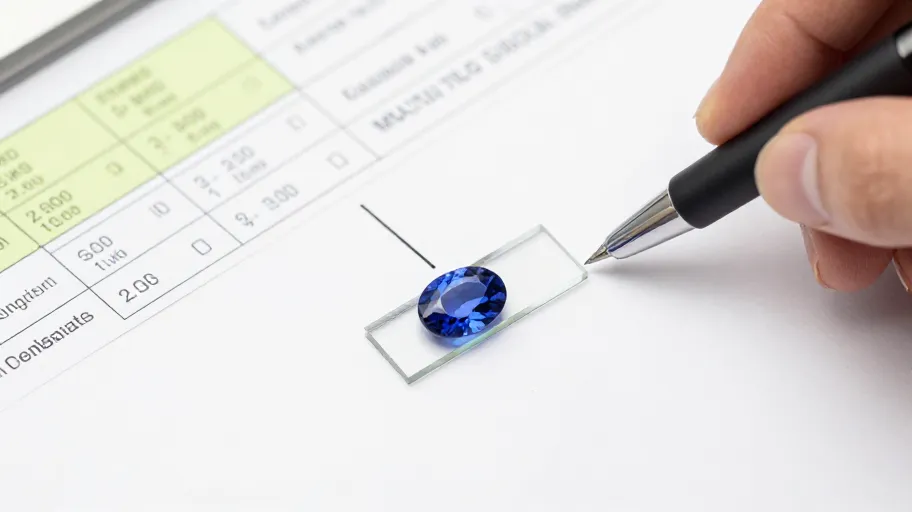
When a revised sapphire crystal sample arrives, the fastest path back to an accurate quotation is not a new enquiry but a structured review: restate the locked specification, compare the revision against the previous round in writing, put your remaining questions to your sapphire watch glass supplier directly, and document approval before asking for updated pricing. We call this the Sample Revision Loop: Specify → Compare → Question → Document → Approve.
Why revisions stall quotations
Most quotation delays after a sample round are not caused by the supplier. They are caused by an unclear change record. If the revision request was verbal — "make the edge slightly cleaner, adjust the coating look" — then the supplier must guess what changed, price a wider range of possibilities, or come back with questions. Any of those outcomes costs you time.
The second stall point is approval drift. Different stakeholders — design, engineering, procurement — each compare the revised sample against a different mental picture of the original. Without one written baseline, "approved" means something different to each of them, and the quotation you receive may be attached to a specification nobody fully agreed to.
The Sample Revision Loop exists to close both gaps before you request new pricing.
The Sample Revision Loop
Step 1 — Specify. Before you open the revised sample package, write down the current locked specification: crystal shape, diameter reference, edge finish, coating intent, engraving or logo requirements, and any assembly constraints from your case design. Mark each line as locked, revised this round, or open. Only the lines marked revised this round should drive the new quotation conversation.
Step 2 — Compare. Review the revised sample against the previous round, side by side, under the lighting conditions your QC team will actually use. Compare against the drawing, not against memory. Record what changed, what stayed the same, and anything that changed without being requested — the last category matters most, because unrequested changes are the ones nobody prices correctly.
Step 3 — Question. Send the supplier a written question set (see below) rather than an open-ended "can you also…". Written questions produce written answers, and written answers become the annex to your quotation.
Step 4 — Document. Log the approval decision: who approved, which sample round, which specification lines, and what remains open. One named owner should sign this off internally. Circulating a "looks fine to me" thread by email is not documentation.
Step 5 — Approve, then quote. Only after the specification record is complete should you ask for updated pricing. A quotation built on a documented specification can be compared line by line; a quotation built on assumptions cannot.
Use this decision table at the Compare step:
| What you observe on the revised sample | What it means for the quotation | Action before re-quoting |
|---|---|---|
| Matches the request and the drawing | Specification is stable | Mark the line locked; include it in the quote baseline |
| Matches the request but not the drawing | Drawing and sample diverge | Resolve which is authoritative; issue corrected drawing |
| Differs from the request | Scope has moved | Confirm whether the change is acceptable; if so, update the spec; if not, return it with the original request attached |
| Includes an unrequested change (finish, chamfer, coating look) | Hidden scope risk | Ask the supplier in writing what drove the change and whether it affects the quote basis |
| Cannot be verified with your in-house equipment | Verification gap | Agree with the supplier how conformance will be demonstrated and recorded |
Approval questions to put in writing
Copy these into your revision response. They convert an ambiguous sample round into a quote-ready specification.
- Specification confirmation: Please confirm in writing that the revised sample corresponds to drawing revision [reference] and list any deviations from that drawing.
- Change basis: For each difference from the previous sample round, please state what changed and why, so we can align our specification record.
- Verification method: For each critical characteristic on our drawing, please confirm how conformance will be demonstrated to us — inspection report, agreed sampling method, or another documented means we specify together.
- Quotation basis: Please confirm which specification lines the updated quotation will be based on, so pricing and drawing revision stay linked.
- Open items: Please list any specification lines you still need from us to finalise the quotation, so nothing is priced on assumption.
- Sample status: Please confirm the current sample policy — including any fee, shipping arrangement or approval process — as it applies to this next round, so we can plan internally.
Question 6 is deliberately neutral. Sample fees, shipping responsibility and approval processes vary and change; confirm the supplier's current policy directly rather than relying on assumptions or on what happened in a previous project.
What a good revision record looks like
A record you can hand to any supplier contains: the drawing revision reference; the sample round identifier; a line-by-line spec table marked locked / revised / open; the written Q&A with the supplier; the named internal approver and date; and the quotation request that follows. If any of those elements is missing, you are not reviewing a revision — you are starting a new negotiation with extra steps.
FAQ
Does requesting another sample round damage the supplier relationship or restart the process? Not if the request is structured. A supplier receiving a documented question set and a clear change record can respond precisely. What strains the relationship is a vague "not quite right, try again" with no specification anchor. Structure the request, and revision becomes routine engineering communication.
Who pays for additional samples, and is any fee returned on order? We cannot state a general answer, and you should not accept one from memory of a past project. Sample fees, shipping arrangements and whether any charge applies at all must be confirmed with the supplier's current policy for your specific project. Put it in writing before the next round is produced.
How many revision rounds should we expect before approval? There is no fixed number we can responsibly quote — it depends on design complexity, how complete your initial specification was, and how changes are communicated. What you can control is whether each round ends with a documented decision. Buyers who close every round with a written approval or a written change request tend to reach a settled specification in fewer rounds than those who do not.
Should we approve the sample before or after receiving the updated quotation? Approve the specification first, then quote. If you quote on an approved sample but the drawing has not caught up, the quotation and the eventual production drawing can diverge — and diverging documents are the root of most downstream disputes. Lock the documents, then price them.
What if our internal team cannot agree on whether the revision is acceptable? Do not send mixed signals to the supplier. Assign one approver, run the Compare step with the full stakeholder group present and the drawing on the table, and record the outcome — including any open items and who owns them. A single documented decision, even a delayed one, is cheaper for the project than two contradictory ones.
Prepare your next quotation the structured way
If you are preparing to re-quote a revised sapphire crystal — or briefing a sapphire watch glass supplier for the first time — send a brief that contains your drawing revision, your locked and open specification lines, and your written questions. The supplier can then return pricing against a specification you actually control.
Primary CTA: Prepare a quote-ready brief. Use the structure above — Specify, Compare, Question, Document, Approve — and submit your brief through JadeZone Sapphire's enquiry channel with your drawing reference and open items listed. Verify the response against your record, compare quotations line by line, and approve only what is documented.
Low-friction checklist CTA — run this before your next sample round:
- Drawing revision reference confirmed and circulated
- Spec table marked locked / revised / open
- Previous and revised samples compared side by side under QC lighting
- Written question set sent (including verification method and current sample policy)
- Supplier answers received in writing and filed
- One named internal approver recorded, with date
- Quotation request linked to the approved specification record