
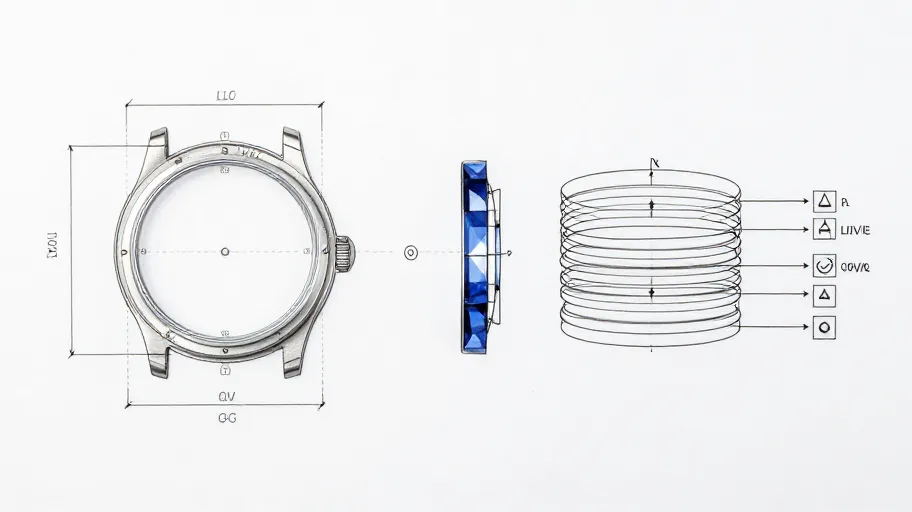
When you write "sapphire crystal tolerance watch" into an RFQ, the phrase alone settles nothing: what protects your project is a drawing that locks the datum, the assembly stack, the edge geometry and the inspection method before anyone quotes. We call this the Four-Lock Tolerance Framework, and it turns vague requirements into questions a supplier can answer in writing.
Why tolerance ambiguity is a sourcing risk, not a drafting detail
Most disputes between watch brands and component suppliers do not start with a bad part. They start with a drawing that two parties read differently. "Tight tolerance" means one thing to a design engineer thinking about the case fit and another to a production planner thinking about yield. Until both sides agree on which dimension carries the risk, which surface is the reference, and how the part will be measured, every quote you receive is an interpretation rather than a specification.
For a sapphire crystal — a hard, brittle material cut and polished to fit a case mid — the cost of that ambiguity is asymmetric. A small misreading can surface only at assembly, when the crystal sits proud of the gasket, rocks in the bezel seat, or fails a pressure check. By then the remedy conversation is about blame. The goal of a well-written RFQ is to move that conversation earlier, onto paper, where it costs nothing.
The Four-Lock Tolerance Framework
Lock the Datum. Every dimension on your drawing must be measured from a stated reference. Is the crystal diameter referenced from the centre, from a seating flange, or from the case opening? If two departments measure the same feature from different datums, a part can pass one inspection and fail another. State the datum in the drawing title block and repeat it in the RFQ text.
Lock the Stack. The crystal does not exist alone. Its height, flange position and gasket groove dimensions interact with the case mid, gasket and bezel in a single assembly stack. Specify the critical stack-up you need the crystal to satisfy, and ask the supplier to confirm which of those dimensions they will hold directly and which depend on your case parts. This single question prevents most "the crystal is fine but the watch leaks" arguments.
Lock the Edge. Sapphire edge geometry — chamfer angles, break-edge condition, coated zone boundaries — is where subjective interpretation creeps in. Describe edge features with referenced callouts and defined inspection conditions (lighting, magnification, viewing angle) rather than adjectives. "Clean edge" is not a specification; "edge condition inspected per the stated method" is.
Lock the Inspection. Agree, before sampling, how conformity will be judged: which instruments, which features, which sampling approach, and what happens when a measured value sits between limits. A crystal measured with a micrometer and one measured with an optical comparator can produce different readings on the same feature. Naming the inspection method in the RFQ is the cheapest risk control available to you.
Decision table: what to specify, what to ask, why it matters
| Lock | What you specify in the RFQ | What you ask the supplier to confirm | Why it matters |
|---|---|---|---|
| Datum | Reference surfaces and datum callouts on the drawing | That their measurement datums match yours exactly | Prevents two valid-looking inspection reports contradicting each other |
| Stack | Critical assembly dimensions and mating part references | Which dimensions they will guarantee on the crystal and which depend on your case parts | Separates crystal-side risk from case-side risk before production |
| Edge | Edge and flange callouts with defined inspection conditions | Their proposed inspection method and viewing conditions for those features | Converts subjective appearance judgements into agreed, repeatable checks |
| Inspection | Instruments and acceptance method you intend to use | Their measurement capability, equipment and reporting format | Aligns evidence, so approval is a documented decision, not an opinion |
Approval questions to put in writing
Before any sample is approved for production, put these questions to the supplier and keep the answers on file:
- Which drawing features will be held directly on the crystal, and which are assembly-dependent?
- What inspection method and equipment will be used for each critical dimension, and what report format accompanies delivery?
- How will the sample be documented — measured values per feature or a pass/fail statement only — so the production batch can be compared to it?
- What is the agreed handling if a delivered batch measures within drawing limits but fails at your assembly? Who measures what, and against which datum?
- What is the current policy on samples, sample-related costs and shipping for this project? Confirm the specifics directly with JadeZone Sapphire — do not assume any arrangement without written confirmation.
These questions are not adversarial. Serious suppliers welcome them, because each answer removes a future dispute from their side of the table as well as yours.
FAQ
Q: How tight should tolerances be on a custom sapphire crystal? As tight as the assembly stack requires, and no tighter. Over-specifying dimensions you cannot inspect or do not need increases cost and qualification time without adding protection. Work backwards from the case fit and gasket compression you need, then assign tolerance where it carries risk.
Q: Should I send a drawing with tolerances, or ask the supplier to propose them? Both. Send your functional requirements with the dimensions that matter, and ask the supplier to confirm or propose the achievable specification for each, in writing, before quoting. The comparison between your requirement and their proposal is itself valuable sourcing information.
Q: What belongs in the RFQ besides dimensions? The Four Locks: datum references, the assembly stack context, edge inspection conditions, and the inspection and reporting method you expect. Add project context — intended assembly, quantities you are planning for, and target timing — so the supplier can respond with a relevant proposal rather than a generic one.
Q: How do I compare quotes from different suppliers fairly? Compare only like-for-like specifications. If one quote assumes wider limits, a different datum, or a lighter inspection report than another, the price difference may reflect scope, not value. Normalise every quote against the same locked drawing first.
Q: What if my drawing is not final yet? You can still send a structured RFQ. State which dimensions are fixed, which are open, and what the assembly requires. Ask the supplier to flag feasibility risks on the open dimensions. An early, honest RFQ is a better risk tool than a late, perfect one.
Download the drawing checklist Our drawing checklist walks through the Four-Lock Tolerance Framework item by item, with the exact fields to complete and the approval questions to attach before you issue an RFQ. Use it on your next custom sapphire crystal project and keep it on file as your approval record.