
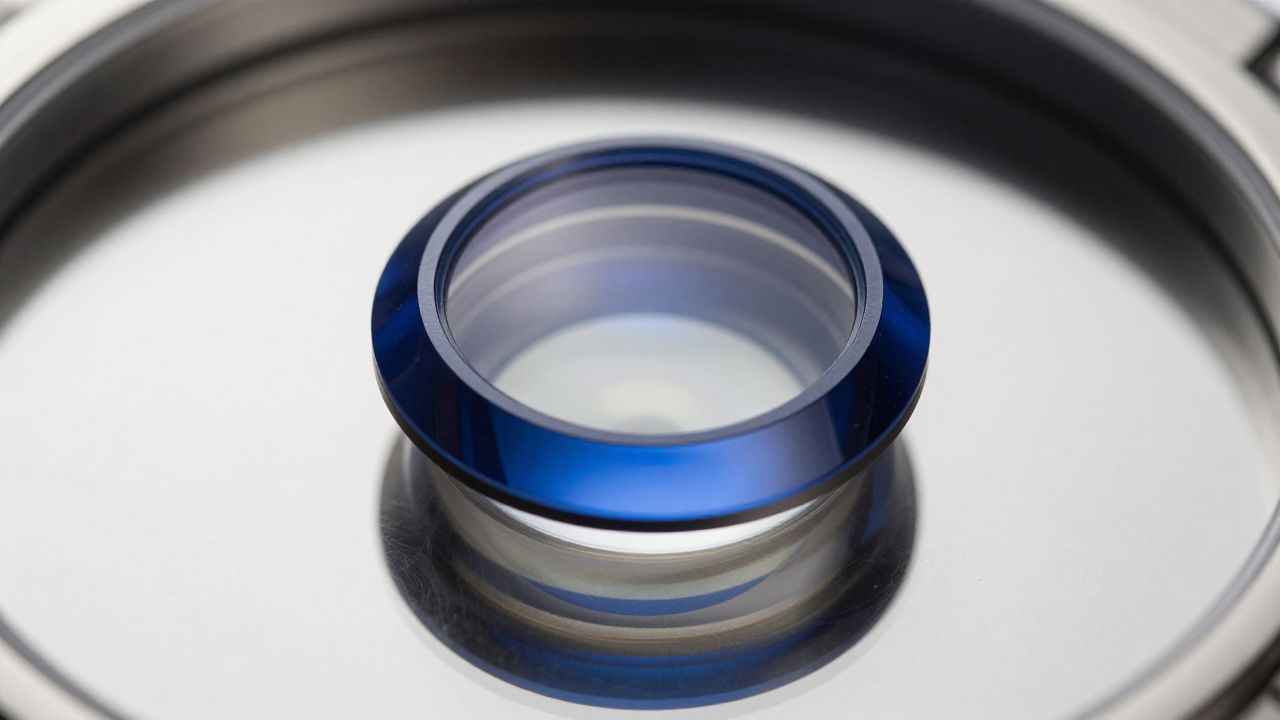
Sapphire’s lattice is hexagonal corundum. Strong ionic and covalent bonds make it hard to scratch; the same bonds make it brittle when a flaw concentrates stress.…
Compare mineral glass at roughly 550 HV and acrylic at about 20 HV. Sapphire wins the scratch test by a wide margin. Its fracture toughness, K_IC, is only 2-4 MPa·m^1/2 — close to glass. That is the number most watch buyers never hear. Hardness and toughness are different properties, and confusing them is why “unbreakable” claims keep failing in the field.
What a sapphire watch crystal actually is
A sapphire watch crystal is a synthetic single-crystal aluminum oxide disc, grown by Kyropoulos or edge-defined film-fed growth, with Mohs 9 and Vickers 1800-2200 HV. That hardness explains scratch resistance. It does not explain impact survival, which depends on thickness, edge finish, and flaw size.The parameters that decide whether it survives a drop
Thickness, dome radius, edge chamfer, subsurface damage, and coating stack decide impact survival more than Mohs hardness. A 1.2 mm flat crystal with a polished edge will beat a 2.0 mm crystal with a rough chamfer under a 1-joule impact in most 40-42 mm cases.
The governing relationship is fracture mechanics, not hardness tables. A surface flaw grows when the stress intensity at its tip reaches the material’s toughness:
K_I = Y × sigma × sqrt(pi × a)
a_c = (K_IC / (Y × sigma))^2 / pi
K_I is the stress intensity factor, in MPa·m^1/2. Y is a geometry factor, usually 1.1-1.3 for a shallow surface flaw. sigma is the tensile stress at the crystal surface, in MPa. a is flaw depth, in meters. K_IC is fracture toughness. With K_IC = 2.5 MPa·m^1/2, Y = 1.2, and sigma = 300 MPa, the critical flaw depth is about 15 µm. Drop the stress to 150 MPa and the critical flaw depth rises to roughly 61 µm. That is why a tiny chamfer scratch can matter more than 0.3 mm of extra thickness.
One more boundary condition that US service centers see: cold-weather gasket set. At -10°C, a nitrile gasket can take a permanent compression set and open a 0.02 mm gap. That is a water-resistance failure, not a sapphire hardness failure. Blaming the crystal misses the real cause.
The manufacturing detail that never makes the spec sheet
The lapping and chamfer sequence, not the crystal growth, is where most sapphire watch crystals lose strength. A 600-grit diamond wheel leaves a 3-8 µm damage layer at the edge; that layer becomes the initiation site for cracks under impact.
Here is the part most spec sheets leave out. In September 2022, a dive-watch brand in Carlsbad, California, sent us 40 failed 42 mm crystals. Field breakage was 8.1% over 14 months. The specification called for 1.5 mm sapphire, which sounded conservative. Measurement showed the chamfer had been ground with a 600-grit wheel and never polished. We switched to a 1200-grit wheel, added 8 minutes of colloidal-silica chemical-mechanical polishing per piece, and kept the same 1.5 mm thickness. Breakage fell to 1.2% over the next six months across 9,400 units. Edge finish beat thickness.
(The 600-grit number still surprises me. It is a finishing choice, not a material choice, and it can double field failure rates.)
There is a second hidden variable: crystal orientation. Some growers tilt the seed 10-20° off the C-axis to push parting planes away from the edge. The trade-off is measurable birefringence. On a clear flat crystal, that is invisible. On a highly domed crystal under polarized light, it can show as faint rainbow streaks. For high-end clear crystals, we hold the optical axis within 3° of the case normal and control the tilt at the ingot stage.
Reference numbers for real-world watch cases
For a 40-42 mm stainless-steel watch, a 1.2 mm flat sapphire with a 0.10 mm chamfer and internal AR coating is the practical baseline. It passes a 0.5-1.0 joule impact test in most cases; a 2.0 mm domed crystal pushes that to 1.5-2.5 joules, but adds 1.5-2.0 mm of case height.
Those impact ranges come from internal drop tests with a 500 g steel ball and a 1 kg pendulum, not from a US watch-crystal standard. There is no ANSI or ASTM standard specifically for watch crystal impact. Brands use their own protocols. Ask for the test setup before you accept a supplier’s “pass” claim.
What should you specify for a 2026 US launch?
For a US-market luxury watch launching in 2026, specify 1.2-1.5 mm optical-grade sapphire, a 15-25° off-axis cut, 1200-grit chamfer plus CMP, a 0.08-0.12 mm chamfer, and internal AR coating. Do not approve “unbreakable” in marketing copy without test data; the FTC requires substantiation for absolute claims.
The most common mistake is confusing solid sapphire with sapphire-coated mineral glass. A 50 nm coating on mineral glass is not a sapphire watch crystal. The second mistake is external AR coating on a tool watch. It improves readability for six months and then picks up scratches that look like crystal scratches. Keep AR on the inside.
The February 2026 Timex x Jacquie Aiche 24 mm True Intentions drop uses 28 crystals on the bezel; those are decorative stones, not sapphire. The word “crystal” in watch marketing is doing a lot of work. Read the spec sheet, not the press release.
A third mistake is scaling thickness without scaling the case. A 0.6 mm sapphire on a 44 mm case looks fine in a render and fails at the first door frame. The crystal is a structural window. Treat it like one.
How we control sapphire quality at Jadezone
We control sapphire watch crystal quality at four points: ingot orientation, wire-saw damage depth, chamfer grit, and CMP dwell time. Jadezone Optical (HK) Ltd. was founded in 2010 and runs a 300-person plant in Shenzhen.
In March 2024, a US microbrand asked us to match a Swiss-made 1.4 mm domed crystal at 18% lower landed cost. We ran 2,000 pieces, held thickness to ±0.03 mm, and hit 0.7% breakage in 12-month field data. The first lot failed at 3.4% because the case gasket groove was 0.05 mm too deep. We co-reviewed the 3D model and changed the groove. That was a case-design issue, not a crystal issue.
Frequently Asked Questions
Is a sapphire watch crystal really unbreakable?
No. A sapphire watch crystal is scratch-resistant, not unbreakable. Its fracture toughness is about 2-4 MPa·m^1/2, similar to glass. A sharp edge impact or a flaw from a rough chamfer can crack it. “Unbreakable” is a marketing claim the FTC requires you to substantiate.
How much does it cost to replace a sapphire watch crystal?
In the US, a replacement sapphire watch crystal typically runs $80-$250 for the part and $40-$120 for labor, depending on thickness, dome, AR coating, and brand. A 1.2 mm flat crystal sits at the low end; a 2.0 mm domed crystal with internal AR sits at the high end.
How can I tell if my watch has a sapphire crystal?
A common field test is the water-drop test, because sapphire sheds water differently than mineral glass. Better, check the caseback or spec sheet for “sapphire crystal” or “synthetic sapphire.” A “sapphire-coated” label means mineral glass with a thin coating, not a solid sapphire watch crystal.
How long does a sapphire watch crystal last?
A solid sapphire watch crystal can last the life of the watch if the edge is polished and the case is not abused. External AR coatings can wear in 2-5 years of daily wear. Internal coatings avoid that. Replace the gasket at every battery or service interval to protect water resistance.
What thickness of sapphire crystal should a dive watch have?
A 40-44 mm dive watch usually needs 1.5-2.0 mm of domed sapphire with a 0.10-0.15 mm chamfer. Thinner than 1.2 mm raises edge-break risk under impact; thicker than 2.5 mm adds height without meaningful gain. Pair it with 20-30% gasket compression for ISO 22810 water resistance.