
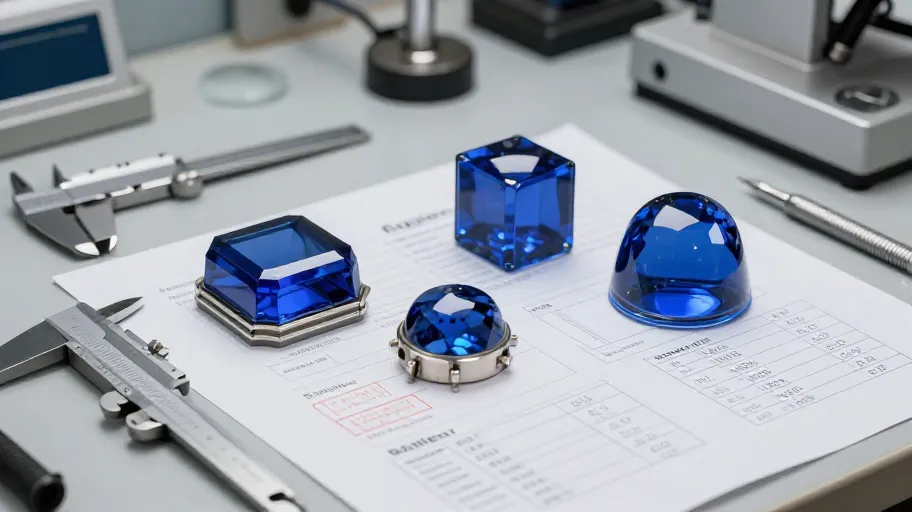
Sapphire watch glass types differ mainly in geometry — flat, domed, box-shaped, double-domed and bevelled variants — and each geometry changes how the crystal seats in the case, how it interacts with the bezel and how light reaches the dial. Before you approve bulk production, resolve five things: the geometry that fits your case architecture, the dimensional and edge specification, any coating requirement, the inspection criteria, and the supplier's stated confirmation on samples, cost and lead terms.
Why crystal selection is a specification decision, not a drawing detail
In many private-label projects, the crystal is treated as a line item on the case drawing and only examined closely when the first sample arrives. That sequencing creates rework. The geometry you choose determines the retention method, the gasket strategy, the clearance over the hands and date disc, and the way reflections behave on the dial side. Change any of those after tooling is underway and you are redrawing the case, not just the crystal.
A more reliable approach is to treat crystal selection as a specification decision made early, with the supplier involved while the case design is still flexible. That is the purpose of the framework below.
The Crystal Approval Loop: Define → Dimension → Specify → Verify → Approve
- Define. Choose the geometry family that matches your case architecture and design language. This is the moment to compare sapphire watch glass types against each other, not after the drawing is frozen.
- Dimension. Translate the geometry into a complete dimensional specification: diameters, heights, curvature descriptions, edge conditions and interface dimensions relative to the case and gasket. Every dimension that matters to fit should be on the drawing, with the tolerance approach agreed — the specific tolerance values are project-specific and should be confirmed with your supplier against their measurement capability.
- Specify. Add material and surface requirements: sapphire quality expectations, edge finishing, any anti-reflective coating and whether it is single-sided or double-sided, and any print or logo requirement on the crystal itself. Coating performance claims should be documented and verified, not assumed.
- Approve. Only approve bulk production when the drawing revision, specification, inspection plan and commercial terms all carry documented confirmation from the supplier. Approval is a signature against evidence, not an email that says "go ahead."
Decision table: matching sapphire watch glass types to case architecture
The table below is a planning aid for early-stage discussion. Confirm every interface detail with your supplier against your actual case design.
| Crystal geometry | Suits case architectures such as | Design considerations to raise with your supplier |
|---|---|---|
| Flat | Dressed cases, tool watches with flat bezels, minimal designs | Simplest seating; confirm gasket and retention method and clearance over hands |
| Domed (single curvature) | Vintage-inspired and classic designs | Confirm dome height, edge condition and how curvature affects reflections; consider coating |
| Box-shaped | Retro cases with stepped or boxed bezels | Confirm edge geometry, seating surface and dimensional interface with the bezel |
| Double-domed | Sport and field designs where curvature carries through the case | Confirm both surfaces' curvature, thickness at centre and edge, and inspection method for curvature |
| Bevelled or chamfered edge variants | Designs where the crystal edge is visible | Confirm bevel angles as project-specific dimensions and how the edge finish will be inspected |
No geometry is universally superior. The right choice depends on your case, your design language and your inspection plan — which is exactly why the comparison should happen before the drawing is frozen.
Questions to resolve before you approve bulk production
Bring these questions to your supplier in writing and record the answers against a drawing revision.
Geometry and dimensions
- Which geometry family does our case design require, and does the supplier recommend any changes to the seating interface?
- Are all critical dimensions on the drawing, and which tolerance values does the supplier confirm they can hold?
- How will curvature or dome profiles be measured and verified?
Material and surface
- What sapphire quality specification applies, and how is it verified?
- Is anti-reflective coating required, and if so, on which side(s)? What coating characteristics will be documented and inspected?
- Is there any printing, logo or marking on the crystal, and what is the acceptance criterion for it?
Process and inspection
- Which dimensions and characteristics are inspected, by what method, and against what acceptance criteria?
- What documentation accompanies a production run — inspection records, drawing revisions, specification sheets?
- What happens if a batch does not meet the agreed criteria? Agree the process in advance rather than negotiating a defect later.
Commercial and logistics
- What is the current MOQ for our geometry and specification? Confirm directly; do not assume a figure.
- What is the current lead time for sampling and for bulk production? Confirm per project.
- What is the sample policy — fee, contents, shipping arrangement? Confirm the current policy in writing before relying on it.
- What are the packaging and shipping arrangements for finished crystals, given that sapphire is hard but edges and coatings need protection?
FAQ
How do I choose between flat, domed and box-shaped sapphire crystals? Start from the case, not the crystal. The bezel profile, retention method and dial side clearance constrain which geometries will seat correctly. Compare the geometry candidates against your case drawing with the supplier, then document the chosen geometry with full dimensions before freezing the design.
When should I involve the crystal supplier in the design process? Early — ideally while the case design is still flexible. Suppliers who see the design before the drawing is frozen can flag seating, edge or clearance issues that are cheap to fix on paper and expensive to fix in tooling.
What should a crystal specification include before bulk approval? Geometry and all critical dimensions with agreed tolerances, edge condition, coating requirement if any, marking requirement if any, drawing revision reference, and an inspection plan stating what is checked, how, and against what criteria.
Can I change the crystal geometry after sampling? You can, but changes after sampling may affect tooling, inspection plans and commercial terms. If a change is needed, ask the supplier to confirm what it affects — including any cost or lead-time implications — before proceeding. Confirm current terms directly rather than assuming.
What documents should I keep on file for an approved crystal? At minimum: the approved drawing revision, the written specification, the inspection plan and acceptance criteria, and the supplier's written confirmations on samples, MOQ and lead terms. These documents are your reference if a future batch raises questions.
Compare crystal geometries before you freeze the drawing
JadeZone Sapphire manufactures custom sapphire watch crystals and precision sapphire components for watch brands, private-label programmes and watchmakers. If you are weighing sapphire watch glass types for an upcoming model, bring your case design and let's compare crystal geometries against your architecture — geometry, edge treatment, coating and inspection criteria — before you commit to bulk production.
Primary CTA: Compare crystal geometries — send your case drawing and design requirements, and receive a geometry comparison for your project. Confirm all sample, MOQ, cost and lead-time policies directly with the team.
Low-friction checklist CTA: Before your next bulk approval, run through the Crystal Approval Loop checklist above. If any box is unchecked, resolve it with your supplier first — then approve.