
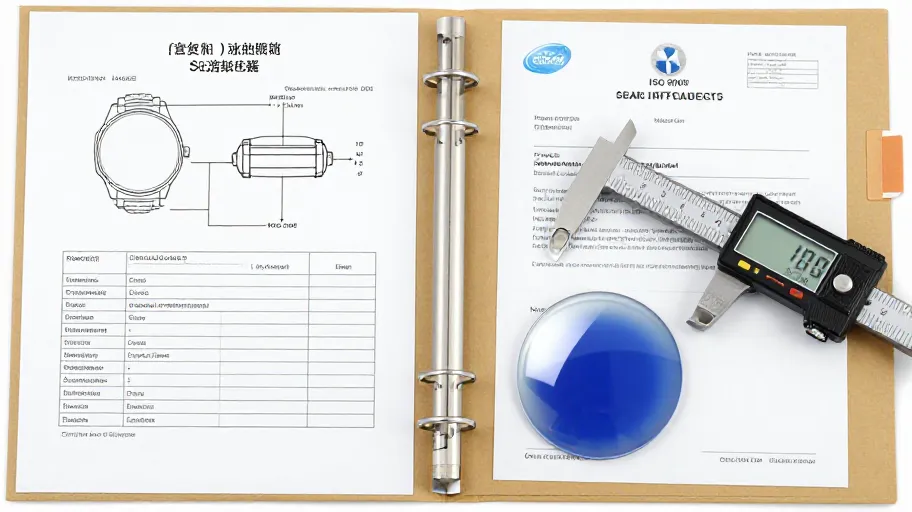
Before you approve a quotation from a sapphire watch glass supplier, assemble a Sign-Off Evidence File: a documented set of specifications, drawings, process confirmations, acceptance criteria and correspondence that defines exactly what you are buying. A quote is only as reliable as the evidence behind it — and the file you keep before sign-off is what protects your brand when production, inspection or a repeat order begins.
Why evidence beats assurances
Procurement teams buying custom sapphire watch crystals deal with a product where small definition gaps become large commercial problems. A crystal that is slightly out of specification, a coating described in vague terms, or an acceptance criterion that was never written down can cost a watch brand far more than the component itself — in assembly delays, warranty conversations and inconsistent batches.
The uncomfortable truth is that verbal assurances, however sincere, do not survive contact with a production floor. What survives is documentation: a drawing with stated tolerances, a written confirmation of material grade, an agreed inspection method, a named contact responsible for deviations. A disciplined sapphire watch glass supplier will welcome that level of definition; a disciplined buyer demands it.
The framework below organises the evidence into five groups. Treat it as a gate: if a group is incomplete, sign-off is premature.
The Sign-Off Evidence File: five evidence groups
| # | Evidence group | What to keep on file | Why it matters at sign-off |
|---|---|---|---|
| 1 | Definition evidence | Final drawings, dimension callouts, edge and curvature descriptions, coating specification in writing, material description | Defines the product itself; the single reference for what was quoted |
| 2 | Process evidence | Written confirmations of the manufacturing route, any secondary operations, coating application and packaging method | Explains how the quoted price and route were derived; makes deviations visible |
| 3 | Acceptance evidence | Agreed inspection criteria, measurement methods, sample-approval reference and the definition of what counts as a conforming piece | Removes arguments later; inspection cannot be "reinvented" after delivery |
| 4 | Commercial evidence | The quotation document itself, validity period, any tooling or setup items listed separately, and terms as confirmed in writing | The commercial baseline you are approving; separates one-off costs from per-piece costs |
| 5 | Correspondence evidence | The email trail that resolved ambiguities, plus a named contact for technical questions | Captures decisions that never made it into formal documents |
Two disciplines make the file work. First, every ambiguous term in a quote gets rewritten as a specific question and the answer is archived. "Sapphire crystal" alone is not a specification; the written definition is. Second, the file is versioned: when a drawing or criterion changes during sampling, the old version is marked superseded rather than deleted, so the history of the decision is preserved.
Approval questions to ask before you sign
Copy these into your enquiry or review call. Each one converts an unknown into a documented answer:
- Which drawing revision does this quotation apply to, and is that revision the one attached to the purchase order?
- How is the sapphire material described in the quotation, and what written material confirmation will accompany it?
- What inspection method and criteria will be used to judge conformity, and who performs the inspection?
- What exactly does the approved sample represent — dimensions, appearance, coating, finish — and does the approved sample become part of the contractual definition?
- What happens if a delivered batch does not meet the agreed criteria: what is the process, who decides, and what are the remedies?
- Who is the named technical contact for deviation questions during production?
- Are there separate line items for tooling, setup, coating or packaging, and which of them recur on a repeat order?
Some of these questions touch on policies — sampling, remedies, recurring costs — that vary by supplier and by project. This article does not state any such policy, and you should confirm the current position directly with the supplier in writing before sign-off. What matters for your evidence file is not what a policy is called, but that a specific, current answer is documented.
How to compare quotations fairly
If you are evaluating more than one sapphire watch glass supplier, comparison only works when the inputs are identical. Send the same drawing revision, the same specification questions and the same acceptance criteria to each supplier, and score the responses in the same table.
| Comparison point | What to record per supplier | Red flag to watch for |
|---|---|---|
| Specification response | Does the supplier answer each specification question in writing, or restate marketing language? | Questions answered only verbally |
| Drawing discipline | Does the quote reference a specific drawing revision? | Quotes issued against an unnamed or unstated drawing |
| Acceptance criteria | Does the supplier propose an inspection method, or accept yours? | No proposal for how conformity will be judged |
| Cost structure | Are one-off and recurring items separated? | A single opaque figure with no breakdown |
| Communication quality | Speed and specificity of answers during quotation | Slow, vague answers at quotation — a signal for later stages |
A quotation that arrives quickly but cannot answer specification questions is harder to approve than a slower quotation with complete written responses. Price comparison without specification comparison is not procurement; it is a coin toss with extra steps.
Archiving for repeat orders
Custom sapphire crystals are rarely a one-time purchase. Collection updates, replacement crystals for service and running production all depend on being able to repeat an earlier order exactly. Your Sign-Off Evidence File is what makes repetition possible:
- Store the final drawing revision, approved-sample reference and acceptance criteria together as a single "order record", not as scattered emails.
- Record the quotation number against the order record so commercial history is traceable.
- Note any deviation decisions made during production, with dates and the person who approved them.
- When reordering, send the complete order record rather than a drawing alone — this gives the supplier the full definition and removes the most common source of repeat-order surprises.
For a sourcing team, the habit is simple: nothing is signed until the file is complete, and nothing is reordered without the file attached.
FAQ
What evidence matters most when approving a sapphire crystal quotation? The definition evidence — final drawings, written material description and written coating specification — matters most, because everything else is judged against it. Acceptance evidence runs a close second: without an agreed inspection method, conformity is a matter of opinion.
Should I approve a quotation before receiving and approving a sample? That is a policy and sequencing question to confirm with the supplier directly. What you can control is documentation: if a sample is part of your process, record in writing what the approved sample represents, and make that record part of the contractual definition before sign-off.
How do I compare quotes from different sapphire watch glass suppliers fairly? Send identical inputs — same drawing revision, same specification questions, same acceptance criteria — and compare the written responses. Score completeness of answers, drawing discipline and cost transparency alongside price.
What questions reveal a supplier's reliability during quotation? Questions about inspection method, deviation handling and named technical contacts. A supplier's willingness to define conformity and accountability in writing tells you more than any claim about capability.
What should I keep on file for a repeat order? The final drawing revision, approved-sample reference, acceptance criteria, quotation number, deviation decisions and named contacts — as one versioned order record, attached to every repeat enquiry.
Prepare a quote-ready brief
If you are preparing an enquiry for custom or OEM sapphire watch crystals, JadeZone Sapphire can work from your brief: drawings, dimensions, coating requirements, quantities and target application. Send your specification and questions, and the quotation you receive back will be built on documented answers you can file — the start of your own Sign-Off Evidence File.
Prepare a quote-ready brief with JadeZone Sapphire today.
Low-friction checklist
Before sign-off, confirm you can tick every box:
- Final drawing revision attached to the quotation and the purchase order
- Material and coating descriptions confirmed in writing
- Inspection method and acceptance criteria agreed and archived
- Approved-sample reference recorded, if sampling is part of your process
- One-off and recurring cost items separated in the quotation
- Deviation-handling process and named technical contact documented
- All supplier policies relevant to your project confirmed directly in writing
- Order record assembled and versioned for future repeat orders