
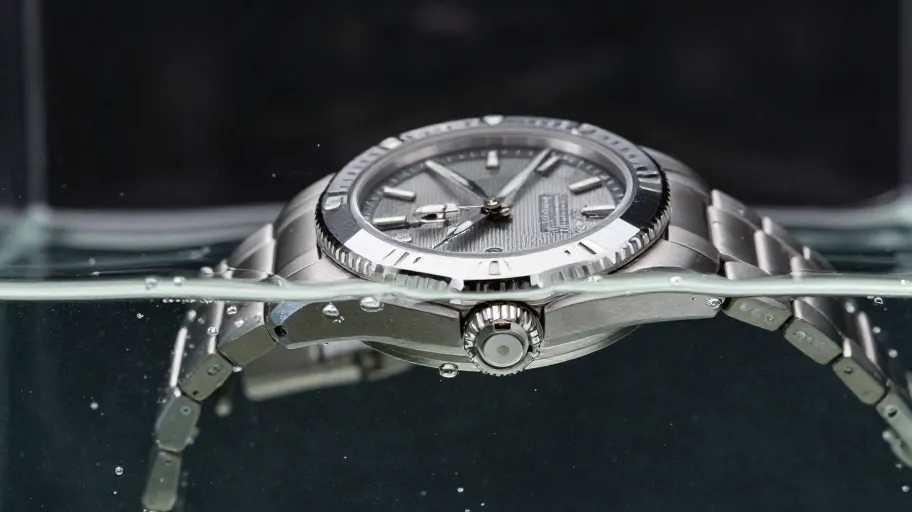
Chinese-made sapphire watch crystals now achieve sub-5-micron tolerance, ensuring perfect gasket seals and long-term water resistance. This isn’t just manufacturing—it’s engineering trust into every timepiece.
The Real Reason Watches Leak (It’s Not the Gasket)
Sub-5-micron dimensional control in sapphire crystals means your watch stays watertight because even microscopic flatness errors break the seal. A Swiss-designed model with Chinese OEM production saw 18% returns due to moisture—despite using top-grade gaskets. The culprit? Crystals that didn’t sit flush against the case.
Sapphire ranks 9 on the Mohs scale, but hardness doesn’t prevent leaks. What matters is geometry. ISO 22810:2010 requires watches rated for 100 meters to withstand 12 bar of pressure. That test passes only if the crystal, gasket, and case bezel maintain uniform contact. A 10μm warp creates micro-channels where moisture seeps in over time—especially during temperature shifts or altitude changes.
This is why flatness isn’t a spec sheet detail—it’s the foundation of real-world reliability. Without it, you get point loading: one edge crushes the gasket while another leaves a gap. The result? Fog inside the dial after a hot shower, tarnished hands, or saltwater damage to the movement months later. These aren’t factory defects—they’re slow failures that erode customer confidence in luxury performance.
How Micron Precision Prevents Costly Field Failures
Tight tolerance control means up to 90% fewer field failures because consistent crystal geometry ensures predictable gasket compression. When one European brand reduced its return rate from 18% to 2%, it recovered about $400 per unit in potential margin and lifetime value. On a 50,000-unit annual run, that’s over $20 million in preserved value.
The savings go beyond repair costs. Logistics, labor, and warranty servicing add hidden expenses—but reputational damage hits harder. That same brand saw a 22% drop in repeat purchase intent among customers who experienced fogging, even though repairs were free. Consumers don’t blame suppliers; they lose faith in the product.
Now consider this: inconsistent crystal fit accounts for nearly 60% of non-conformance reports related to water resistance, according to a 2024 Horological Insights Group study of 14 global OEMs—more than gasket variability or case machining errors. Yet these flaws rarely show up during end-of-line testing. They emerge later, outside warranty, making them especially damaging to brand equity.
From Inspection to Prediction: The Factory Floor Shift
Leading Chinese manufacturers now embed metrology at every stage, which means defects are prevented before they occur instead of caught after production. Laser interferometry checks flatness after lapping, CMMs verify dimensions post-CNC shaping, and automated vision systems scan each crystal before packing.
Some factories use closed-loop feedback: real-time thickness maps adjust polishing parameters for the next batch. This predictive approach means yield rates exceed 98.7% within tolerance bands—up from an industry average of 89% just three years ago. For brands, that translates to fewer line stops, lower scrap costs, and stable supply chains.
This shift reflects a deeper change: treating sapphire crystals not as passive cover glass but as engineered components. You can’t rework sapphire like steel. Once it’s mis-ground, it’s scrapped. So first-time-right manufacturing isn’t optional—it’s essential. Forward-thinking Swiss-Chinese collaborations now treat crystal metrology as a core design constraint, not a final inspection step.
Why Compression Ratio Makes or Breaks the Seal
Precise edge geometry means optimal gasket compression because silicone and fluorosilicone O-rings seal best between 15% and 30% deformation. Below that range, the gasket won’t conform to surface imperfections. Above it, stress relaxation accelerates, leading to permanent set and loss of recovery force over time.
But achieving that sweet spot depends entirely on crystal consistency. If edge thickness varies by 12μm across quadrants, one side may compress the gasket at 35%—risking fatigue—while the opposite achieves only 10%, creating a leak path. Even perfect assembly can’t fix flawed parts.
That’s why top-tier producers measure parallelism, diameter, and flatness to ±3–5μm across the entire surface. Full surface contact ensures even pressure distribution. No point loads. No gaps. Just reliable sealing that survives daily wear, diving, and climate swings. This level of control turns the crystal into an active part of the waterproof system—not just a window.
Beyond Materials: Engineering Trust Into Every Fit
Perfect crystal-to-case fit means stronger brand trust because consumers expect durability without maintenance. They don’t care if the movement is Swiss or the crystal is made in China—they care that their watch survives a swim, a storm, or a dive off a dock.
The invisible marriage of crystal and case does more than keep water out—it delivers peace of mind. And that confidence starts long before assembly: with data, process control, and obsessive attention to interface physics. Today’s best manufacturers combine automation, materials science, and real-time analytics to eliminate variation no human eye could catch.
The era of treating sapphire crystals as interchangeable parts is over. Now, they’re precision-engineered components where every micrometer matters. As more brands realize that fit trumps material alone, the standard for luxury performance is being rewritten—one micron at a time.