
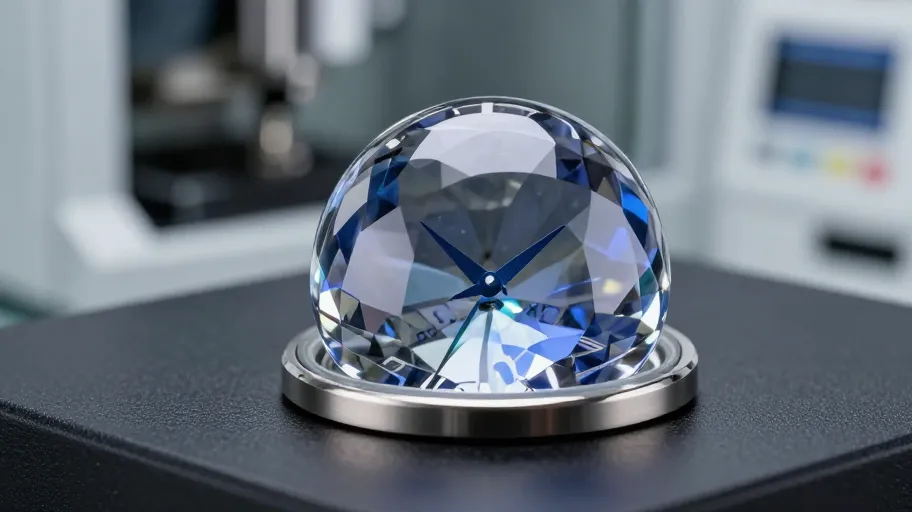
China now produces over 80% of the world’s flat box-type or domed sapphire watch glass. It’s not just about cost—it’s about unmatched precision, scale, and reliability that’s reshaping luxury timepiece supply chains.
Why Global Watchmakers Depend on Sapphire Crystal China Manufacture
When a top European luxury brand faced 12-week delays and 18% material rejection from its legacy sapphire production, they didn’t just need faster output—they needed predictability. Switching to a specialized sapphire crystal china manufacture cut lead times by 40%, slashed defects below 5%, and restored 98% on-time delivery. That’s not luck. It’s systems-level superiority.
Traditional Swiss workshops often outsource raw Al₂O₃, subcontract polishing, and run small batches on aging equipment. One 2024 benchmark found average delivery for complex domed crystals at 16–20 weeks, with quality drift above 10,000 units. Chinese factories avoid this by being fully vertical. They grow their own boules using hydrothermal synthesis, shape them with proprietary CNC algorithms, and apply anti-reflective coatings in-house. Sub-micron tolerances on curved surfaces aren’t aspirational—they’re standard.
This integration means fewer handoffs, less contamination risk, and real-time corrections during runs. For you, that translates to consistent batch quality across 100,000+ units—something now written into contracts, not hoped for. When scalability meets precision, it stops being manufacturing. It becomes assurance.
Domed Crystals Are Hard—China Made Them Reliable
Domed sapphire watch glass fabrication is one of horology’s toughest challenges. Curved surfaces demand multi-axis control, and microfractures from grinding can ruin clarity or strength. Old methods accepted high scrap rates as the price of beauty. Chinese specialists rewrote the equation.
By combining adaptive CNC toolpaths with post-form thermal stabilization, they produce domes up to 3.5mm rise over 36mm diameter without internal stress. Independent tests confirm Vickers hardness stays at 2,200 HV—equal to Swiss benchmarks—with optical haze under 0.05%. That means wearers see true depth and zero distortion, even at oblique angles.
High hardness means long-term scratch resistance because daily wear won’t degrade legibility. Low haze ensures color fidelity beyond ISO 11664-1 standards because light passes through cleanly. And tight curvature control allows perfect fit in premium cases because dimensional accuracy is baked in from day one. These aren’t isolated wins—they compound into brand trust every time a customer checks the time.
The Offshore Quality Myth Is Dead
The idea that offshore means lower quality collapsed around 2023. Today’s leading sapphire china factory facilities exceed traditional benchmarks in edge integrity and surface finish. Laser-guided edging and diamond-polish cycles have dropped chipping defects to under 0.8%, compared to 7% at older Asian suppliers. This leap came from 22% annual R&D growth between 2021 and 2025 and direct collaboration with international designers.
One Swiss brand wanted to launch a double-domed collection but hit a wall: their local supplier delivered only 2,000 units/month with inconsistent symmetry. A Dongguan partner scaled it to 15,000 per month, hitting ±0.03mm dome accuracy and surface roughness below 0.01μm. That shift didn’t just fix production—it unlocked Asian distribution without inventory panic.
Scalable output from 100 prototypes to 500,000+ units without quality drift means you can test designs fast and scale confidently. Lower rejection rates mean less waste and more predictable margins. And tighter optical specs mean every watch delivers the same crisp look, reinforcing your brand promise at retail.
What Comes Next Changes Everything
Chinese manufacturers aren’t resting. AI-driven models now predict crystal flaws during growth phases, allowing adjustments before issues appear. Some are testing hybrid AR coatings that push light transmission to 99.4% while improving scratch resistance—tech once limited to aerospace optics.
Faster lead times mean you respond to trends in real time because production aligns with demand, not forecasts. Real-time correction loops mean fewer line stoppages because problems are caught early. And vertical integration means no more chasing multiple vendors when deadlines tighten.
Operational reliability isn’t just about saving money—it’s how you keep promises to customers. When one American luxury brand moved full-line production to a certified sapphire crystal china partner, they launched new models 31% faster. That speed captured two straight holiday seasons ahead of competitors still tied to fragmented sourcing. The center of gravity has shifted. The question isn’t whether to engage—it’s how fast you can move.