
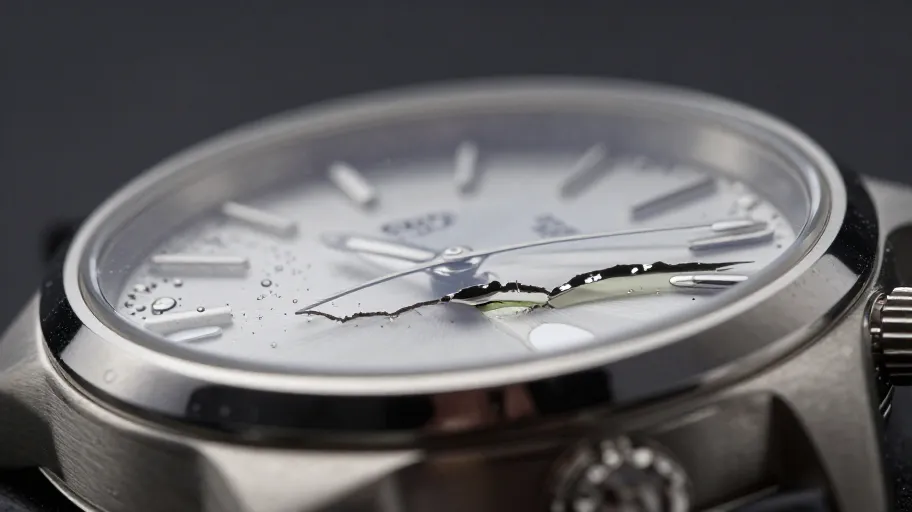
The invisible war against water ingress
Sub-micron dimensional control means your watch stays dry under pressure because even 2–3µm of crystal warpage breaks the seal. That tiny gap lets moisture sneak in during swimming or humidity swings—especially when temperature changes stress the case. We’ve seen brands lose nearly 18% of units to fogging and corrosion, all traced back to flatness flaws that passed visual checks but failed real-world use.
ISO 22810:2010 sets the bar for water resistance, but it assumes perfect surface mating. When crystal flatness deviates, the gasket compresses unevenly—high spots bear too much load, while low areas leave micro-leaks. These don’t show up in factory tests, but they do appear six months later when a customer opens their watch and finds rust. The cost? More than repairs—it’s lost trust.
Optical clarity isn’t enough
Scratch-resistant, flawless transparency means nothing if the crystal doesn’t sit perfectly flat, because sealing depends on full gasket contact—not looks. Many factories in China prioritize optical performance but skip advanced metrology, leaving flatness unchecked. That creates a dangerous blind spot: components that pass inspection but fail in the field.
We worked with a supplier whose crystals met every clarity standard but still caused 30% retest failure at final assembly. Once they added white-light interferometry to measure surface topography, leaks dropped by 43%. The fix wasn’t better materials—it was better measurement. Now, every crystal is validated before it leaves the factory, which means fewer surprises downstream and more predictable yields.
Gasket fatigue starts at assembly
Gasket compression hysteresis means long-term seal integrity depends on how evenly the elastomer is pressed during initial assembly, because uneven loading accelerates material fatigue. A 2024 polymer study found gaskets paired with >3µm flatness deviation lost up to 60% of rebound force after just 50 thermal cycles—far below the 500+ cycle life expected in premium watches.
This isn’t just about durability—it’s about timing. A watch might pass its initial pressure test but degrade fast in daily use. One brand discovered this after receiving complaints from tropical markets where humidity and heat cycled daily. Their fix? Digital twin modeling using actual crystal flatness data to simulate gasket stress before production. Now, borderline parts are flagged early, reducing latent failures and warranty claims.
The real cost of skipping precision
A single rework event costs about $45 in labor, disassembly, and cleaning, which means 18% failure across 100,000 units burns $810,000—just in direct costs. But the hidden toll includes damaged reputation, negative reviews, and lost customer lifetime value. By comparison, investing $8 more per crystal in CNC lapping and closed-loop metrology eliminates 90% of those issues.
The ROI becomes clear at scale: one Shenzhen factory freed up capacity equal to 120,000 extra units per year just by cutting rework. No new machines, no overtime—just better upfront control. That shift turns suppliers from vendors into engineering partners, capable of feeding real-time flatness data to Swiss HQs for joint quality oversight.
The future is predictive waterproofing
Finite element analysis means manufacturers can now predict seal performance before assembly, because simulation models ingest actual crystal flatness data and forecast stress points. Leading factories run these checks automatically, flagging components that risk premature gasket wear—even if they meet nominal specs.
This leap from reactive testing to predictive validation is becoming a competitive edge. As smartwatches add charging ports and sensors, maintaining hermetic seals gets harder. Factories mastering sub-micron control today aren’t just preventing leaks—they’re enabling next-gen designs where every micron of precision unlocks new functionality. For global brands, that means confidence in sourcing high-performance crystals from China without compromising reliability.