
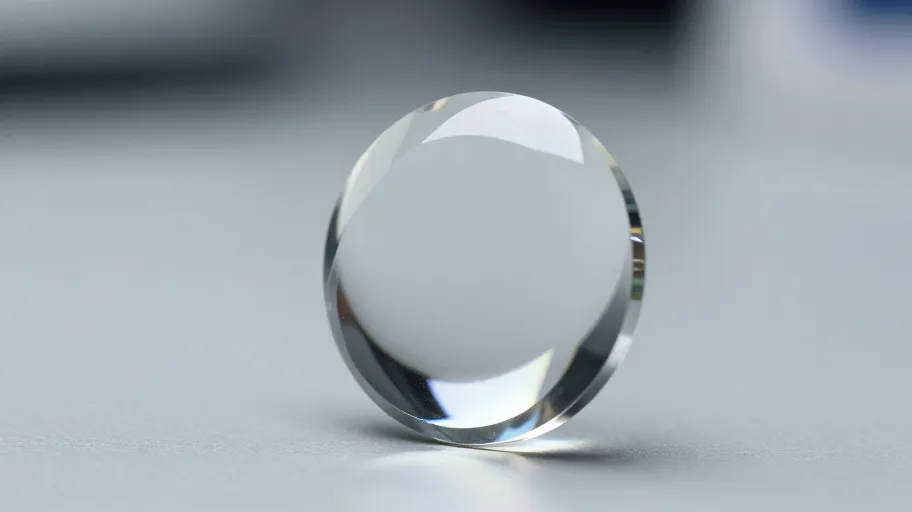
How double side AR coating turns sapphire into invisible optics
Double side AR coating means you get over 99.5% visible light transmission because anti-reflective films are applied to both surfaces of the sapphire crystal. That’s critical because uncoated sapphire reflects about 8% of incoming light at each air-to-sapphire interface due to refractive index mismatch. With only one side coated, you still lose nearly 8% on the reverse—capping total transmission at around 92–93%. But when both sides are treated with precision multi-layer dielectric coatings via PVD, reflection drops below 0.25% per surface.
This means sharper image fidelity and less glare in real-world use—because human eyes don’t care about lab specs, they care about readability under sunlight. For avionics displays, that extra 6–7% transmission prevents data washout during midday solar exposure, reducing pilot cognitive load. One Tier-1 aerospace supplier saw a 68% drop in brightness-related service calls after switching to double-side coated crystals from a leading sapphire China factory.
It also means lower power demands. In medical endoscopes, every lost percentage point forces higher illumination intensity, increasing heat on delicate tissues. Dual-coated sapphire reduces that burden, improving patient safety and extending device life. The physics is simple: two interfaces demand two solutions.
Single side may save money now but risks more later
Single side AR coating means acceptable performance in low-risk environments because it cuts reflectance on one surface to ~0.5%, which works fine for indoor consumer wearables or basic sensors. It typically costs 18–25% less per unit than double-side treatment, making it tempting for budget-driven projects.
But this choice often leads to hidden downstream costs because system integration magnifies optical inefficiencies. In LiDAR systems, even 1% residual reflectance across multiple components creates ghosting and false object detection. A 2025 SAE International simulation showed replacing single-side with double-side coated sapphire reduced false positives by 41% in urban driving conditions.
For procurement teams, that means settling for single-side introduces risk not just in performance, but in warranty claims, recalibration labor, and brand damage. One defense contractor’s financial model found a 4.3x ROI over five years after upgrading to double-side coated sapphire—driven by increased mission readiness and reduced field maintenance.
China factories now lead in coating precision and consistency
Advanced sapphire China factories mean tighter batch-to-batch repeatability because they use automated plasma-assisted PVD systems with real-time closed-loop monitoring. This level of control ensures sub-nanometer layer uniformity across thousands of units—something legacy suppliers in Southeast Asia struggle to match.
A 2024 OpticaTech Insights benchmark found top Chinese manufacturers achieved coating consistency within ±1.2% variation over 10,000 units, outperforming regional competitors by 40%. That means engineers can rely on optical models without worrying about unexpected reflectance spikes in production runs.
And it’s not just about replication—these factories now co-engineer optical subsystems. They offer custom spectral tuning for specific wavelengths like 532 nm (green lasers) or 1550 nm (eye-safe LiDAR), turning component suppliers into design partners. That access means faster innovation cycles and better integration without sacrificing quality.
From optics to operational advantage
Higher optical throughput means lower-power system designs because less energy is wasted on reflection losses. One medical OEM redesigned its portable dermatoscope using double-side AR-coated sapphire and cut battery size by 30% without compromising image quality—accelerating time-to-market by 22%.
Improved contrast ratio enhances usability in variable lighting, which is a key differentiator in military, outdoor, and clinical settings. Reduced need for system-level calibration means up to 35% faster production test times, according to yield data from Shenzhen-based integrators.
The clearest optics don’t just transmit more light—they prevent failures. As global standards rise for display clarity and sensing accuracy, double side AR coating is no longer a premium option. It’s the baseline for reliable, high-performance systems built today. If your product involves visual interpretation, operates in mixed lighting, or connects to other optical elements, skipping dual coating isn’t saving money—it’s betting against success.