
Micron by Micron The War for Dimensional Clarity
Dimensional accuracy in sapphire isn’t just about looking good—it means your optical system performs reliably under real-world conditions. When a sapphire window varies by more than ±1µm across its surface, it distorts light paths in LiDAR, AR displays, and medical sensors. That tiny shift can reduce detection accuracy by up to 15%, delay product launches, or trigger field failures.
China’s top sapphire factories solve this with closed-loop CNC polishing systems that measure thickness in real time and adjust pressure on the fly. This means each wafer meets tight tolerances without endless rework—because adaptive correction cuts post-process corrections from 22% down to under 4%. For OEMs, that translates to an 18% drop in unit cost and faster time-to-market.
One U.S.-based wearable maker saw a 37% reduction in customer complaints after switching to Chinese-sourced sapphire certified for <±0.5µm flatness. Why? Consistent optics mean fewer false alerts in blood oxygen tracking. In healthcare devices, precision isn’t overhead—it’s patient safety built into the lens.
Surface Quality Where Nanoscale Defects Cost Millions
Surface imperfections in sapphire don’t just look bad—they kill semiconductor yields. A single 2-micron pit can become a crack during thermal cycling, wiping out entire chip arrays in advanced packaging. That’s why elite Chinese sapphire lines adhere to MIL-PRF-13830B standards, routinely achieving 10-5 scratch-dig ratings—on par with Japanese suppliers but at half the lead time.
Instead of relying on human inspectors comparing samples under angled light, these factories use machine vision powered by deep learning models trained on thousands of defect images. The system detects grayscale anomalies invisible to the eye and classifies them with 99.2% accuracy. One Anhui-based plant reported a 44% jump in first-pass yield after deployment, saving $2.8 million annually in reprocessing and warranty claims.
Better surface quality also unblocks downstream production. A Singapore MEMS foundry eliminated pre-bonding microscopy checks when sourcing from AI-verified Chinese lines, shortening assembly cycles by 11 hours. In high-mix environments, time saved upstream becomes capacity unlocked downstream.
AI Inspection How Machines Keep Humans Honest
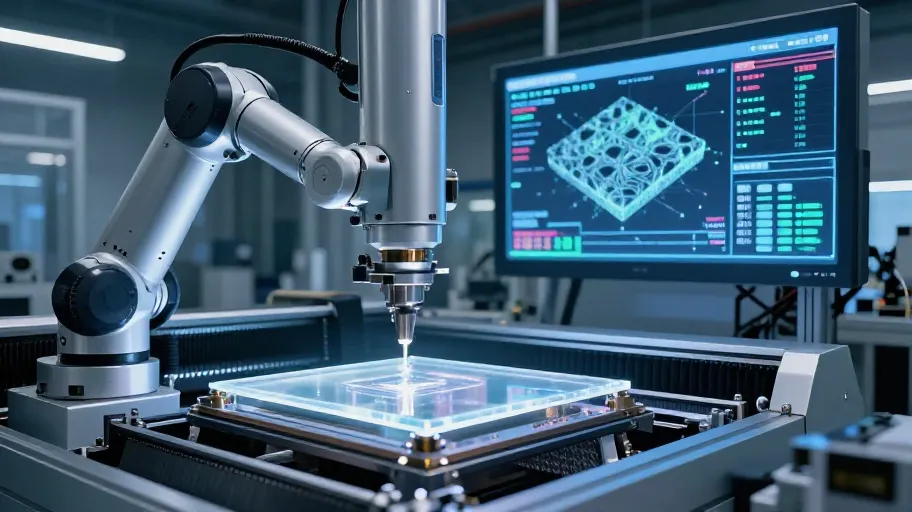
Manual inspection doesn’t scale—and fatigue leads to errors. That’s why leading Chinese sapphire factories deploy robotic arms moving boules through automated metrology stations every 90 seconds, capturing over 50,000 data points per wafer. Laser interferometry maps surface topography with sub-200nm resolution, detecting warpage far below what any technician could spot.
This level of automation means statistical process control stays consistent across shifts and facilities. According to a 2024 Global Photonics Consortium benchmark, ISO 9001-certified Chinese sapphire plants reduced defect escape rates by up to 60% compared to regional peers without integrated metrology. Fewer escapes mean fewer line stoppages, lower scrap, and faster ramp-up for new products.
The business impact is clear: higher precision no longer comes at a premium. With AI handling routine checks, engineers focus on optimization, not firefighting. And when a sudden spike in edge chipping was caught mid-run for AR headset lenses, coolant imbalances were corrected within minutes—saving hundreds of wafers. Visibility equals velocity.
Beyond Cost The New Metric Is Confidence
The old question—“Who offers the lowest price?”—is fading. Today’s procurement teams ask, “Who delivers the highest confidence?” Chinese sapphire leaders answer with cloud-connected quality dashboards that give clients real-time access to inspection data. No more waiting weeks for final audits. Problems are flagged, traced, and fixed before they spread.
Now, pilots are testing digital quality twins—unique metrology fingerprints assigned to each batch. If a device fails in the field after 18 months, OEMs can cross-reference its original flatness map and surface scan to determine if it was environmental stress or a latent flaw. This traceability speeds root cause analysis, strengthens recalls, and builds long-term trust.
We’re entering an era where ‘made in China’ increasingly means ‘engineered with embedded intelligence.’ These aren’t just factories—they’re feedback loops where every micron tells a story of reliability, resilience, and reinvented value.