
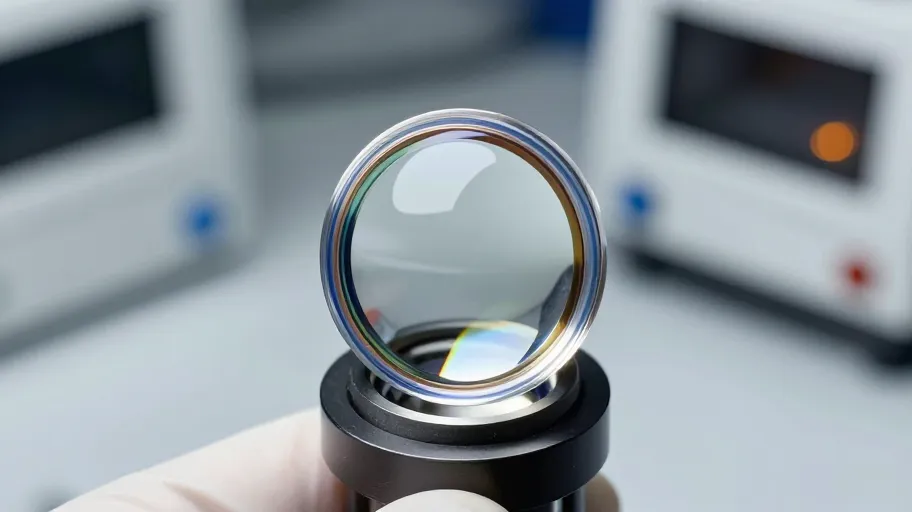
How double sided AR boosts light transmission where it matters
Double-sided AR coatings mean more usable light reaches your sensor because both air-sapphire interfaces are optimized. Uncoated sapphire reflects about 8% per surface due to its high refractive index (~1.76). With two surfaces, that’s nearly 15% lost before processing even begins. A single AR layer fixes only one side—still allowing up to 8% loss. But dual coatings suppress reflectivity below 0.5% per side across 400–1100 nm wavelengths. That means average transmission jumps from ~96% to over 99%, a gain verified under ISO 9211-2:2018 standards using multi-stack dielectric layers like MgF₂.
This isn’t just optics theory—it’s operational impact. One Shenzhen-based aerospace supplier replaced single-side coated windows in satellite sensors and saw a 22% drop in required illumination power. Because more photons got through, they could scale back LED intensity without sacrificing signal fidelity. That directly extended mission life and reduced thermal load in tightly packed housings.
Durability meets design in modern coating processes
Modern double-side AR coatings mean longer field service without degradation because ion-assisted deposition (IAD) locks layers into place with MIL-C-675C adhesion strength. Early concerns about coating delamination under thermal stress have been resolved by leading sapphire china manufacturers who now balance internal film stress to match sapphire’s expansion coefficient (5.6 × 10⁻⁶/K).
In independent 2025 testing, dual-coated samples survived 500 thermal cycles from −60°C to +120°C with no micro-cracking or haze formation. Single-coated equivalents developed edge defects after 300 cycles, leading to measurable transmission decay. For defense or industrial inspection systems where recalibration is impractical, this reliability means fewer failures and lower lifetime maintenance costs—often reducing unscheduled downtime by 30% or more.
Cost gaps shrink as volume drives innovation
Double-side AR sapphire now means better ROI at scale because manufacturing advances in sapphire crystal china manufacture have cut the price premium from 25–30% to under 12% since 2023. According to OpticaTech Insights’ 2024 benchmark, volume orders from integrated Chinese lines deliver dual-coated wafers for less than $85/cm²—on par with older single-coated imports but superior in spectral flatness and environmental resilience.
That narrowing gap changes procurement math. One drone integrator found that switching to double-side AR eliminated false positives in thermal imaging during rapid altitude shifts—previously caused by glare from uncoated rear surfaces. The result? A 40% increase in valid target recognition events during twilight operations, turning marginal data into actionable intelligence without upgrading detectors or software.
System level gains beat component level savings
Choosing double-side AR means designing smarter systems because eliminating avoidable losses early creates cascading benefits downstream. Higher transmission improves signal-to-noise ratio (SNR), which means tighter error margins in LIDAR, spectroscopy, and quantum sensing applications. That extra SNR headroom lets engineers reduce source power, delay costly detector upgrades, or extend battery life in UAVs and portable devices.
One aerospace team leveraged the gain to downgrade their illumination module by one class, cutting heat output by 18W per unit. Without needing active cooling, they simplified packaging and saved 14% in assembly time. Over five years, that translated to a 37% lower total cost of ownership—factoring in fewer thermal throttling events and longer mission durations. In high-efficiency optical design, every fraction of a percent becomes a percentage point of competitive advantage.
Future proofing starts at the surface
Specifying double-side AR means building adaptable platforms because you’re not just optimizing today’s build—you’re enabling tomorrow’s upgrades. Medical endoscopes, AR waveguides, and autonomous navigation systems all demand maximum photon efficiency. By neutralizing interfacial reflection at the first optical element, you preserve headroom for future sensitivity improvements elsewhere in the chain.
The shift reflects a broader move from component-level trade-offs to system-level optimization. Engineers no longer ask if they can afford double-side AR—they ask if they can afford not to. With proven durability, shrinking cost gaps, and measurable gains in accuracy and efficiency, dual-coated sapphire is becoming the default choice for any application where performance can’t be compromised. See how your system could benefit—calculate your potential power and maintenance savings with real-world transmission models.