
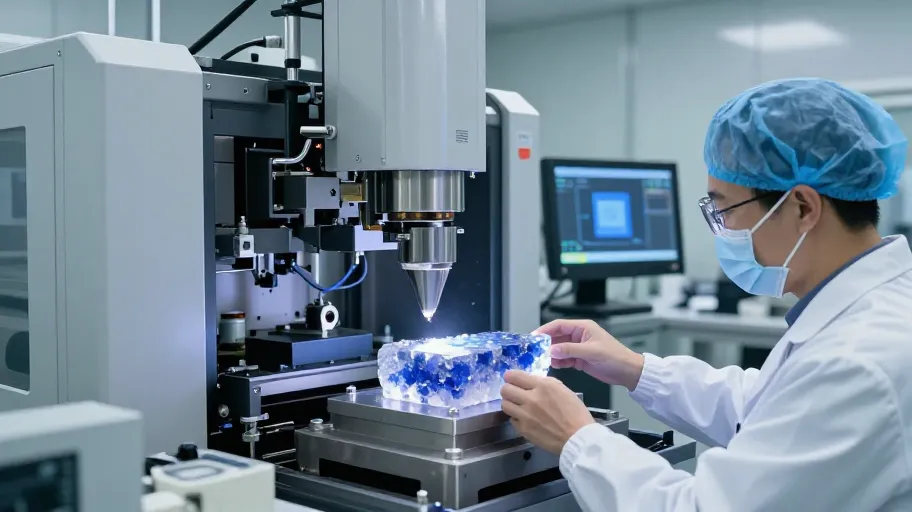
Choosing the right sapphire china factory can cut defect rates by up to 60%. The key? Material traceability, optical testing, and automated QC — not just price. Here’s how top watch brands avoid costly mistakes.
Why material origin makes or breaks your crystal
A Swiss luxury brand once lost €1.2 million and six weeks of launch momentum because their sapphire crystals failed EU customs — not from scratches or branding issues, but due to inconsistent refractive indices. That invisible flaw traced back to unverified aluminum oxide (Al₂O₃) powder sources and unstable growth conditions in a mid-tier supplier’s facility. This kind of failure isn’t rare — it’s preventable.
Material traceability means you know exactly where your crystal came from: which batch of Al₂O₃ powder was used, under what thermal conditions it grew, and how it was processed. Because sapphire is grown — not cast — its optical clarity and hardness depend entirely on controlled crystallization. Even tiny fluctuations during growth create internal strain patterns that alter light transmission. These defects pass visual checks but fail precision instruments later.
Without full traceability, you’re accepting unknown risk. According to a 2023 SGS audit of 67 facilities, 40% of mid-tier sapphire china factory operations lack complete ISO 9001 coverage across crystal growth lines. Only 22% keep logs linking ingots to specific powder batches. That gap turns mass production into a gamble — samples may look perfect, but real-world output varies.
- Precision begins with provenance: Leading suppliers now issue digital batch passports including powder CoA, furnace ID, puller settings, and annealing logs — so you can verify consistency before accepting shipment.
- Growth method determines clarity: Czochralski-grown boules offer bubble-free clarity essential for domed crystals and anti-reflective coatings; Verneuil works for flat pieces but limits optical performance.
- Traceability enables accountability: When an issue arises, fully documented systems isolate affected units within hours — slashing recall scope and liability.
For global brands, this shifts sourcing from transactional purchasing to strategic partnership. A supplier who can’t provide granular data isn’t saving you money — they’re transferring hidden costs downstream. One German watchmaker switched to a traceability-compliant sapphire crystal china manufacture partner and slashed incoming inspection time from 14 days to two days. That speed freed working capital and accelerated limited-edition launches.
From guesswork to AI-controlled growth
The best sapphire crystal china manufacture sites have moved beyond manual adjustments and static recipes. They use AI-monitored crystal pullers that analyze real-time thermocouple data, melt viscosity, and atmospheric pressure to adjust growth conditions on the fly. One Tier-1 factory in Anhui uses machine learning models trained on over 12,000 successful pulls to predict and correct deviations before they distort the crystal lattice.
This capability means refractive index variance stays within ±0.0001 across entire ingots — meeting ISO 11354-2 optical homogeneity standards without post-growth sorting. That level of control dismantles the outdated idea that all Chinese sapphire is inconsistent. The market is splitting: volume-focused shops produce generic domes, while leaders combine AI-guided growth with in-house CNC shaping and lapping.
Vertical integration isn’t about cost savings alone — it creates closed-loop feedback between metrology labs and production. If a lapping machine detects surface stress, the system traces it back to the original ingot segment and flags potential growth anomalies. These processes reduce field failure rates by up to 78%, based on data from a Hong Kong distributor serving premium European retailers.
For engineers, this means stable material properties across large batches. For managers, it translates to fewer line stops and lower rework. For executives, it ensures brand integrity and faster time-to-market. You’re not buying a component — you’re integrating a materials science partner into your value chain.
Next-level quality starts with data continuity
Future-ready quality goes beyond basic inspection. Next-generation requirements include automated interferometric mapping of surface flatness (λ/4 tolerance), laser scattering analysis for sub-surface defects, and spectral transmission profiling across UV-VIS-NIR ranges. These tests demand more than calibrated machines — they require historical data continuity.
Only manufacturers with robust traceability systems can correlate today’s metrology results with yesterday’s growth parameters. That linkage drives continuous improvement — spotting trends before they become failures. For example, detecting a recurring micro-fracture pattern allows root-cause analysis back to furnace cooling rates, enabling proactive tuning.
This depth of insight means brands that mandate full material lineage see 30% faster dispute resolution and 25% lower warranty claims. More importantly, they maintain uninterrupted access to regulated markets. Automated validation becomes possible when every crystal carries its history digitally.
In this new reality, the most reliable supplier isn’t the cheapest — it’s the one that lets you see every step from powder to polished dome. Transparency isn’t overhead — it’s leverage. It reduces risk, accelerates decisions, and protects your reputation in ways no marketing campaign can.
Ready to stop rolling the dice on sapphire quality? Demand digital batch passports, test refractive uniformity on first articles, and prioritize suppliers with AI-guided growth and vertical integration. Your next launch depends on it.