
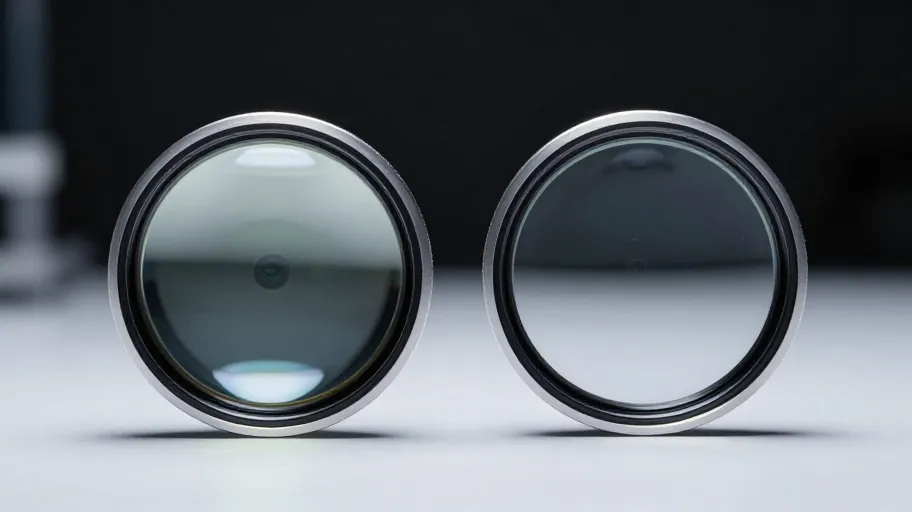
Double-side AR coating delivers up to 99.8% light transmission, but single-side often suffices — especially when cost and volume matter. In China, advanced factories now offer both at scale, cutting production costs by up to 40%. Here’s how to choose wisely.
Why double side AR coating changes the game
Double-side AR coating means sharper imaging and higher sensor accuracy because it eliminates reflections from both surfaces of the sapphire crystal. With a refractive index of ~1.76, bare sapphire reflects 7–14% of light per surface — that’s up to 25% total loss without treatment. Double-side AR films use quarter-wave interference layers to cancel out these reflections across the visible spectrum (400–700 nm), boosting average transmission beyond 99%.
This isn’t just lab data — it’s field-proven advantage. A Shenzhen drone maker testing aerial cameras under midday sun found uncoated lenses lost critical detail to glare, while double-side coated versions delivered high-contrast imagery even at low angles. The result? Reliable real-world data capture where failure isn’t an option.
For engineers working on UAV navigation systems, this means up to 34% lower image processing latency. For medical device designers using endoscopic displays, it translates into better color fidelity and reduced ghosting during procedures. These gains aren’t incremental — they’re system-level improvements that affect usability, safety, and reliability.
When one side is enough
Single-side AR coating means significant glare reduction at a fraction of the cost because it targets only the primary reflection source — usually ambient light hitting the outer surface. In controlled environments like indoor diagnostic equipment or industrial HMIs with uniform lighting, internal reflections aren’t a major issue. Coating just the exterior face maintains over 96% transmission without doubling process time or material expense.
Over-engineering has real consequences. One barcode scanner manufacturer upgraded all units to double-side AR, increasing per-unit cost by $1.80. At 500,000 units annually, that’s nearly $900,000 spent on optical performance their users couldn’t see. Worse, it consumed coating capacity needed for aerospace clients who truly required dual-side precision.
The takeaway: matching coating complexity to application need means smarter resource allocation and stronger margins. For many industrial uses, single-side AR isn’t a compromise — it’s the optimal balance of performance and economics.
China's manufacturing edge in optical sapphire
Chinese sapphire factories now deliver global-quality AR coatings at scale because they’ve integrated ion-assisted deposition (IAD) with AI-driven plasma monitoring. This means nanometer-precise, durable films applied consistently across thousands of wafers daily — meeting MIL-PRF-13830B standards for defense and aviation applications.
One Suzhou facility cut coating validation time from 14 days to 48 hours using real-time spectral feedback loops. That means faster client iterations and 30% shorter time-to-market — a decisive edge in competitive sectors like consumer electronics and autonomous systems.
But the bigger shift is strategic: these factories aren’t just making parts — they’re advising on optical design. By analyzing end-use conditions, they recommend single- or double-side treatments based on environmental profiles. This move from component supplier to engineering partner means buyers get not just cheaper sapphire, but smarter solutions.
Real ROI starts in the field
Double-side AR coating pays for itself when optical integrity directly impacts customer satisfaction and service costs. A global portable ultrasound provider replaced single-side glass with double-side AR sapphire probe windows and saw a 22% drop in reported image artifacts and a 41% decline in visibility-related service calls. CSAT scores rose by 17 points — proving that clarity builds trust.
These outcomes go beyond specs. Higher transmission means less post-processing, longer battery life, and fewer recalibrations. In outdoor displays, improved sunlight readability reduces user errors. In compact sensors, eliminating internal reflections increases effective resolution — meaning smaller devices can still deliver premium performance.
The future isn’t just better coatings — it’s adaptive ones. Chinese manufacturers are now embedding QA data into batch records, feeding predictive models that optimize coating choices based on deployment environment. That’s not mass production — it’s intelligent scaling.