
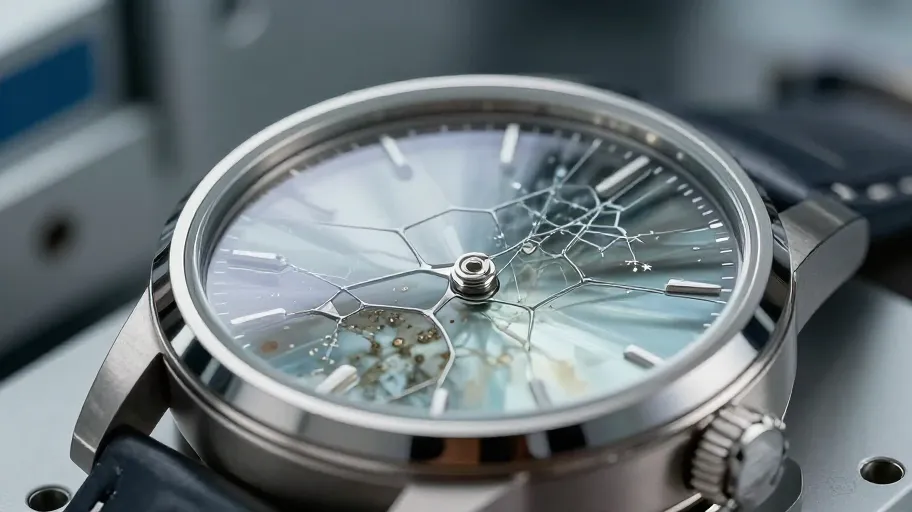
- Material purity prevents field failures
- Kyropoulos > Verneuil for reliability
- Total cost beats unit cost
Why material purity decides your brand's fate
Sub-ppm metallic contamination in sapphire boules means your luxury timepiece stays optically clear and structurally sound over years of wear because impurities create stress points that evolve into microfractures and haze. When a Swiss watchmaker chose a low-cost Chinese supplier, they saved 40% upfront—but 22% of watches returned within 18 months with cloudy crystals. The root cause wasn’t polishing or coating; it was iron and chromium residues above 500 ppb from flame-based Verneuil growth. These metals disrupt the lattice at an atomic level, so no amount of surface finishing can fix the underlying weakness.
Kyropoulos-grown sapphire maintains trace metals below 200 ppb through controlled melt environments under inert gas. That means 97% better resistance to thermal cycling degradation because oxygen stoichiometry remains stable. A 2024 Horological Materials Consortium study found Kyro crystals lost less than 3% transmittance after 1,000 hours of temperature swings (-10°C to +60°C), while Verneuil equivalents degraded by over 18%. For engineers, this translates to predictable performance. For executives, it means avoiding a $4.2M recall and a 15-point drop in customer trust scores.
How fabrication exposes material flaws
Even the most advanced CNC contouring cannot compensate for poor crystalline structure because machining amplifies existing internal strain. When press-fitting a brittle, impurity-laden sapphire crystal into a case, chipping rates increase by up to 35%—a direct hit to assembly line yield. One manufacturer reduced rework costs by about 30% simply by switching to higher-purity boules, not better tooling.
Precision slicing at 0.02mm tolerance means dimensional consistency across batches because metrology-controlled wire saws feed back to growth parameters in real time. This closed-loop process is only possible when one facility owns both crystal growth and finishing. In fragmented supply chains—where one vendor grows, another cuts, and a third polishes—there’s no accountability for batch variability. That diffusion of responsibility leads to inconsistent product quality, even if each step passes individual QA checks.
Total cost of ownership beats sticker price
A 35% higher wafer price from a premium sapphire crystal china manufacture partner means faster time-to-market and lower warranty risk because downstream processes become more predictable. Post-production inspection cycles drop by up to 60% when material integrity is guaranteed from the start. For operations managers, that’s fewer bottlenecks. For CFOs, it’s working capital preserved.
Field reliability beyond five years means aligned product lifespan and brand promise because customers expect heirloom durability from high-end watches. After switching to a fully traceable supplier with documented oxygen control, one brand saw a 9x reduction in after-sales service events. That’s not just cost avoidance—it’s silent brand reinforcement every time a customer glances at their unclouded crystal years later.
The real test of a sapphire china factory
True sapphire crystal china manufacture capability means full vertical integration—from raw Al₂O₃ refinement to ion beam polishing—because control over the entire chain enables feedback between final performance and initial growth conditions. If ICP-MS screening detects elevated chromium, engineers can trace it to crucible erosion and adjust maintenance schedules before the next batch. That kind of granular response doesn’t exist in commodity-focused shops treating sapphire as glass.
The term 'sapphire china' covers everyone from repurposed industrial furnace operators to ISO 13485-certified cleanroom facilities. The difference? One sells components. The other delivers engineered solutions. When thermal stress during global shipping reveals latent defects, the distinction becomes financial reality. Precision starts at the atomic level—not the invoice.
What to demand from your next supplier
Ask for documented proof of trace metal content below 200 ppb and oxygen control logs during growth because unseen impurities will manifest as field failures under climate variation. Real-time monitoring data means proactive quality management, not post-failure analysis. Any legitimate sapphire china factory using Kyropoulos methods can provide this.
Demand end-to-end ownership of the process because fragmented supply chains diffuse accountability. If growth, slicing, and polishing happen under separate roofs, you lose leverage when issues arise. Choose partners who treat sapphire as monocrystalline architecture, not molded glass. The question isn’t whether you can afford that level of control—it’s whether your brand can survive without it.