
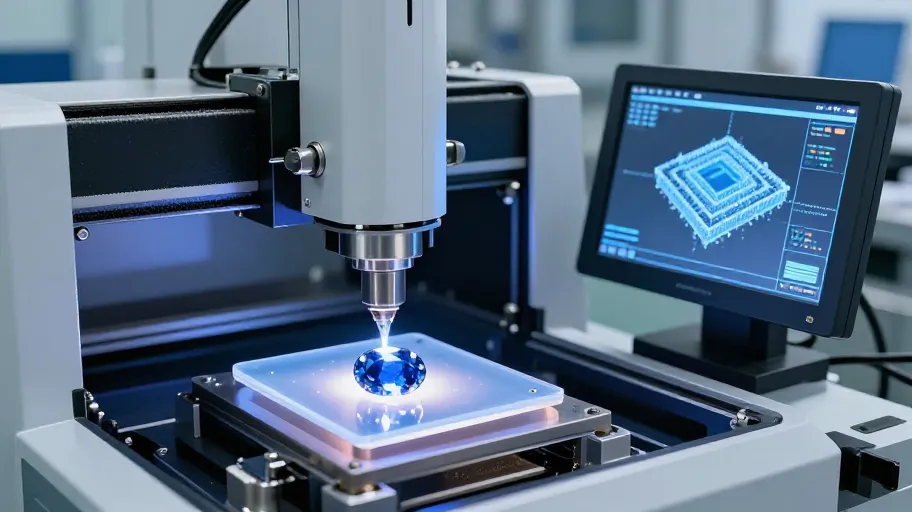
China produces over 80% of the world’s synthetic sapphire crystals—not by chance, but through obsessive control of dimensions, clarity, and surface quality. Here’s how they do it—and why it matters for your next product launch.
Why ±3 Microns Makes or Breaks a Smartphone Launch
A single 5-micron deviation once halted production at a top Chinese smartphone maker, delaying their flagship launch by three weeks and costing $2 million. That’s because modern devices demand parts that fit like DNA strands—no wiggle room. Today’s leading sapphire crystal china factories maintain dimensional accuracy within ±3µm, meaning components align perfectly during automated assembly. This precision means faster time-to-market and fewer line stoppages because tolerances stack predictably across modules.
The real risk isn’t just one bad batch—it’s unpredictable variation. A 2024 Global Photonics Alliance study found that 68% of sapphire failures occur after crystal growth, during slicing and annealing. Residual stress from uneven cooling causes micro-warping, which only shows up under thermal load in final testing. Top-tier sapphire china factories now treat cutting not as a mechanical step, but as a feedback-driven process using CNC-guided diamond wire systems. These tools adjust in real time based on sensor data, reducing thickness variance by up to 74% compared to older methods.
This level of control directly impacts yield. One wearable supplier reported increasing first-pass acceptance from 82% to 96% after switching to ±3µm suppliers. That jump eliminated an entire secondary finishing line, saving $1.3 million annually and shortening lead times by 11 days. For engineering teams, tighter tolerances mean less margin stacking—so you can design thinner bezels, tighter seals, and better optical coupling without over-engineering.
The Machines That Keep Sapphire Perfect
Automation alone doesn’t guarantee perfection—verification does. In every high-end sapphire crystal china factory, Coordinate Measuring Machines (CMM) scan each blank with micron-level precision, generating full 3D maps traceable to national calibration standards. These reports aren’t just paperwork—they cut incoming inspection time by up to 40%, according to one major smartwatch OEM. When every wafer comes with certified data, engineers skip manual checks and move straight to integration.
Beyond the factory floor, labs use Kelvin Probe Force Microscopy (KPFM) to detect hidden lattice distortions before they become warping defects. While KPFM isn’t used in mass production, it acts as an early-warning system: regions with uneven surface potential often deform post-annealing, even if initial cuts look fine. By feeding this data back into CNC algorithms, engineers now preemptively adjust slicing paths to avoid stress zones. This closed-loop system shifts quality from reactive correction to predictive control—a capability that separates true technology leaders from commodity producers.
What makes this valuable isn’t just defect avoidance—it’s design freedom. When you trust your sapphire dimensions down to ±3µm, you can push toward medical-grade wearables or AR waveguides that require near-perfect flatness. The factories mastering this today won’t just survive the next spec bump—they’ll define it.
Don’t Trust ‘Precision’ Without Proof
Many suppliers claim ‘high-precision cutting’ but provide no process capability data (CpK). Some still rely on calipers or visual checks—methods useless for sub-5µm control. The danger? A batch might average 0.8mm thickness, yet vary between 0.794mm and 0.806mm. That spread is invisible to the eye but catastrophic for automation. Pick-and-place robots misalign, adhesives apply unevenly, and air gaps form between sapphire and OLED layers—killing contrast and boosting reflectivity.
In high-end applications, optical clarity means nothing if mechanical fit fails. A perfectly transparent lens that doesn’t seat flush becomes a liability, not an asset. This is why dimensional stability isn’t a standalone spec—it’s the foundation of optical, mechanical, and functional performance. Leading buyers now demand full CMM datasets and process capability indices before onboarding any sapphire china factory.
The bottom line: ±3µm isn’t about hitting a number—it’s about de-risking your supply chain. It reduces rework, accelerates qualification, and unlocks advanced designs. As AR glasses and implantable sensors demand ever-tighter tolerances, the factories already operating at this level aren’t just surviving—they’re setting the pace.
See If Your Supplier Can Meet the Real Standard
If your current sapphire crystal manufacturer doesn’t provide full CMM reports, CpK values, or evidence of post-annealing deformation controls, you’re likely carrying hidden risk. Ask them: What’s your actual thickness distribution? How do you monitor stress-related warping? Can you prove consistency across batches?
Better yet—test it. Run a side-by-side trial with a verified ±3µm supplier and measure the impact on your assembly yield, inspection time, and rework rate. Most teams see measurable gains within two production cycles.
Ready to eliminate six-figure delays caused by ‘almost good enough’ sapphire? Compare your current specs against the real benchmark—then decide whether you want to chase quality or lead with it.