
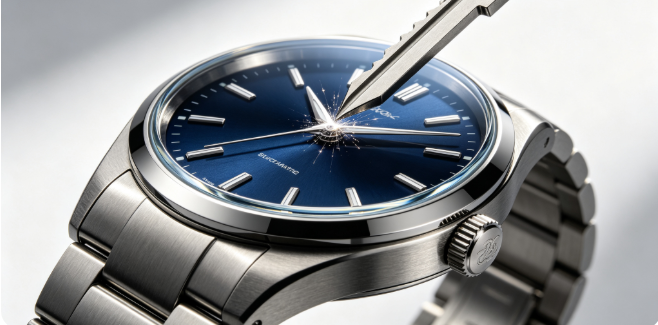
Sourcing a sapphire watch crystal manufacturer requires shifting focus from unit price to process verification. To mitigate supply chain risk, procurement teams must audit a supplier's quality control systems, raw material traceability, and precision machining capabilities before engaging in sampling. The most effective way to compare manufacturers is to apply a rigorous verification framework that exposes actual technical capability rather than relying on sales specifications.
The 4-Pillar Verification Protocol
When evaluating potential suppliers, data often overrides intuition. However, the data provided in sales brochures is often insufficient. To truly compare manufacturers, procurement teams should utilize the 4-Pillar Verification Protocol. This framework assesses the supplier across four distinct areas: Material Integrity, Optical Precision, Surface Treatment, and Process Control. By scoring suppliers against these four pillars, you move beyond a price comparison to a risk-based assessment.
Pillar 1: Material Integrity and Traceability
The foundation of any high-quality crystal lies in the raw material. Not all sapphire boules are created equal. When vetting a manufacturer, the primary task is to determine the origin of the sapphire and the level of impurity control.
A superior manufacturer should be able to provide traceability for their raw material ingots. You must ask if they grow their own crystals or source them from sub-suppliers. Sourcing introduces variability, as the manufacturer cannot fully control the cooling rates and chemical composition of the ingot growth process.
Key areas to investigate include:
- Bubble and Inclusion Density: High-quality sapphire should be virtually free of visible inclusions that could cause structural weak points.
- Material Orientation: The orientation of the crystal axis (C-axis or A-axis) affects hardness and machinability. A manufacturer must control this to ensure consistent performance during the grinding process.
Ask the supplier: "Can you provide a certificate of origin for the sapphire boules used in my order, and how do you document impurity levels?"
Pillar 2: Growth and Machining Technology
How the manufacturer transforms a raw sapphire boule into a finished watch crystal is a critical differentiator. There are two main methods for sapphire growth: the Kyropoulos method and the Edge-defined Film-fed Growth (EFG) method. While both produce sapphire, the Kyropoulos method generally yields larger boules with lower dislocation density, often preferred for high-end watch applications, whereas EFG is typically used for shapes like tubes or ribbons.
However, growth is only half the battle. The machining process determines the final geometry. For watch brands requiring complex shapes—such as dome crystals, extreme bubble shapes, or intricate cutouts—the manufacturer's CNC grinding and polishing equipment is non-negotiable.
Machining Tolerances: You need to verify the equipment's capability. Do not accept general statements like "high precision." Instead, request the specific tolerances the manufacturer can hold for diameter and thickness on your specific geometry.
Edge Finishing: The quality of the bevel or chamfer is a tell-tale sign of a manufacturer's attention to detail. Inspect sample edges for chips or micro-fractures, which indicate poor coolant control or worn tooling.
Ask the supplier: "What is the standard tolerance for diameter and thickness on a dome crystal with a height-to-diameter ratio of [Insert Your Ratio]?"
Pillar 3: Optical Precision and Surface Quality
For a watch brand, the visual appeal of the crystal is paramount. Optical clarity is not just about the transparency of the sapphire; it is about the flatness (or spherical accuracy for domes) and the surface finish.
When comparing manufacturers, evaluate their polishing capabilities. Poor polishing can leave "orange peel" textures or fine scratches that distort the dial. Furthermore, for crystals with high dome heights, maintaining a consistent refractive index without distortion is a technically challenging process that requires advanced tooling paths.
Flatness and Parallelism: Request the metrology reports (interferometry data) for standard samples. This data proves the surface deviates from the ideal plane or sphere only within a specific, measurable range.
Surface Roughness: Measured in Ra (micrometers), this metric quantifies the smoothness of the surface. Lower Ra values indicate a smoother finish, which is critical for ensuring AR coatings adhere correctly.
Ask the supplier: "How do you measure and verify the optical flatness of your crystals, and can you share a typical interferometry report for a similar project?"
Pillar 4: Surface Treatment and Coating Durability
Many sapphire watch crystals undergo surface treatments, such as anti-reflective (AR) coatings or hydrophobic/oleophobic coatings. The application of these coatings is often where quality failures occur, such as delamination or "peeling" after exposure to humidity or salt water.
A robust manufacturer will have a clean-room environment for coating application to prevent dust contamination. They should also utilize rigorous adhesion testing, such as cross-hatch tests (ASTM D3359) or humidity chamber testing, to validate the durability of the coating.
Coating Hardness: Some manufacturers claim "diamond-like carbon" (DLC) coatings or similar proprietary hard coats. You must verify if these coatings affect the underlying sapphire's hardness or if they are merely aesthetic.
Layering: Are the coatings applied to the top, bottom, or both sides? Double-sided AR coating requires precise alignment to avoid ghosting images.
Ask the supplier: "What specific ASTM standards do you use to test the adhesion and abrasion resistance of your AR coatings?"
Decision Table: Evaluating Supplier Maturity
To facilitate an objective comparison, use the following table during your vetting process. This tool helps distinguish between a basic supplier and a strategic partner.
| Evaluation Criteria | Basic Supplier Profile | Premium/Strategic Supplier Profile |
|---|---|---|
| Material Sourcing | Buys blanks from external markets; limited traceability. | Grows own boules or has long-term exclusive contracts; full traceability. |
| Process Control | Relies on final inspection; limited in-process monitoring. | Statistical Process Control (SPC) at every stage; real-time adjustment. |
| Metrology | Basic calipers and visual inspection. | Coordinate Measuring Machines (CMM), laser micrometers, interferometry. |
| Coating Tech | Single-layer vacuum coating; standard warranty claims. | Multi-layer magnetron sputtering; validated adhesion testing results. |
| R&D Support | Produces exactly what is drawn; no input on design for manufacturability. | Engages in Design for Manufacturability (DFM); suggests geometry optimizations for yield. |
Strategic Approval Questions for Procurement Teams
Before initiating a sample run or signing an NDA, pose these questions to your shortlisted sapphire watch crystal manufacturer. Their willingness and ability to answer these questions transparently is a strong indicator of their technical maturity.
- Quality Escalation: "When a batch falls out of tolerance, what is your specific escalation protocol, and at what stage of production do you typically catch dimensional errors?"
- Yield Rates: "For a custom dome geometry similar to ours, what is your historical yield rate during the polishing phase, and what factors most commonly contribute to material loss?"
- Sub-tier Management: "Do you handle the coating process in-house, or is it outsourced? If outsourced, how do you audit the sub-supplier's environmental controls?"
- Verification of Samples: "If the initial samples are approved, how do you ensure that mass production units match the optical characteristics of the approved golden sample?"
Frequently Asked Questions
How do I verify if the sapphire is synthetic or natural?
Virtually all watch crystals are made of synthetic sapphire (corundum) grown in a lab. To verify this, you can request the Material Safety Data Sheet (MSDS) or certificates of analysis confirming the chemical composition (Al2O3). Natural sapphire is rarely used due to cost and inclusions.
Does thickness always equal better durability?
Not necessarily. While thickness adds bulk strength, the geometry and edge treatment are equally important. A poorly chamfered thick crystal can be more susceptible to chipping than a thinner one with a polished edge. Durability is a result of both material thickness and surface finishing quality.
What is the difference between double-domed and single-domed crystals?
A double-domed crystal is curved on both the exterior and the interior, often resembling a section of a sphere. This offers better magnification of the dial and a vintage aesthetic. A single-domed crystal is flat on the interior and curved on the exterior. The manufacturing difficulty is higher for double-domed shapes, requiring more complex tooling and longer polishing cycles.
Why do prices vary significantly between suppliers for the same specification?
Price variance usually reflects the "yield cost." A manufacturer with advanced CNC equipment and mature process control can produce the part with higher yields (less waste) and lower labor hours, whereas a manufacturer with older technology may have higher scrap rates and longer production times, translating to a higher price.
How can I validate coating performance without a laboratory?
You can request the supplier to perform a "tape test" or cross-hatch adhesion test on a sample and send you a video of the process. Additionally, a simple salt-water spray test, conducted by the supplier under your observation (via video call), can demonstrate the coating's resistance to corrosion.
Use the Supplier Evidence Checklist
Selecting the right manufacturing partner is a critical decision that impacts your brand's reputation for quality and durability. By moving beyond price quotes and implementing the 4-Pillar Verification Protocol, you can identify a sapphire watch crystal manufacturer that aligns with your technical standards and quality expectations.
Start your sourcing project with confidence. Contact JadeZone Sapphire to discuss your custom specifications and verify our process capabilities.
Contact JadeZone Sapphire → https://jzsapphire.com/index.php/contact-us
JadeZone Sapphire — Shenzhen and Hong Kong manufacturer of custom sapphire watch crystals and precision sapphire components. Evaluate suppliers on evidence. Verify before you commit.