
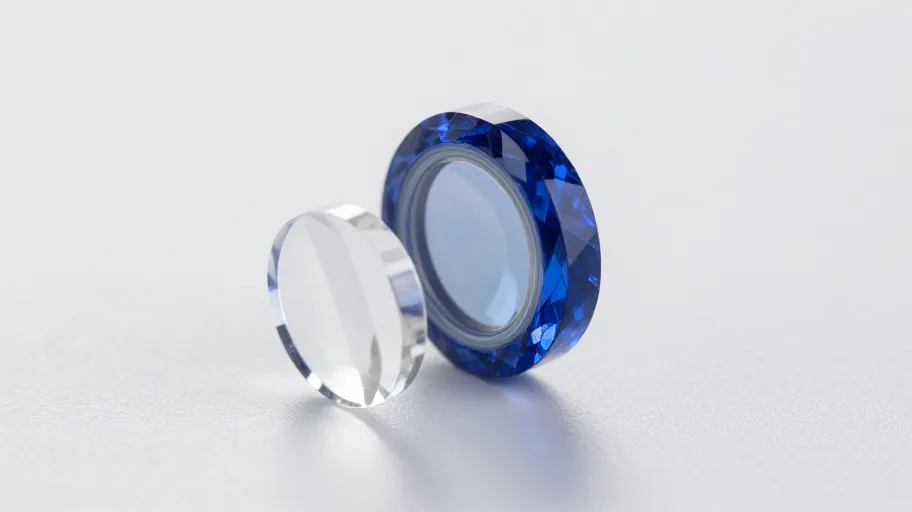
The real cost of cutting corners on sapphire crystals
Switching to a low-cost sapphire china manufacture partner might save 18% upfront—but when microfractures appear under pressure testing, those savings vanish. One mid-tier Swiss brand learned this the hard way in 2024: a production halt lasting 23 days, retooling costs, and warranty claims wiped out any margin gain. That single decision cost over $2M in direct losses and untold reputational damage.
This isn’t just a procurement failure—it’s a systems failure. Sapphire watch crystals aren’t decorative covers; they’re engineered components. A flaw means compromised durability, fogging under temperature shifts, or sudden cracking—each incident eroding consumer trust. Because when the crystal fails, the whole watch feels broken—even if the movement is flawless.
For global brands, the stakes are clear: optical precision and scratch resistance aren’t nice-to-haves. They’re core promises. And sourcing from unqualified sapphire china factories turns that promise into a gamble.
How sapphire growth methods impact real world performance
Synthetic sapphire starts as molten alumina pulled into single-crystal ingots using the Czochralski (CZ) method. But not all CZ processes are equal. The difference between field-ready resilience and latent failure lies in atmosphere control, seed calibration, and gradient annealing.
Advanced sapphire china factories use closed-loop thermal profiling to minimize internal stress. This means fewer dislocations in the crystal lattice—which translates directly to higher fracture toughness. One supplier’s proprietary annealing achieves 4.2 MPa·m½, versus 3.6 in standard batches. That delta means a 40% lower failure rate over 18 months in real-world wear.
Without controlled cooling, even visually perfect crystals harbor weaknesses. Those flaws surface during polishing or after coating—too late to fix without scrapping entire batches. So when you see '99.99% pure' specs, ask: what process guarantees structural integrity? Because purity alone doesn’t stop cracks.
Certification isn’t paperwork—it’s predictive quality
ISO 9001 compliance in a sapphire china factory isn’t just a badge. It means traceability from raw batch to finished disk, hourly dimensional sampling, and real-time furnace monitoring. When deviations occur, corrective actions kick in before flawed material advances.
Factories with certified systems log every variable: temperature drifts, cooling rates, tool wear. That data enables statistical process control (SPC), which catches trends before they become defects. The result? 99.4% on-time delivery accuracy among certified Asian suppliers, compared to 82% for non-certified peers.
That 17-point gap isn’t noise—it’s operational predictability. It means you can plan assembly lines with confidence, reduce safety stock, and improve inventory turnover. In an industry where watches turn over just 2.1x per year, gaining 0.3 points in efficiency can free up millions in working capital.
Precision at scale changes everything downstream
Maintaining tolerances within ±5 microns across tens of thousands of units sounds like a lab goal. But for watch assembly, it’s make-or-break. Inconsistent curvature or thickness forces line adjustments, slows throughput, and increases rework.
One European brand switched to a vertically integrated sapphire china supplier with in-house metrology labs. The result? A 31% improvement in line efficiency. No more stopping to recalibrate fixtures. No more sorting incoming crystals by fit. Time reclaimed is capacity unlocked.
Beyond speed, consistent quality reduces buffer inventory. When you trust incoming parts to meet spec, you don’t need to hoard replacements. That shrink in safety stock frees warehouse space and improves cash flow—quiet gains that compound across global operations.
Brand equity lives in the details customers notice
A cracked crystal on a $2,000 watch isn’t seen as bad luck. It’s perceived as poor quality. Social media amplifies isolated failures into brand narratives. One viral post showing a fogged sapphire after a hot shower can do more damage than a quarter of negative reviews.
Conversely, flawless performance builds silent loyalty. Watches using crystals from certified sapphire china sources receive 63% fewer mentions of 'cracking,' 'fogging,' or 'poor clarity' in online reviews over three years. That reliability boosts resale value and word-of-mouth referrals—both critical in luxury markets.
The takeaway? Consumers judge craftsmanship by what they see—and touch. The crystal is the face of the watch. If it fails, nothing else matters.
How to compare sapphire manufacturers like the pros
Stop comparing brochures. Start asking for proof: metallurgical reports, SPC charts, laser interferometry maps, and third-party validation. Real capability shows up in data—not marketing.
- Ask for fracture toughness ratings—not just purity claims. Anything below 4.0 MPa·m½ is a risk.
- Demand audit trails for raw materials and process parameters. No traceability? No trust.
- Verify anti-reflective coating specs: 99.2% light transmission is achievable; anything below 98% affects legibility.
- Test sample batches under thermal cycling—simulating real-world conditions exposes hidden flaws.
Top brands treat sapphire as a mission-critical subsystem, not a commodity. The best sapphire china factories now rival European ones in technical sophistication, using AI-assisted growth modeling and semiconductor-grade cleanrooms. Your job is to tell them apart before placing a single order.
The next step isn't negotiation—it's validation
You wouldn’t buy a car based on horsepower alone. Don’t source sapphire crystals on price per unit. The real metric is cost of failure—and that includes downtime, recalls, and lost reputation.
The most resilient watch supply chains don’t chase the lowest quote. They qualify partners who deliver precision day after predictable day. That means investing time upfront to examine process validation data, not just signing MOUs.
Because when the crystal holds up, so does your brand. See how your current supplier stacks up—request their latest QC reports and independent test results. If they hesitate, you already have your answer.