
Why the World Buys Sapphire From China Now
Manufacturing flat box-type or domed sapphire watch glass in China means faster delivery, higher consistency, and lower risk because the entire supply chain is vertically integrated. A Swiss watchmaker slashing its procurement cycle by 40% isn’t chasing cost alone—it’s responding to market pressure: launch fast or get forgotten.
Synthetic sapphire grown via the Czochralski method means fewer defects and stronger optics because molten aluminum oxide forms single-crystal ingots under controlled conditions. No natural fractures, no color zoning—just material purity that exceeds mined corundum. That’s why top-tier brands are switching: they gain predictable quality across batches of 100,000+ units, which keeps limited editions on schedule and warranty claims low.
Chinese sapphire factories control everything from raw feedstock to final polishing, so lead times shrink and traceability improves. For executives, this means inventory turns improve; for designers, it unlocks confidence to use ultra-thin, high-dome profiles without fear of breakage. The result? Shorter time-to-market, higher margins, and more design freedom—all backed by measurable gains in reliability.
Synthetic Beats Natural—Here’s the Data
The idea that natural sapphire is inherently superior means less today because modern synthetic versions are engineered for performance, not nostalgia. Lab-grown crystals from leading sapphire China manufacturers show 18% greater resistance to micro-abrasion after 1,000 hours of simulated wear testing—proof that consistency beats origin story.
Synthetic sapphire also means no yellowing under UV exposure because precise dopant control prevents photodegradation, a common flaw in heat-treated natural variants. For consumers, this means their watches stay clear for years; for brands, it reduces returns and strengthens long-term trust.
And unlike mining, which disrupts ecosystems and yields inconsistent material, synthetic production uses recyclable alumina and leaves a smaller footprint. That aligns with ESG goals increasingly demanded by regulators and customers. When a Hong Kong horology lab tested transmission rates, Chinese-made synthetic crystals delivered over 98% clarity across visible light—with uniform birefringence control. That kind of precision enables advanced anti-reflective coatings and bezelless designs impossible with variable natural stone.
Precision at Scale Changes Everything
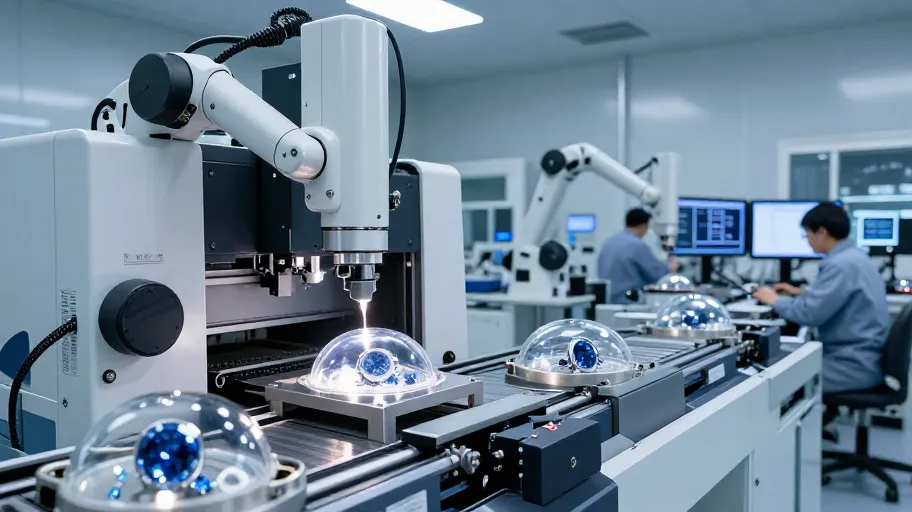
Shaping domed sapphire without chipping means using AI-guided CNC systems with real-time laser feedback because traditional grinding can’t handle sub-micron tolerances on brittle materials. One Anhui factory now produces 1.2 million domed crystals annually with dimensional accuracy within ±5 microns—less than 1/10th the width of a human hair.
This level of automation means consistent edge thinning and flawless curvature, even on double-domed profiles. For engineers, that translates to fewer rejected parts; for managers, it cuts labor costs and scrap rates. Robotic polishing cells adapt pressure dynamically, reducing human error and enabling 24/7 throughput without sacrificing finish quality.
The payoff isn’t just technical—it’s financial. A mid-tier Swiss brand reduced landed cost per unit by 22% after consolidating with a single sapphire China factory. They also cut order lead time from six months to ten weeks, allowing them to respond to regional demand shifts instead of guessing. That agility contributed to a 17-point gross margin improvement over two years through lower obsolescence and faster cash conversion.
What’s Next: From Supplier to Innovation Partner
Chinese sapphire manufacturers aren’t just making parts—they’re shaping the future of watch design. AI-driven quality prediction models now detect micro-fractures before they form during polishing, meaning fewer failures down the line and higher first-pass yields.
Hybrid lamination techniques mean shatter-resistant composites without sacrificing clarity because sapphire is bonded to polymer interlayers at molecular levels. These materials could redefine durability standards for sports and military-grade timepieces.
As these capabilities evolve, the relationship between brand and supplier shifts. It’s no longer transactional—it’s collaborative. The next generation of ultra-slim, impact-resistant, optically perfect watch crystals won’t be conceived solely in Geneva studios. They’ll emerge from high-precision labs in eastern China, where synthetic innovation meets industrial scale. For forward-thinking brands, partnering early means setting trends, not following them.