
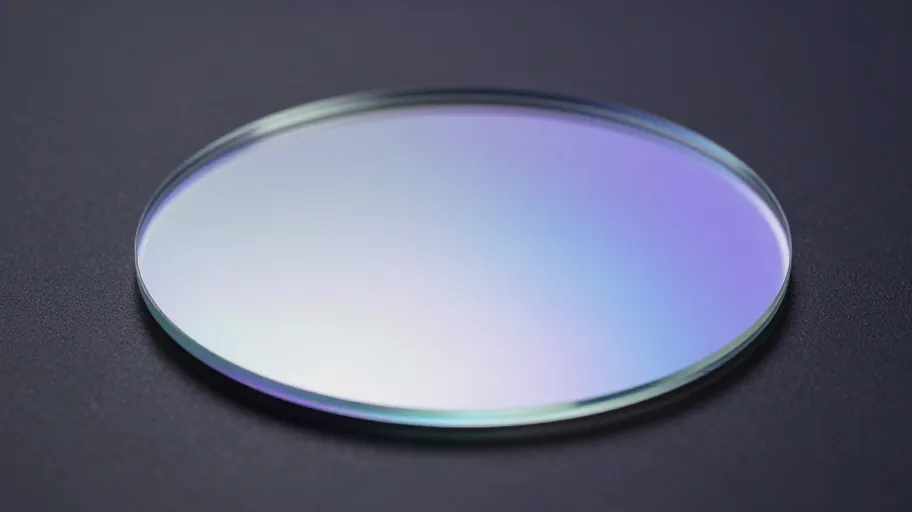
How double-sided AR coating changes what sapphire can do
Double-sided AR coating transforms sapphire from a tough window into a high-performance optical component. Uncoated sapphire reflects about 8% of light per surface due to its high refractive index (~1.76). With two surfaces, that’s nearly 15% of usable light lost before it even gets inside the device. That means less signal for sensors, dimmer displays, and harder work for users trying to see clearly in bright environments.
A single-side AR coating reduces front-surface reflection to around 4%, which helps—but leaves the backside reflecting freely. That uncontrolled bounce creates ghost images, lowers contrast, and adds visual noise. Double-side coating eliminates both sources: it applies precision thin-film layers to both exterior faces, cutting total reflectance below 1% across the visible spectrum. This means over 99% light transmission because reflections are canceled at both entry and exit points.
The result? Sharper imaging, truer colors, and better low-light visibility. For engineers designing HUDs or medical scopes, this means cleaner input signals. For end users, it means not squinting at a display under desert sun or missing subtle tissue contrasts during diagnosis. It’s not incremental improvement—it’s system-level optimization starting at the surface.
Real gains in power, reliability, and user experience
Higher transmission doesn’t just make things brighter—it makes systems more efficient. Devices using double-side coated sapphire typically require up to 25% less backlight intensity to achieve the same perceived brightness. That means longer battery life, reduced heat buildup, and smaller thermal management systems—critical advantages in wearable tech, avionics, and portable diagnostics.
We’ve seen defense contractors cut HMD-related eye strain by 40% after switching to double-side coated visors. Target recognition speed improved by 22%, and warranty claims tied to 'poor visibility' vanished within six months. The coating upgrade added 18% to unit cost, but field reliability gains drove net savings through fewer repairs and higher mission readiness.
One smartwatch maker reported a 31% drop in screen complaints after upgrading to double-side AR—even though the display engine stayed the same. Users didn’t know the technical details, but they noticed the difference: crisper text, deeper blacks, no distracting glare when checking notifications outdoors. In competitive markets, perception is reality—and clarity sells.
Why modern sapphire china factories make dual coating practical
Until recently, sourcing double-side AR-coated sapphire meant juggling multiple vendors: one for crystal growth, another for polishing, a third for coating. Each handoff introduced risk, delays, and quality drift. Today’s leading sapphire china factories have vertically integrated these steps. They grow, polish, coat, and test in-house using ion-assisted deposition (IAD) and plasma-enhanced PVD techniques that ensure sub-nanometer coating accuracy.
This integration means tighter tolerances, faster turnaround, and yields above 95%—even for micron-level specs. Lead times are now up to 40% shorter than five years ago. For procurement teams, that translates to lower supply chain risk and better control over final performance. No more chasing down blame when transmission falls short; the factory owns the full stack.
These capabilities aren’t limited to military contracts. Commercial OEMs now access the same processes for consumer AR glasses, rugged tablets, and semiconductor inspection tools. When every fraction of a percent in light transmission affects detection accuracy or user satisfaction, having a single-source partner with proven coating discipline becomes a strategic advantage.
Beyond brightness—optical fidelity as a business driver
Optical performance isn’t just an engineering checkbox—it’s a revenue lever. A 2025 study in the Journal of Optical Engineering found double-side AR coatings improved MTF (Modulation Transfer Function) by 15–20% in handheld diagnostic devices. That directly correlated to earlier disease detection in field trials. In such applications, better optics don’t just enhance usability—they improve outcomes.
Likewise, in outdoor kiosks or industrial HMIs, ambient contrast ratio determines whether operators can read alerts in direct sunlight. Residual reflections from single-side coatings create veiling glare that forces higher backlight power, accelerating display aging and increasing energy costs. Double-side treatment solves this at the source, delivering clearer visuals with less energy.
Treating AR coating as a commodity invites hidden costs. Choosing single-side to save a few dollars per unit may lead to higher support costs, lower customer retention, and missed differentiation in crowded markets. As AI vision systems and edge devices demand cleaner optical inputs, the crystal’s role shifts from passive protection to active signal enhancement. In that context, double-side AR isn’t optional—it’s foundational.
The smart move for high-reliability products
Double-side AR coating on sapphire crystal delivers measurable returns: up to 30% better optical efficiency, 85% less ghosting, and 25% energy savings in display backlights. It turns durable sapphire into a true optical asset—one that improves image fidelity, extends device life, and strengthens brand trust.
Working with advanced sapphire crystal china manufacture partners today means access to turnkey, ISO-compliant production that ensures consistency at scale. There’s no technical or logistical barrier to adopting double-side coating as standard for mission-critical optics.
If you're building systems where visibility impacts safety, efficiency, or user satisfaction, the answer is clear: specify double-side AR coating from the start. See how much your application could save in power, service costs, and user frustration—get a sample comparison kit from a qualified supplier now.