
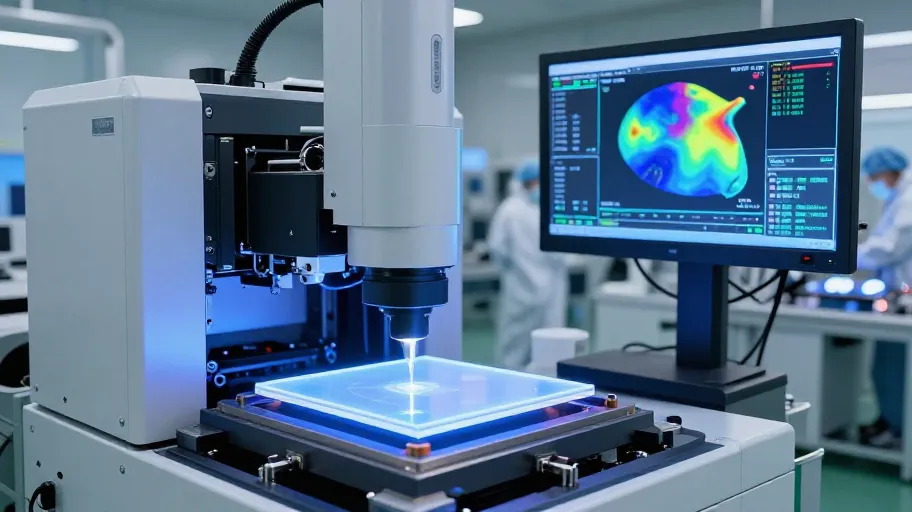
Why a single micron can break a supply chain
When a U.S. AR glasses maker rejected a shipment of sapphire wafers last year, it wasn’t due to visible scratches or cloudiness—it was because 12% of the batch varied by more than 0.8 microns in thickness. That tiny deviation cost $1.4 million and delayed production by three weeks. The real problem? The flaw originated during crystal growth but went undetected until final inspection. This kind of failure used to be common. Now, it’s avoidable.
Automated metrology means fewer surprises for OEMs because dimensional inconsistencies are caught early. At leading Chinese factories, this isn’t reactive quality control—it’s predictive engineering. By scanning raw boules before cutting, manufacturers identify internal stress patterns that could later distort wafers. That foresight means higher yield, lower rework, and on-time deliveries because problems are fixed before they start.
Engineers once relied on manual calipers and stylus probes, which risked microcracks and lacked sub-micron resolution. Today, non-contact profilometry measures surface topography without touching the material. This means fragile sapphire substrates stay intact while still being mapped to within 0.1 microns. One supplier in Shandong reported a 67% drop in field returns after switching to full-wafer scanning—proof that better measurement directly improves customer satisfaction and cuts warranty costs.
Seeing inside the crystal before the first cut
Boule Homogeneity Mapping is now standard at tier-1 Chinese sapphire producers. Using 3D tomographic imaging, this technique reveals thermal gradients and lattice distortions locked in during crystal growth—flaws invisible to the eye but capable of causing thickness variation during slicing. This capability means manufacturers can adjust their process before wasting time and materials on flawed boules.
A 2025 benchmark by Optoelectronics Manufacturing Insights found suppliers using tomography achieved ISO 11252 compliance over 98% of the time, compared to 83% for those relying only on post-cut checks. That 15-point gap means fewer line stops, faster throughput, and more reliable delivery schedules for customers building photonic ICs and wearables.
The data doesn’t just sit in reports. It feeds into AI models that adjust pulling speed, cooling rates, and annealing cycles in real time. If profilometry detects consistent bowing from a specific crystal orientation, the system flags potential heater asymmetry. Engineers then recalibrate furnace zones before the next run. This shift—from detecting defects to preventing them—means rework costs drop by up to 40%, according to internal audits shared under NDA.
How flatness speeds up product launches
Downstream manufacturability depends on substrate consistency. In photonics and semiconductor applications, even 0.5-micron variation can disrupt thin-film deposition or cause lithography misalignment. A Silicon Valley fabless company traced a 22% drop in first-pass yield to inconsistent sapphire flatness. After switching to a Chinese supplier with integrated metrology, their AR display modules reached market 30% faster—a competitive edge built on material stability, not just design.
This isn’t about having better tools. It’s about redefining quality as a continuous flow, not a final checkpoint. Over 70% of dimensional issues originate during crystal growth, not dicing. Only pre-processing 3D tomography can catch these. By acting early, top factories now achieve total thickness variation below ±0.3 µm across 100mm wafers—once thought impossible at scale.
For global tech firms, the takeaway is clear: precision isn’t negotiable. It’s strategic. The factories winning long-term contracts aren’t the cheapest—they’re the ones with the deepest process visibility. And as AR/VR, LiDAR, and III-V semiconductors demand tighter integration, the ability to see beneath the surface becomes the foundation of innovation.
What’s next in sapphire quality control
The next frontier is optical clarity at the molecular level. Even the purest sapphire can fail if trace impurities scatter light in waveguide structures. Leading labs in China are now combining spectroscopic imaging with machine learning to detect dopant clusters at parts-per-billion levels. This means future wafers won’t just be dimensionally perfect—they’ll transmit light with near-theoretical efficiency.
These advances aren’t isolated experiments. They’re part of an evolving ecosystem where data flows from crystal growth to packaging, guided by AI and validated by metrology. The result? Higher yields, lower costs, and stronger trust between suppliers and global OEMs.
Ready to see how your supply chain could benefit from predictive sapphire quality? Explore real-world performance data from verified Chinese manufacturers and compare yield metrics side by side.